I just looked over at mine, damn if it isn't exactly lined up on 11.I've never found it onerous on any bass except those that don't have the top strap button at least close to the 12th fret.
As I write this, I feel the urge to turn it up to "11".

TalkBass has been independent since 1998. Add your voice.
Create a free account to reply to discussions, view embedded media, and browse with fewer display ads.
Join free Log in
Want zero display ads or expanded classifieds tools? Compare plans.
I just looked over at mine, damn if it isn't exactly lined up on 11.I've never found it onerous on any bass except those that don't have the top strap button at least close to the 12th fret.


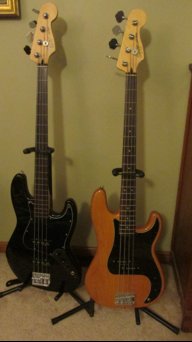
 IMO, it happens to some people - with some basses - because we are all built differently, and thus the bass hangs differently. The first two basses here? No neck dive - for ME - although the 4001 does like to be slightly parallel to the floor. But, that's not neck dive in my world. That last bass? You bet your bippy it's a neck diver - by anybody's definition. I can't imagine the shape of the creature that wouldn't think so... As for my Thunderbird? I prefer to think of it as not so much a neck diver, as just "slightly biased towards the head stock"...
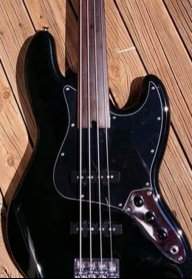
Yes. For me, neck dive means the headstock has a tendency to want to go down (towards the floor). That can be in varying degrees of severity, but any time it requires some effort to counterbalance from the player (either by holding the neck with your fretting hand or pushing down at the body), then that qualifies.



Hey genius, what about the finish?!Just wear a sandpaper jacket. Holds the strap nice and firm right where you put it.
EDIT: make sure it's made with the rough side facing OUT. Very important.

Some folks see nothing but problems while others take it all in stride, as in, "It's all good."
I have a Jack Casady bass which is a hollow body with the upper strap button directly behind the neck-body joint. That strap button location together with the weight distribution makes this the Jacques Cousteau of neck divers. It doesn't bother me at all but There are others here who talk as if their left arm is curling a twenty pound dumbell all night.
My point? Whether neck dive is a problem is for you to decide.

Neck dive is real.... but if the upper 'Horn' ( or strap button location on a single-cut) is close to the 12th fret, its virtually guaranteed to be a non-issue.
But even for SGs, RGs, explorers, flying Vs , T-birds with crazy heavy headstocks (etc!) THERE IS AN EASY WORKAROUND that I just ran into the other day...
check it out:

Warwick thumb. Just a great bass with terrible neck dive. Would love to own one but can't
I'm just trying to get a handle on why I read about neck dive but have never experienced it and don't know anyone else who has.

This!I can't say I noticed or was really bothered by it until I owned a really well balanced bass. Now, I can tell the difference in a fraction of a second.
(By the way, that really well balanced bass was/is Dingwall.)


Jazz Basses are pretty much imune due to their gigantic offset body.I've played Fenders since the 1970s, and neck dive has never been an issue for me.
Your results may vary, but I doubt it.

<SNIP>
I didn't know neck dive was a thing before coming here.
As long as your bass weighs 9 pounds or so, you likely won't have it
Never experienced it either.


Neck dive is very real and it can be very annoying.Hey folks...
Am I living a sheltered life or is there something I'm missing here. I understand the basic premise of balance and how strap button placement, top horn length, etc, can have an effect on balance, or the obvious too much weight out at the end of that lever called the neck, but are there other factors like where you wear you bass in relation to your body, neck angle in relation to the ground, type of strap, width of strap, etc that can contribute to or cause neck dive.
I'm just trying to get a handle on why I read about neck dive but have never experienced it and don't know anyone else who has.
Thanks in advance for any and all opinions and experiences.

If that was the root cause, why do some folks not experience the phenomenon, yet others using the same instrument do experience it?
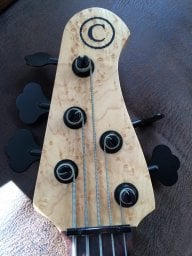
When the neck weighs more than the body.
Also due to heavy tuners.
Or the upper horn is not long enough to balance the bass properly.


