
I've heard quite a few different terms to describe an effed up neck, but I'd never heard the term "neck dive" until I got to this forum. Would someone please enlighten me?

Enjoy the benefits of a premium membership!
Upgrade Account
-
TalkBass has been independent since 1998. Add your voice.
Create a free account to reply to discussions, view embedded media, and browse with fewer display ads.
Join free Log in
Want zero display ads or expanded classifieds tools? Compare plans.
You are using an out of date browser. It may not display this or other websites correctly.
You should upgrade or use an alternative browser.
You should upgrade or use an alternative browser.
More options
Who Replied?

Neck dive is nothing wrong with the neck, other than perhaps a heavy headstock - it's just the tendency of a poorly-balanced bass to have the headstock fall towards the floor when worn on a strap rather than hanging nice and level.
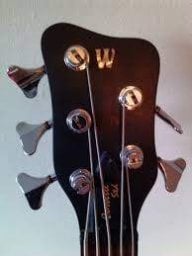
It can be a factor of materials like light body with heavy neck, heavy tuning keys, large headstock. It can also be due to strap button positioning. General rule of thumb is the upper strap button wants to be even with the 12th fret for good balance.

The biggest problem with neck dive is you end up using your fretting hand to hold the bass up and/or changing up your picking arm position to keep weight on the body.
Gooooootcha! My second favorite guitar I've ever owned, was a white Gibson SG, so I'm familiar with this "condition". It's weird that, in my 30+ years in & around music and musicians... I've never heard the term. I come to this forum, & I'm the only guy here who HASN'T heard it! I was wondering if it might've had something to do with the "plyability" (for lack of a better term) of the neck. For instance... with my Talman bass (as well as many other thin-necked low-end models), it's incredibly easy to raise or lower the pitch simply by applying forward or backward pressure on the neck. I shall henceforth refer to THAT condition as "rubber neckin'" to avoid confusion!
Thank you!
Thank you!

Neck dive defined:I've heard quite a few different terms to describe an effed up neck, but I'd never heard the term "neck dive" until I got to this forum. Would someone please enlighten me?
When your bass neck goes HERE.
When you want it to be here.
This bass,by the way,is not neck heavy.
I had to make it "dive"for the pic.
Last edited:


thunderbird and neck dive go hand in hand....
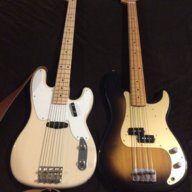
It's not a very big surprise that you hadn't come across it before because the much shorter and lighter guitar neck wouldn't dive like a long scale bass. It's usually only bad if the strap button isn't at or close to the 12th fret. A wide strap with suede on the inside can help a bass stay where you want it to.
We always used the term "neck-heavy". NBD... I can adapt! ;-)It's not a very big surprise that you hadn't come across it before because the much shorter and lighter guitar neck wouldn't dive like a long scale bass. It's usually only bad if the strap button isn't at or close to the 12th fret. A wide strap with suede on the inside can help a bass stay where you want it to.

So you actually apply pressure to the neck of your bass when playing? I'm curious as to the benefit of this practice ! Thx

Neck dive defined:
When your bass neck goes HERE.View attachment 1148016
When you want it to be here.View attachment 1148018
This bass,by the way,is not neck heavy.
I had to make it "dive"for the pic.
In some territories, it's a federal offense to force 'neck dive'...
... smart move photographing yourself, Mr. Federal Witness Protection Program man, as you went headless...
... which amazingly prevents neck dive...
... brilliant.

That was a random snipe. FWIW, I have three 'birds and don't have any neck dive issues.thunderbird and neck dive go hand in hand....
We always used the term "neck-heavy". NBD... I can adapt! ;-)
FYI: "NBD" means "new bass day" around here.

That was a random snipe. FWIW, I have three 'birds and don't have any neck dive issues.
Same thing here. Have several TBirds and Firebirds from "back in the day" the 60's. And no issues. Neither with my Epi's but I have tried a few that did have that issue.
Did not know what to attribute that issue to as these were seemingly identical to mine.

I have a 2015 Gibson Tbird that had a mild to moderate tendency to neck dive. I experimented with different straps until I found one that minimized that behavior, a 4" Moody leather strap with suede backing. It seems to me that it's the suede that's doing the trick in keeping the strap from sliding on my shoulder.
Italia also makes a nice 4" leather strap with suede backing for about half the price of the Moody, might be a good choice.
Italia also makes a nice 4" leather strap with suede backing for about half the price of the Moody, might be a good choice.



My first 5 string bass had a wonderfully light swamp ash body and was probably under 9lbs. At the time I also had a 4 string bass with a solid padauk body that was close to 11lbs. The 4 string bass balanced perfectly on the strap while the 5 string would drop like a rock if I didn't support the neck and because of this was very fatiguing. At gigs I would play the 5 string as long as I could stand to wrestle it and then I would grab the heavier but better balanced 4 and play the rest of the night in comfort.
uuhhh... not exactly. I'm just sayin' that, if pressure is applied forward or backward, the pitch changes. More easily on some than others. You've probably seen guitar players do it intentionally to achieve a vibrato effect or show off during a solo. I can't really think of a practical application for it in the world of bass... but I'd be willing to bet that Les Claypool has done it!So you actually apply pressure to the neck of your bass when playing? I'm curious as to the benefit of this practice ! Thx
HAH!!! It's "No Big Deal" in cell phone world. Again... I'll adapt.FYI: "NBD" means "new bass day" around here.


