• TalkBass has been independent since 1998. Add your voice.
    Create a free account to reply to discussions, view embedded media, and browse with fewer display ads.
    Join freeLog in
    Want zero display ads or expanded classifieds tools? Compare plans.

New Carvin P bass, about time?

Status
Not open for further replies.
Angled headstocks make more practical sense to me. No need for string trees. I'd also rather have the truss rod adjustment at the headstock, it's just easier to get at. Although the spoke wheel truss rod adjustment at the heel is great, on the few basses that employ that option.

Anyway, Carvin has something like seven headstocks to pick from. Pick one and be happy. :D

i have no problem with it, i was commenting more on the angle headstock paired with a fender-ish style instrument is not that common, as most copies have the straight pull/string tree headstock and most modern styled instruments have an angled headstock.
 
I'm not totally clear on how the ordering works for these. The website says the PB-4s are $769. Presumably, that's only if the choose all the standard options and don't add anything extra. But when I go through the selection process, if I choose standard for everything, I get to the part to select the neck and all of the options cost additional money (the cheapest is the 5-piece all maple neck for an extra $100). If I select nothing, it automatically selects the 5-piece maple neck and adds an extra $10; if I select any of the options, I'm adding at least $100 to the price. So I don't see how you can actually get the order to come in as low as $769?

Also, what's the story with the different neck options? Do any of them matter to playability, durability, stability (or more doubtfully) tone? Or is it just an aesthetic thing? I think I read somewhere that 1-piece Carvin necks can be somewhat unstable and so someone suggested getting a 5-piece neck. Has that been other folks' experience? If that's the case, maybe being forced to get the 5-piece neck isn't such a bad thing, but it does seem curious that they advertise the guitar for $769 and then you don't actually seem to be able to build the guitar at that price.

Or am I missing something?
 
Okay, correction. I see, it's the case that gets the price above $769. And I guess they can't ship the bass to you without a case...

Anyway, still curious about folks' thoughts about what the best choices are for neck options.
 
I am sure the standard necks are fine - while Carvins in the past may have occasionally had a dud, the stuff they are putting out now is very solid.
That being said, you can't go wrong with a 5 piece neck. I have the maple/walnut/maple/walnut/maple on my SB5001 but for a PB-4 I'd go 5-piece all maple. Mainly because I want a matching painted headstock with no overlay and I think it might look silly to paint over the two darker colored wood stringers (which will show if you don't choose a peghead overlay.)
 
I'm not totally clear on how the ordering works for these. The website says the PB-4s are $769. Presumably, that's only if the choose all the standard options and don't add anything extra. But when I go through the selection process, if I choose standard for everything, I get to the part to select the neck and all of the options cost additional money (the cheapest is the 5-piece all maple neck for an extra $100). If I select nothing, it automatically selects the 5-piece maple neck and adds an extra $10; if I select any of the options, I'm adding at least $100 to the price. So I don't see how you can actually get the order to come in as low as $769?

Also, what's the story with the different neck options? Do any of them matter to playability, durability, stability (or more doubtfully) tone? Or is it just an aesthetic thing? I think I read somewhere that 1-piece Carvin necks can be somewhat unstable and so someone suggested getting a 5-piece neck. Has that been other folks' experience? If that's the case, maybe being forced to get the 5-piece neck isn't such a bad thing, but it does seem curious that they advertise the guitar for $769 and then you don't actually seem to be able to build the guitar at that price.

Or am I missing something?

Just made this in the builder. All standard options. Didn't force me to take the 5 piece neck

-MA - Maple Neck/Alder Body (Standard) $0.00
-CG - Clear Gloss Finish (Standard) $0.00
B - Jet Black $0.00
-TN - Tung Oil Finish Back Of Neck (Standard) $0.00
-SBH - SB-Style Headstock (Standard) $0.00
- $0.00
-RWF - Rosewood Fingerboard (Standard) $0.00
-DI - Dot Inlays (Standard) $0.00
-FR - Med-Jumbo Frets .048" H .103" W (Standard) $0.00
-R14 - 14in Fretboard Radius (Standard) $0.00
-BLK - Black Pickups $0.00
-CH - Chrome Hardware (Standard) $0.00
-4011 - Nickel Roundwound .040 .060 .080 .100 $0.00
-WHP - White Pickguard (Standard) $0.00
HC8W - Black Tolex Wide Hardshell Bass Case $79.00
Custom Shop Total: $848.00


Sub-Total $848.00

I love Carvin one piece necks. I've got a kit bass with the one piece neck. Love it more than my Jazzes. Ordered the same neck on the SB40000 for a Warmoth build I did. It is chunkier than the B4 neck, but still very good. Gonna order a 22 fret one piece neck for another project I'm finishing soon. No complaints at all from me on the one piece-ers.
 
Here are a couple slap clips from the same basses:

Link Removed

Link Removed

Settings are like that the last clips, but I bumped the bass a fuzz.

Here's a quick clip from my new PBJ:

Link Removed

Here's a similar setting from my SB5000:

Link Removed

The build specs are pretty much exact. Alder body, maple neck/fretboard, stock electronics. The one diff I can think of is the SB has stainless jumbo frets and the PBJ has low wide frets. That seems more like a feel diff. The PBJ has stock Carvin strings, the SB has some DR Fatbeams on it. The SB weighs 9.5 lbs and the PBJ weighs 8.4 lbs.

Here are the two basses in question:
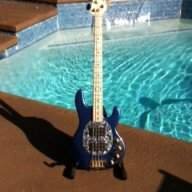
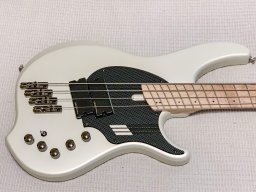
PB-SB.jpg
 
Well mangs, mine arrived today. I was surprised at how early it arrived. UPS usually comes at 6pm. I only played it for a little bit because I had to get ready for work.

I only played it for a little while but it seems to have what I want from a 5-string P. My #1 requirement was clear & articulate B string. This seems to have it but I have to spend more time with it to fully confirm. String spacing is very nice. Not too wide or too close. The weight is good. I'm not sure how much it weighs exactly but it must be under 10 lbs. It's lighter than my Korean-made Warrwick Corvette Standard 5-string.

I have Carvin flats on it. These were a pleasant surprise. No bright clanginess that comes with new flatwounds. They don't feel like brand new strings either. Very nice. Are these how all Carvin flats are or did they play the bass a lot before it shipped?
 
I went for brighter tonewoods as I prefer them. Can always make a bass sound darker, but not brighter. The tone knob is magic for this.

What woods did you go with to make the bass brighter--other than a maple fretboard (for which I thought general opinion held didn't make much of a difference in terms of brightness)?
 
Cool, thanks Jarrett.

I'm also interested to hear from the folks who got their Carvins set up as a PJ. How do they like the pickup placement? I've heard that the problem with PJs is that it forces the pickup placement of at least the P, if not both pickups, to be less ideal than they would be if either pickup existed alone, and thus, a PJ, with the P soloed typically doesn't sound as good as a straight up P.

Any truth to that? Any truth to that as it relates to these new Carvins? Do you think there would be a similar issue if one went with the HB pickup instead of a J in addition to the P?
 
Usually the placement of the P pickup is not an issue on PJs, more often than not it's the jazz pickup. People are always debating how close it should be to the bridge.

The issue with the P pickup comes into play when someone is trying to make a P bass pickup and a humbucker fit in together. The placement of the P pickup and the placement of a humbucker in the Stingray position will overlap each other.
 
Status
Not open for further replies.