• TalkBass has been independent since 1998. Add your voice.
    Create a free account to reply to discussions, view embedded media, and browse with fewer display ads.
    Join freeLog in
    Want zero display ads or expanded classifieds tools? Compare plans.

New Ernie Ball Tim Commerford Models

What is musos? Congrats Dr Stingray you have one of nicest stingray collections . Yes to the flats. Love it . Bernard Luis Johnson and Carol Kaye would approve . :headphone::thumbsup::smug:

Thank you I have to say your SR5H Special is totally droolworthy as well (PS as stated by Roger W, musos is slang for musicians )

I don’t have any more gig pics at the moment but quite a lot were taken by the organisers so if I come across these I’ll post - in the meantime a couple of new pics of the bass (now with the pickguard plastic protector removed…) which show more of the detail - note the chamfered upper pick up screw adjusters - it actually makes quite a difference (if you plant your thumb there) - very comfortable.

This is also the lightest bass I have (no more than 8 lbs), and has a lot of resonance.

7903D468-7936-4D19-A751-E03016201C92.jpeg
1D120501-C0AC-46D3-8F59-C481E9BCD601.jpeg
85F39EB7-CCB1-44FC-8E11-E3CD0FF3F838.jpeg
 
Last edited:
What is musos?

A specific breed of dullard musician.

A snob, who never takes musical risks, and will stand by the bar, loudly critiquing other musicians music / chops / tone / instruments / amps, for (in their opinion) failing to match all of the established safe bet points of reference from the 60's / 70's.

As bad as they are, it's worse when a group of them get together, and form a band - muso's playing for the two, or three other muso's, nursing a pint, and judging both the band, and the rest of the audience.
 
  • Like
Reactions: lowdownthump
Thank you I have to say your SR5H Special is totally droolworthy as well (PS as stated by Roger W, musos is slang for musicians )

I don’t have any more gig pics at the moment but quite a lot were taken by the organisers so if I come across these I’ll post - in the meantime a couple of new pics of the bass (now with the pickguard plastic protector removed…) which show more of the detail - note the chamfered upper pick up screw adjusters - it actually makes quite a difference (if you plant your thumb there) - very comfortable.

This is also the lightest bass I have (no more than 8 lbs), and has a lot of resonance.

View attachment 4383290 View attachment 4383291 View attachment 4383292

Very nice weight that amazing .
 
Unfortunately I don't have a great way to record a good sample, I'm sorry. On top of that, I have it strung with LaBella flatwounds made for the string thru Mustangs, and while it sounds incredible, I know there aren't many Stingray players running flats out there. I got mine quickly because I was an early order, mine is number 11 of 50.
That's cool. Mine is also number 11 of 50 (for the long-scale & passive model).
 

The short scale natural ash looks great - how does it sound with active electronics?

I can’t praise the long scale passive enough - it’s sharing duties with my Classic Sabre currently (I’m taking both to each gig and changing basses part way through) - another outdoor gig today - the TC is really good for playing old style R and B - the Joe Dart type of thing as well. In fact I’ve been getting into the Vulfpeck MSG video - it’s definitely influenced my planing, especially when I use the TC Stingray!
 
I think people in the thread have a philosophical difference regarding what a "signature" bass is supposed to be.

Some people are expecting a signature bass to a near exact replica of the artist's personal bass, historically. Even if it's just color and relatively easy hardware swaps (I don't mean this in a condescending way). This has been the general approach by many manufacturers for years. EBMM may have done it that way in the past - I'm just not sure.

It seems EBMM's current approach to a signature model is more along the lines of,
  • "Mr./Ms. Artist, if EBMM built you an ideal bass for your current needs, what would you like it to have?"

I understand why some people may not like the current EBMM approach, but it does open up a way for them to add new features, quirks, etc. without disrupting their current brand and fanbase. If there's massive pushback, it can just be a 200-instrument run and that's that. I would love to see some of these features offered on a regular stingray model, though (bridge mutes, string-thru body bridge).

I think people in the thread have a philosophical difference regarding what a "signature" bass is supposed to be.

Some people are expecting a signature bass to a near exact replica of the artist's personal bass, historically. Even if it's just color and relatively easy hardware swaps (I don't mean this in a condescending way). This has been the general approach by many manufacturers for years. EBMM may have done it that way in the past - I'm just not sure.

It seems EBMM's current approach to a signature model is more along the lines of,
  • "Mr./Ms. Artist, if EBMM built you an ideal bass for your current needs, what would you like it to have?"

I understand why some people may not like the current EBMM approach, but it does open up a way for them to add new features, quirks, etc. without disrupting their current brand and fanbase. If there's massive pushback, it can just be a 200-instrument run and that's that. I would love to see some of these features offered on a regular stingray model, though (bridge mutes, string-thru body bridge).


You hit the nail right on the head. The whole purpose of how THIS signature series is being done is to create and provide Tim’s ideal set-up, giving players a great tool to develop their own playing and style.

On another note, regarding traditional signature series instruments, I don’t see the attraction of owning an exact replica of a famous player’s bass.
 
Interesting comments about what a "signature bass" should be or not be. I've bought many signature basses over the years--in many cases not even knowing or never hearing the person it is named after. It's always the specs that I look at. Same applies to this Tim Commerford signature. To be honest, although I'd heard the name, I had no idea who he was other than a bass player for some band I'd never heard. I'd never heard a RATM song until just a couple of months ago. Not really my kind of music.

BUT... I really like what Music Man has done with these basses. All four of them. I've spent the last month trying to talk myself out of ordering the short scale active. I keep trying to convince myself that MM will come out with an active short scale that looks like this one but is not a signature (and sans the higher price tag). But, honestly, I'd doubt they will anytime soon. Yeah, they will do their yearly short scale release... passive with a couple of new colors. Which is fine and maybe I'll be tempted with one of those as well. But right now, that active shorty is getting harder and harder to resist. Not to mention, when the orders number reaches fifty that's the end of the show.

I was recently lucky enough to score a BFR Okume passive Stingray (absolutely AWESOME sounding bass, BTW). You rarely see them for sale besides some clown putting the price at five grand or something. I just happened to be on Reverb at the right time and got one at a fair price. It would have been gone in hours (and it was... to me!), as the shorty Stingrays most often are. I don't want the same thing to happen with this TC active short scale. I hate hunting for a used rare bird on Reverb and Ebay. Better order it now!!! (have I convinced myself yet???)
 
I would love to try one of these basses, they look sooo nice.
But the question is... They must sound like a standard Musicman right?
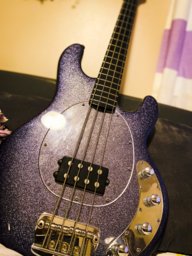
I can't speak for the active short scale Stingray (never heard or played one), But I've had several short scale passive Stingrays both EBMM and SBMM and now I have the passive full-scale Stingray as well, so I can compare the passive versions (and passive versions to full scale active Stingrays, which I have a couple of those too).

Generally speaking, the short scale passives have their "own voice." Yes, you can hear the Stingray in them, but there is a certain variation in frequency response that tells you it is a slightly different animal compared to the regular Stingray. To my ears, more midrange punch/presence, less deep bass, and less sizzly high-end. Less upper harmonics and overtones. It's all still there, just attenuated. Don't know how the active short scale would compare because that preamp is going to introduce the EQ curve of the regular Stingray to the slightly different short scale characteristics.

As far as comparing the the two varieties of passive Stingrays (short and long), I'd start by saying they are very similar in their basic characteristics. The long scale reintroduces some of the upper harmonics and overtones. Maybe a way to describe the long scale passive would be somewhere between the short scale "sound" and regular Stingray "sound." But I think the African mahogany and lack of thick poly finish of the BFR passive long scale Stingray adds a twist as well. That bass gets a super "creamy" sound with the tone rolled back about halfway in parallel and single coil mode that honestly reminds me a little bit of a Warwick. Not exactly the same, obviously, but leaning a bit in that direction. The passive long scale can certainly get a good "Stingray sound" as well, but with the coil switching and tone knob, there are lots of other sounds to be had too (as with the short scale, which has the same electronics). One last descriptor I think I could use in comparing them is that the long scale passive is a bit smoother overall compared to the short scale passive. Not quite as "pointed" sounding. Both are very percussive with quick attack, just as any Stingray is noted for.

Anyway, hopefully this novel I have written here will answer some questions about the differences. I'm looking forward to someone comparing the active short with the regular active Stingray (or passive Stingrays).

As for the active Tim Commerford full-scale Stingray, yeah, I'd imagine that is about as close to your typical "Stingray sound" as any of the four varieties of the Commerford basses get.
 
Last edited:
  • Like
Reactions: Wood and Wire
Interesting comments about what a "signature bass" should be or not be. I've bought many signature basses over the years--in many cases not even knowing or never hearing the person it is named after. It's always the specs that I look at. Same applies to this Tim Commerford signature. To be honest, although I'd heard the name, I had no idea who he was other than a bass player for some band I'd never heard. I'd never heard a RATM song until just a couple of months ago. Not really my kind of music.
FWIW, I prefer Commerford’s work in Audioslave. Combining the musicianship of the RATM instrumentalists with the songwriting and vocal abilities of Chris Cornell was great as long as it lasted.
 
I would love to try one of these basses, they look sooo nice.
But the question is... They must sound like a standard Musicman right?
I would imagine this bass sounds similar to a standard SRS4, or it would at least play like one. Probably more close to the newer Classic SR4. I still can't wrap my head around the price, I start to marinate in the idea then I see what that kind of money can buy and simply move on, there is sooo many basses out there that are rad, and below this price point. But I guess if you're motivated enough...
 
  • Like
Reactions: lowdownthump