• TalkBass has been independent since 1998. Add your voice.
    Create a free account to reply to discussions, view embedded media, and browse with fewer display ads.
    Join freeLog in
    Want zero display ads or expanded classifieds tools? Compare plans.

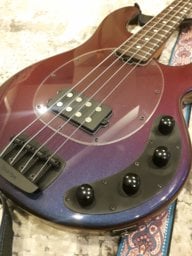
New Ernie Ball Tim Commerford Models

I'm a big fan of everything that Tim Commerford produces, so I'm biased.I don't think it commands double the price tag. In fact, I'm almost certainly doesn't despite people buying them like mad.

But there are some pretty cool innovations on the bass - the adjustable nut, adjustable mutes, adjustable thumb rest. I was actually wondering how much it would cost to buy a SUB and add these features to it. I'm sure it's achievable.

For me it's made me wonder a lot about muting. I had never considered it relevant in anything but old music, but now I'm wondering whether it would enhance my overdriven tone, which I use almost all the time in my originals band. I do enjoy sustain, but I think that's a minority instance for me.
 
Just out of curiosity, since I am not familiarized with the MusicMan models, what is the standard bass equivalent to this one?

Is it the MusicMan Stingray special?
Or the MusicMan Stingray?
Because the first one is for sale on Thomann for 2690-2790 euros and the second one is for sale for 2310 euros.

The Tim Commerford is for sale for 2679 euros.

At least if you're an European, you can get the TC cheaper than a regular special.
 
  • Like
Reactions: MattZilla
To the people that are upset and saying it's not a signature since it's got a different fretboard than his old Ray, maybe when he designed this one he just wanted an ebony fretboard instead of maple. If moving forward he plays the new one with an ebony fretboard,
I know I personally would much rather accommodate those of my fans who respects me for who I am now than those who only respects me for who I was, and that I'd much rather see a signature bass that actually gets used by the artist in question than one that is a copy of one that once, but not anymore, was used by the artist.

People finding this strange, which seems to be the majority of people posting in this thread, seems strange to me.

Yes, it seems strange to me too. If EBMM asked me to design my own signature bass, I wouldn't just hand them one of my old basses and say "recreate this". I'd want to actually make some design decisions and make it special.
 
I think people in the thread have a philosophical difference regarding what a "signature" bass is supposed to be.

Some people are expecting a signature bass to a near exact replica of the artist's personal bass, historically. Even if it's just color and relatively easy hardware swaps (I don't mean this in a condescending way). This has been the general approach by many manufacturers for years. EBMM may have done it that way in the past - I'm just not sure.

It seems EBMM's current approach to a signature model is more along the lines of,
  • "Mr./Ms. Artist, if EBMM built you an ideal bass for your current needs, what would you like it to have?"

I understand why some people may not like the current EBMM approach, but it does open up a way for them to add new features, quirks, etc. without disrupting their current brand and fanbase. If there's massive pushback, it can just be a 200-instrument run and that's that. I would love to see some of these features offered on a regular stingray model, though (bridge mutes, string-thru body bridge).
 
I think people in the thread have a philosophical difference regarding what a "signature" bass is supposed to be.

Some people are expecting a signature bass to a near exact replica of the artist's personal bass, historically. Even if it's just color and relatively easy hardware swaps (I don't mean this in a condescending way). This has been the general approach by many manufacturers for years. EBMM may have done it that way in the past - I'm just not sure.

It seems EBMM's current approach to a signature model is more along the lines of,
  • "Mr./Ms. Artist, if EBMM built you an ideal bass for your current needs, what would you like it to have?"

I understand why some people may not like the current EBMM approach, but it does open up a way for them to add new features, quirks, etc. without disrupting their current brand and fanbase. If there's massive pushback, it can just be a 200-instrument run and that's that. I would love to see some of these features offered on a regular stingray model, though (bridge mutes, string-thru body bridge).
The Epiphone Jack Casady is based on a Gibson Les Paul Signature bass, but pickup was completely redesigned so it isn’t an exact replica of Casady’s old bass, but what he wanted in a bass. Exactly what you’re saying.
 
  • Like
Reactions: Wood and Wire
Ernie Ball is really hitting it out of the park right now with their new models .

The 2 Short Scales really have my interest. Mutes, finger ramps…..yes!!


Glad to see these signature models but it makes me ask ….. Why haven’t we seen a Louis Johnson, Bernard Edwards, Gail Ann Dorsey , or Paul S Denman model?

Back to the OP - I'd sure like to see a Bernard Edwards signature bass. Le Freak!
 
Last edited:
The Epiphone Jack Casady is based on a Gibson Les Paul Signature bass, but pickup was completely redesigned so it isn’t an exact replica of Casady’s old bass, but what he wanted in a bass. Exactly what you’re saying.

Warwick's signature basses is another example of artists designing whatever they want, rather than recreating an instrument the respective artists are known for.

Look at Lee Sklar's and John Entwistle's signature Warwick for instance.
 
Back to the OP - I'd sure like to see a Bernard Edwards signature bass. Le Freak!

The problem with that may be how Bernard Edwards quickly switched to other basses (Fender included) after those initial years with the Stingray.
Same with Louis Johnson.

Even though Bernard acted as a consultant for Leo at Music Man, he didn't stay with them.
 
Last edited:
  • Like
Reactions: Peteyboy
Back to the OP - I'd sure like to see a Bernard Edwards signature bass. Le Freak!

I love Bernard but I don't think I could give up the truss wheel for Ye Olde Bullet Truss. It is a looker though!

Also, you can never change the strings.

1BUuqBeg.jpeg
 
I don't really understand why this had to be a signature bass.
Does Tim actually play a passive short-scale Stingray?
I'm also curious why there are now two short-scale Stingrays that happen to be Signature models.

A previous poster in this thread said that Tim has been raving about his short-scale stingray for over a year, so that would be yes, he does actually play one.
 
The problem with that may be how Bernard Edwards quickly switched to other basses (Fender included) after those initial years with the Stingray.
Same with Louis Johnson.

Even though Bernard acted as a consultant for Leo at Music Man, he didn't stay with them.
Bernard may have played other basses from time to time but he never stopped playing his Stingray . He played that bass at his last performance right before he went back to his hotel room and passed away from pneumonia .


As for Louis Johnson….he moved on to the MusicMan Sabre . He had other basses too. Even his own line. But still kept playing the Sabre.
 
The problem with that may be how Bernard Edwards quickly switched to other basses (Fender included) after those initial years with the Stingray.
Same with Louis Johnson.

Even though Bernard acted as a consultant for Leo at Music Man, he didn't stay with them.

I thought Louis Johnson was but Bernard was just an everyday user - his bass was a 1977 (subsequently owned by John Taylor of Duran Duran). Bernard liked it enough to record a lot of the Chic, Sister Sledge etc material on it and although he was associated with other basses (eg Yamaha) in the mid/later 80s, he certainly used that Musicman in the early/mid 90s with Chic right up to his passing.

Louis was working with Musicman, but he too played other basses (I saw him using an Alembic in late 70s/early 80s live and understand he sometimes tracked with it although the Musicman was his signature tone from about 1977. He used a P bass prior to that - I saw him use one when both he and George were in the Billy Preston band in the early 70s. In the later 80s onwards, Louis was associated with many types of bass.

Although both players are sadly deceased, I don’t see how any of this precludes there being Musicman artist basses provided appropriate clearance to do so can be achieved. Other good ones would be Pino Palladino fretless and Tony Levin SR5 (peach).

However I’ll settle on my on order TC natural long scale for now :cool:
 
Shouldn't signature instruments would be something unique that the player helped develop? Something like the Roscoe Beck, the Marcus Miller, or Tony Franklin?

EBMM is getting a little carried away with the idea, I think. Am I thinking wrong? Why would someone would pay extra for an instrument that has nothing to do with the signature player?​
 
  • Like
Reactions: Gothic
Shouldn't signature instruments would be something unique that the player helped develop? Something like the Roscoe Beck, the Marcus Miller, or Tony Franklin?

EBMM is getting a little carried away with the idea, I think. Am I thinking wrong? Why would someone would pay extra for an instrument that has nothing to do with the signature player?​
What did Tony Franklin develop on his bass? He modded a 70's fretless P with a J pickup and a Badass bridge. That could've come from a lot of people.
 
  • Like
Reactions: roswell1965