
Yeah -it's a nice option - and the switch is right there, so people shouldn't think of it as a double J, but a single-J with more options.I really dig the red and the green ones. I may be different than most, but I DO like the double bucker at the bridge.

Enjoy the benefits of a premium membership!
Upgrade Account
-
TalkBass has been independent since 1998. Add your voice.
Create a free account to reply to discussions, view embedded media, and browse with fewer display ads.
Join free Log in
Want zero display ads or expanded classifieds tools? Compare plans.
You are using an out of date browser. It may not display this or other websites correctly.
You should upgrade or use an alternative browser.
You should upgrade or use an alternative browser.
New Ibanez Talman
- Thread starter aproud1
- Start date
More options
Who Replied?It is - I said I wanted a second switch for the EQ.Huh, I'll have to read closer - I thought that was a coil splitter for the bridge pickup, not active EQ.
Nevermind - didn't read your second sentence.
Last edited:

They missed the boat with the EQ though - they should probably have left this passive or at least added a second switch to disable the active eq - also 2 slide switches would look way more retro than one.
It looks like both the bass and treble can be boosted or cut. So maybe in the middle or cut sounds the same as running passive? Worst case is maybe a simple bypass with a $3 switch gets you to passive?
I would almost certainly want better pickups (at least in the P position), but who knows? Ibanez does some really impressive stuff at very low prices.
I am quite curious to see how these sound. Maybe the stock pickups are good? It looks as though these pickups have been used in other Ibanez basses. So we might be able to take a guess as to how they sound stock. Heck, at $200 for a TMB100, it might be enough to just try one out for fun. As long as the build quality and stock sound are not too bad. They sure look like fun, with a shape that is refreshing.

Anyone know the differences between the TMB100 and TMB300 models (other than different colors)?
If you look at the Ibanez photos closely... It seems as though that back of the neck on the TBM300 ($300) is glossy whereas the TBM100 ($200) neck is satin. Maybe? It would be interesting if they did them differently, to give us some more options to choose from.
[Invalid or Expired Link Removed]
Yeah, it's an easy mod - but even easier at the factory - and like I said they could have two slide switches together for that mid-60s mission control look - I suspect they didn't want it to be TOO jag-ish.It looks like both the bass and treble can be boosted or cut. So maybe in the middle or cut sounds the same as running passive? Worst case is maybe a simple bypass with a $3 switch gets you to passive?
I am quite curious to see how these sound. Maybe the stock pickups are good? It looks as though these pickups have been used in other Ibanez basses. So we might be able to take a guess as to how they sound stock. Heck, at $200 for a TMB100, it might be enough to just try one out for fun. As long as the build quality and stock sound are not too bad. They sure look like fun, with a shape that is refreshing.
And totally yeah - I'd actually be shocked if they didn't sound pretty darn good out of the box - I'm just enough of a snob to feel the need to "upgrade" a $300 bass before I gig it.
If you're wondering - still haven't figured out what to do with my Dano to make it "better" - other than straplocks, but I don't think they really count - though I have been considering putting in some GFS p/us to increase the output just slightly to bring the resonant frequency down a few Hz.


Yeah, it's an easy mod - but even easier at the factory - and like I said they could have two slide switches together for that mid-60s mission control look - I suspect they didn't want it to be TOO jag-ish.
And totally yeah - I'd actually be shocked if they didn't sound pretty darn good out of the box - I'm just enough of a snob to feel the need to "upgrade" a $300 bass before I gig it.
If you're wondering - still haven't figured out what to do with my Dano to make it "better" - other than straplocks, but I don't think they really count - though I have been considering putting in some GFS p/us to increase the output just slightly to bring the resonant frequency down a few Hz.
 Everyone feels differently about mods. On less expensive basses, it's just about the first thing I consider - "how can I make it better".
That's exactly what I think - but I never get around to it and end up with a $300 bass that sounds like a $300 bass and not like the great bass it could be with a couple of simple fixes.
I extend that further: these are tools I enjoy, make money with, and appreciate as fine musical instruments. But everybody is different, and no single instrument can fit all players. I ask what can I tweak to make it fit what I need to do.
Now, on a vintage or other collectible instrument that has demonstrated its value over time, I'm not going to go carving or swapping on it just because. That would be a disservice to the instrument. But I have modded every instrument I own, including my Rickenbacker 4002 bass. The key is balance: do the mods meet a cost/benefit test to really change something? For example, changing out a Fender pickguard to a preferred color or pattern is a no-brainer due to the inexpensive and reversible aspects of the change. The next step would be what to do with a bass I gig with, as that would mean more allowance for mods because I will earn more $$$ with them. I have about $300 in my Ibby SRA305, and about that much more for the EMG actives setup, because it is a main gigging instrument and I needed the clearest tone with the lowest noise floor possible for the digital boards I play through. For a garage sale or pawn shop bass, after a good setup to make it playable, mods could cost more than the bass did, and therefore not be cost effective, so I would play it as is or flip it. On my Rick 4002 bass, I depreciated the value of the bass by changing out a volume pot for a push-pull on the front pickup to take its capacitor circuit in or out. But...it is reversible: I kept the original part, and swapping back will raise the value back up.
Some instruments take so much modification to conform to the taste of the player that the player is better off getting another instrument. After much consideration, that would be the case with this Talman Bass for me. At the very least, I would swap the pickup configuration, and the new pickguard and body routing puts it outside the cost/benefit ratio, to say nothing of Ultralite tuners, because this instrument, with the short upper horn and full sized tuners, will probably be neck heavy, which due to my back I will not deal with either sitting or standing.
Other persons' mileage will vary. That's why there are so many basses to choose from.
For those who criticize the electronics, just remember that, in 4-knob setup instead of stacked pairs, this is the original Spector setup: volume, volume, active treble, active bass. Not saying it is better or worse, just giving perspective.
I agree with everything you say except this. If you buy a $50 bass and you can make it your perfect bass for $500, where nothing else would give you that, you have not wasted money (obviously I am using extreme numbers to illustrate my point but there is nothing wrong with putting more money into a palying bass than it is "worth" if that's the way to bet the bass you want. Which isn't to say everyone should go out and buy $299 squires then spend $1200 on custom shop pickups and hardware (which is the wrong way to get a "high end" Fender) but as this is reasonably unique and made of quality woods - even replacing all the hardware and electronics might be justified if it's the right thing for someone - I'm just too lazy to do all that.I extend that further: these are tools I enjoy, make money with, and appreciate as fine musical instruments. But everybody is different, and no single instrument can fit all players. I ask what can I tweak to make it fit what I need to do.
Now, on a vintage or other collectible instrument that has demonstrated its value over time, I'm not going to go carving or swapping on it just because. That would be a disservice to the instrument. But I have modded every instrument I own, including my Rickenbacker 4002 bass. The key is balance: do the mods meet a cost/benefit test to really change something? For example, changing out a Fender pickguard to a preferred color or pattern is a no-brainer due to the inexpensive and reversible aspects of the change. The next step would be what to do with a bass I gig with, as that would mean more allowance for mods because I will earn more $$$ with them. I have about $300 in my Ibby SRA305, and about that much more for the EMG actives setup, because it is a main gigging instrument and I needed the clearest tone with the lowest noise floor possible for the digital boards I play through. For a garage sale or pawn shop bass, after a good setup to make it playable, mods could cost more than the bass did, and therefore not be cost effective, so I would play it as is or flip it. On my Rick 4002 bass, I depreciated the value of the bass by changing out a volume pot for a push-pull on the front pickup to take its capacitor circuit in or out. But...it is reversible: I kept the original part, and swapping back will raise the value back up.
Some instruments take so much modification to conform to the taste of the player that the player is better off getting another instrument. After much consideration, that would be the case with this Talman Bass for me. At the very least, I would swap the pickup configuration, and the new pickguard and body routing puts it outside the cost/benefit ratio, to say nothing of Ultralite tuners, because this instrument, with the short upper horn and full sized tuners, will probably be neck heavy, which due to my back I will not deal with either sitting or standing.
Other persons' mileage will vary. That's why there are so many basses to choose from.
For those who criticize the electronics, just remember that, in 4-knob setup instead of stacked pairs, this is the original Spector setup: volume, volume, active treble, active bass. Not saying it is better or worse, just giving perspective.
Yes, I have put more money into an instrument just because. Point taken. I got close to that with my second Ibby SRA305, especially since it is a main gig instrument. I fouled up the first one, and this leads me to the final point which your post illustrates: so long as you plan to keep the bass, all is good. But if you ever want to resell it, plan on taking a loss, because nobody wants the modifications you have done. That's why it is called "custom."I agree with everything you say except this. If you buy a $50 bass and you can make it your perfect bass for $500, where nothing else would give you that, you have not wasted money (obviously I am using extreme numbers to illustrate my point but there is nothing wrong with putting more money into a palying bass than it is "worth" if that's the way to bet the bass you want. Which isn't to say everyone should go out and buy $299 squires then spend $1200 on custom shop pickups and hardware (which is the wrong way to get a "high end" Fender) but as this is reasonably unique and made of quality woods - even replacing all the hardware and electronics might be justified if it's the right thing for someone - I'm just too lazy to do all that.
If I liked the ergonomics of traditional P/J style instruments, I might get one. But I like narrower string spacing than Fender standard; If I play a P pickup, it is with the orientation reversed, I like a humbucking J-bridge pickup, and I can't stand any sort of neck dive. So this bass is not for me.
Last edited:
Right - it may be a total waste of money (as you say, it likely is) if you intend to re-sell. It always amazes me the number of guys on eBay and Kijiji who have "improved" their old Fenders and what-not and think they're worth MORE - especially if it's an iconic model, the closer to stock the better.Yes, I have put more money into an instrument just because. Point taken. I got close to that with my second Ibby SRA305, especially since it is a main gig instrument. I fouled up the first one, and this leads me to the final point which your post illustrates: so long as you plan to keep the bass, all is good. But if you ever want to resell it, plan on taking a loss, because nobody wants the modifications you have done. That's why it is called "custom."
Indeed.Right - it may be a total waste of money (as you say, it likely is) if you intend to re-sell. It always amazes me the number of guys on eBay and Kijiji who have "improved" their old Fenders and what-not and think they're worth MORE - especially if it's an iconic model, the closer to stock the better.
Buying for resale vs. buying for enjoying / playing are two entirely different propositions that sometimes overlap, but often do not. Anyway, my thinking is "how can I tell what I like / want if I haven't tried lots of possibilities & alternatives?" That's part of what modding is about - cheaper than buying a whole new bass each time, for sure!I agree with everything you say except this. If you buy a $50 bass and you can make it your perfect bass for $500, where nothing else would give you that, you have not wasted money (obviously I am using extreme numbers to illustrate my point but there is nothing wrong with putting more money into a palying bass than it is "worth" if that's the way to bet the bass you want. Which isn't to say everyone should go out and buy $299 squires then spend $1200 on custom shop pickups and hardware (which is the wrong way to get a "high end" Fender) but as this is reasonably unique and made of quality woods - even replacing all the hardware and electronics might be justified if it's the right thing for someone - I'm just too lazy to do all that.
Yes. There is value in that. I bought a Squier II guitar in the early '90's for the sole purpose of carving on it and trying all sorts of different configurations of pickups, wiring and hardware. I learned a lot, and it refined what I like and don't like in a bass. It can be an expensive hobby, even just with parts.Buying for resale vs. buying for enjoying / playing are two entirely different propositions that sometimes overlap, but often do not. Anyway, my thinking is "how can I tell what I like / want if I haven't tried lots of possibilities & alternatives?" That's part of what modding is about - cheaper than buying a whole new bass each time, for sure!
These are probably the same mass-produced pickups that are in their GIO and lower SR basses. Good pickups. Not great, but good when properly adjusted.
Thanks. I just tried looking around for some youtube clips to get an idea of what they sound like but did not come up with too much of interest. It seems as though the DXP and DXJ pickups have been used in the past, but are not on any other current production basses. At least as far as I can tell with a little googling.
That's exactly what I think - but I never get around to it and end up with a $300 bass that sounds like a $300 bass and not like the great bass it could be with a couple of simple fixes.
I know this one all too well. There is never enough time to have all the fun that we want.
Yeah, it's an easy mod - but even easier at the factory - and like I said they could have two slide switches together for that mid-60s mission control look - I suspect they didn't want it to be TOO jag-ish.
And totally yeah - I'd actually be shocked if they didn't sound pretty darn good out of the box - I'm just enough of a snob to feel the need to "upgrade" a $300 bass before I gig it.
If you're wondering - still haven't figured out what to do with my Dano to make it "better" - other than straplocks, but I don't think they really count - though I have been considering putting in some GFS p/us to increase the output just slightly to bring the resonant frequency down a few Hz.
Yeah, we'll see how these basses fell and sound. I'm curious. It's amazing what quality the low end gear is these days.
The Dano's are what they are. Not for everyone and not really an all-around thing. But they have their schtick and it's a fun sounding schtick.
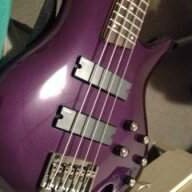
Just wanted to throw this on here. First time I have come across this particular link. Shows some of those colors really well. They look a lot different then the generic stock pics. The pick guard is not so bad either IMO.
[Invalid or Expired Link Removed]
[Invalid or Expired Link Removed]
Just wanted to throw this on here. First time I have come across this particular link. Shows some of those colors really well. They look a lot different then the generic stock pics. The pick guard is not so bad either IMO.
[Invalid or Expired Link Removed]
Thanks, confirms that they're not offering the mint color in the 300.


