Here's how to determine your preferred freq marks and figure out "o'clock" frequencies.
Here's the generic graphic I made. The compass is there for calculations, the clock because alot of us think in those terms.:

Here's the finished item again and the three finished workup charts (HPF, Low Mid, High Mid). Where lines intersect the rim of the knob are the positions were interested in. I labeled the clock position freqs and the red line freqs I picked 'cause they were easy to remember. You can choose your own.


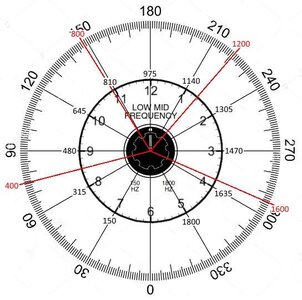

So, here's the math.
For each knob, a Hz Per Degree (hpd) has to be calculated. In other words, how many hz are contained in each degree of the compass. It'll be the multiplier and divisor for all other calcs for that knob only.
Using the Low Mid Freq knob...
...as the example, we see the entire freq range is from 150hz to 1800hz. That freq range spans 300 degrees on the compass (all knobs are 300 degrees from 7 to 5 o'clock).
So, what's the Hz Per Degree (hpd)?
(1800hz - 150hz) / 300deg = 5.5hpd
5.5hpd is used for any calcs you wanna do on this knob.
-Where is 400hz?
((400 - 150hz) / 5.5hpd) + 30deg = 75.45deg
On the diagram, run a line from the center of knob to the 75.5deg compass heading. Rounding the answer is fine.
-What frequency is at 10 o'clock?
*note that 10 o'clock is 120 deg on the compass.
((120deg - 30deg) x 5.5hpd) + 150hz = 645hz
On the diagram, 645hz is on the line from the center of knob to the 120deg heading on the compass.
And that's it. The above three equations did what I'd wanted for each knob.
This isn't measured by test equipment, and there is a fudge factor involved. Agedhorse said the 300deg range sounds right, with the caveat that in actual practice, it's usually a little less. Works for my purpose of putting a few more visual references on my amp.
If this is helpful to you, have a ball.
Edit: forgot to mention, this is good for the WD800 and Plus DI Preamp also.
Here's the generic graphic I made. The compass is there for calculations, the clock because alot of us think in those terms.:
Here's the finished item again and the three finished workup charts (HPF, Low Mid, High Mid). Where lines intersect the rim of the knob are the positions were interested in. I labeled the clock position freqs and the red line freqs I picked 'cause they were easy to remember. You can choose your own.
So, here's the math.
For each knob, a Hz Per Degree (hpd) has to be calculated. In other words, how many hz are contained in each degree of the compass. It'll be the multiplier and divisor for all other calcs for that knob only.
Using the Low Mid Freq knob...
...as the example, we see the entire freq range is from 150hz to 1800hz. That freq range spans 300 degrees on the compass (all knobs are 300 degrees from 7 to 5 o'clock).
So, what's the Hz Per Degree (hpd)?
(1800hz - 150hz) / 300deg = 5.5hpd
5.5hpd is used for any calcs you wanna do on this knob.
-Where is 400hz?
((400 - 150hz) / 5.5hpd) + 30deg = 75.45deg
On the diagram, run a line from the center of knob to the 75.5deg compass heading. Rounding the answer is fine.
-What frequency is at 10 o'clock?
*note that 10 o'clock is 120 deg on the compass.
((120deg - 30deg) x 5.5hpd) + 150hz = 645hz
On the diagram, 645hz is on the line from the center of knob to the 120deg heading on the compass.
And that's it. The above three equations did what I'd wanted for each knob.
This isn't measured by test equipment, and there is a fudge factor involved. Agedhorse said the 300deg range sounds right, with the caveat that in actual practice, it's usually a little less. Works for my purpose of putting a few more visual references on my amp.
If this is helpful to you, have a ball.
Edit: forgot to mention, this is good for the WD800 and Plus DI Preamp also.
Last edited: