• TalkBass has been independent since 1998. Add your voice.
    Create a free account to reply to discussions, view embedded media, and browse with fewer display ads.
    Join freeLog in
    Want zero display ads or expanded classifieds tools? Compare plans.

NEW SIRE Marcus Miller V5 - passive

It's a C shape and 9.5. body is roasted hard maple.
Body Material : Roasted Hard Maple
Body Shape : New Marcus Miller Jazz Type
Body Color : NT,TS

Roasted Hard maple body? Sounds strange. I think according to other sites and logic the neck is roasted maple but the body is Alder. Don't know though if they have different choices but it's seem more likely it's a missprint. It's happened before :)

 
I've had my first two Sires (M3 and V7, both fretted, a 4 and a 5) since they started (V7 is Marcus-signed, #99), and still lovin' both of them!
 
  • Like
Reactions: One Way
Awe

Awesome, that's good to hear. I specifically am wondering about the V5 though, anybody have experience with long term V5 ownership?
Yeah, that I can't help with, though they've been out a year or more now - not out long enough for any really long term experiences...
 
  • Like
Reactions: Jon Draffan
This is great. What's the signal chain you're using?

I think I just ran into my old Boss BR1600 mixer and gave a small boost at 100hz, a small cut at 2k and had a little wider Q and did a slight cut at 10k. Dumped over to iMovie to sync video and audio. Definitely not high tech! :D

Tasty sounding bass, tastefully played! :thumbsup: I was going to ask what your preamp settings were then remembered this is the passive one. Great tone. Strings?

I had just put on a new set of D’Addario Pro Steels, 45-65-80-100-130.
 
  • Like
Reactions: bholder
Can any V5 owners tell me if this bass has the pickup canal route underneath the pickguard?

PXL_20210819_212957621.jpg


No route :)
 
Does anyone have a link to a comparison between the Sire V5 and the V5R? I would think the Sire website would have a side-by-side, but I couldn’t find it.

Of course, your opinions on the differences between these two would also be welcome!

Thanks.

 
Add another Sire fan! I honestly hadn't given Sire instruments much attention (no particular reason, just wasn't looking for another inexpensive instrument), but my wife recently gave me a 4 string V5 as a birthday gift! After a few weeks with it,... I'm amazed.

It's a beautiful instrument with one of the best necks I've come across at any price point. Seriously, the fretwork, binding refinement, and rolled edges are unbelievable for @ $500. Yeah, the painted blocks aren't 'premium', but are executed perfectly and are totally acceptable at this price.The finish is great with a nice transition from the satin back of the neck to the glossy poly on the face. Roasted maple, too - awesome! The fret ends are near perfection on my bass - rolled over top of the binding with a lot of attention to detail. The nut is ok, I will file the top of it (not the slots, they are fine) so it is a little less proud and smooth. Mine also has a tiny finish imperfection on the face of the fretboard near the 20th fret, but is unnoticeable unless searching for it.

The hardware is good: tuners, proprietary bridge, pickguard, pots, etc are all good quality. The bridge is basically a beefier version of a vintage Fender bent steel bridge. It mounts with a different screw arrangement, but works perfectly well - I like it! The threaded barrel saddles are a touch that I prefer for fine tuning string spacing. All good.

The body finish is flawless on my example. Literally zero imperfections. The Jazz shape is almost the same as a Fender & feels familiar and in no way budget - pretty light too! I haven't weighed it, but it is a bit lighter than my Fender AMRI 62 Jazz. The truss rod adjustment channel at the heel-end is a welcome modification form Fender norms and looks just fine to me.

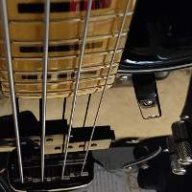
If you looked closely at my quick photos below, you may notice I installed aftermarket Aguilar pickups (a 70's J set). That's the only area I found lacking on the Sire - the stock Marcus Miller Sire branded pickups have strong output, but tonally tilted a little too much on the treble side. Fundamental bass and midrange detail are all there, but the treble is in "strident" territory. I found myself using an eq pedal with a significant rolloff above 1k to make me happy, which is fine, but in my opinion the bass sounds much more balanced with the Aguilar set. The Aguilar's have slightly lower output, but better matched bass & treble with a subdued midrange that still retains a gritty character. The stock pickups are a fine value at the price point however, and certainly get the job done.

Since I pulled it apart to perform the pickup swap, I also tested the shielding job. It consisted of black shielding paint in all 3 cavities, attached together with grounding wires. There was a lot of work put into carefully painting the cavities (it was done quite nicely) and running the extra wires. However, it was entirely pointless as the paint was entirely ineffective. I used a continuity tester and multimeter with zero conductivity evident in the paint itself. Literally zero even with test probes a millimeter apart on the paint. Sire wasted some time on this - I wonder if it was a bad batch of paint?. I went ahead and copper foil shielded the cavities with foil tunnels connecting the pickup cavities. Sure enough, after finishing the pickup mod, the bass was significantly quieter in solo pickup mode after the proper shielding was done. It's also worth noting that the Sire pickup covers are either a tiny bit undersized, or the Aguilar a tiny bit oversized as they were a tight fit in the cavities as well as pickguard cutout which required a little bit of filing. The install was still only about an hour or so job even with the added shielding.

How does it play, and how's the tone? Great and great. The neck feel experience is far above average for a jazz bass & the body contours feel familiar and solid. I think the belly carve is a little different and the horn shapes on the body differ slightly from a Fender, but in the dark you'd swear you were holding a Fender body. Tonally, even with the stock pickups it sounds like a Jazz bass. Distinct, tight, resonant, and responsive are all apt adjectives for the sound. Acoustically, it rings out well with excellent sustain.

Bottom line: KILLER bass for a head-scratchingly low price! I had considered getting a 70's spaced Fender Jazz at some point so I had both options in my arsenal, but that itch has been fully scratched with the Sire V5. To be perfectly honest, if Sire offered just this finished neck for $500 as a replacement part for a Fender, it would still be a great value! (note: I do not know if these necks will fit a standard Fender neck pocket.) If asked to recommend a nice 4 string bass under the $600 mark, this is an easy option to suggest! I believe a comparable Squier is about $100 less, but nowhere near the fit and finish of the Sire.

I love this bass and would be comfortable using it on any gig or session. In fact I'm working on an independent country record this week remotely & I will definitely keep this bass close at hand! (Now I'm thinking of trying out a Sire S7 FM Larry Carlton model guitar. Sire has me intrigued!)

1.jpg


2.jpg
 
I've found that shielding paint can act strange with a typical multimeter - some types are not necessarily very conductive on the surface unless you scratch into them a bit - that is to say, no conductivity on the surface using your meter probes doesn't mean the two points aren't connected on the insides, just that there's poor surface conductivity. Anyway, that's been my experience - it can seem non-conductive to a meter but still do the shielding job. That's why the ground wires are (typically) screwed in with little "star" locknuts, to ensure connection.

YMMV. :p

Oh yeah, I've got 6 Sire basses now, and this year ventured into their 6 string guitars with a T7FM and an S7V - give them a try, quality at price point is at least as good as it is on the basses!
 
Last edited:
  • Like
Reactions: OldShark and scotch
I've found that shielding paint can act strange with a typical multimeter - some types are not necessarily very conductive on the surface unless you scratch into them a bit - that is to say, no conductivity on the surface using your meter probes doesn't mean the two points aren't connected on the insides, just that there's poor surface conductivity. Anyway, that's been my experience - it can seem non-conductive to a meter but still do the shielding job. That's why the ground wires are (typically) screwed in with little "star" locknuts, to ensure connection.

YMMV. :p

Oh yeah, I've got 6 Sire basses now, and this year ventured into their 6 string guitars with a T7FM and an S7V - give them a try, quality at price point is at least as good as it is on the basses!

Of.course
I've found that shielding paint can act strange with a typical multimeter - some types are not necessarily very conductive on the surface unless you scratch into them a bit - that is to say, no conductivity on the surface using your meter probes doesn't mean the two points aren't connected on the insides, just that there's poor surface conductivity. Anyway, that's been my experience - it can seem non-conductive to a meter but still do the shielding job. That's why the ground wires are (typically) screwed in with little "star" locknuts, to ensure connection.

YMMV. :p

Oh yeah, I've got 6 Sire basses now, and this year ventured into their 6 string guitars with a T7FM and an S7V - give them a try, quality at price point is at least as good as it is on the basses!

Agreed. I did scratch into the paint, tried to be as thourough as possible. It's also relevant that the resulting noise floor dropped considerably with the copper foil vs the stock black shielding paint.

I admit I prefer and am biased towards foil vs paint, but I have had good experiences with conductive paint as well. My understanding from some experienced techs/builder/repair folk is that the paint can become less effective if not fresh in the can or mixed poorly. Copper foil, alternatively, can be problematic as the adhesive dries and loses continuity and moves around in the control cavity. It's important to solder all copper pieces together and provide intelligent mechanical placement.

If I were a betting man, my money would be a can of shielding paint at the Sire factory not getting mixed up thoroughly throughout the day.
 
  • Like
Reactions: bholder

Latest posts