• TalkBass has been independent since 1998. Add your voice.
    Create a free account to reply to discussions, view embedded media, and browse with fewer display ads.
    Join freeLog in
    Want zero display ads or expanded classifieds tools? Compare plans.

**New SWR headlite™ Mini-Amp**

Why only 400W - good question indeed.

For all we know, the headlite might just contain the same B&O clas D power module as used by Genz Benz and by GK's MB2-500.

They all claim a power of 500Watts at 4 Ohms, however without saying at which level of THD.
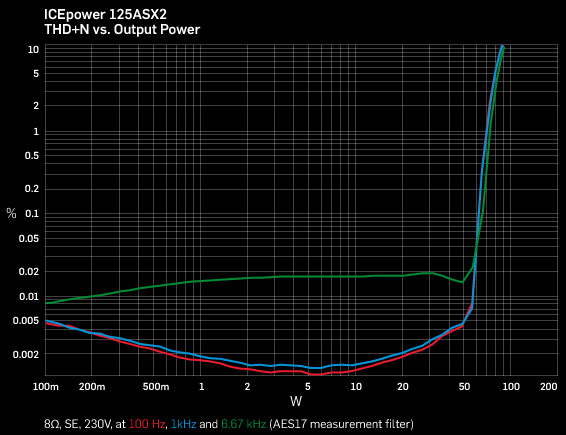
A look at the specifications of the power module the Link Removed shows that this is a 2x 125W stereo unit run permantly in bridge mode to realize at 4 Ohms 450W at 1%THD and 550W at 10% or at 8Ohms 250W at 1% THD and 300W at 10% THD.

The graph show one channel output (non-bridged)
graph_125asx2_130209.jpg


So what's 400 or 500W is only the question what distortion you are willing to accept. Just as any old all tube head... :smug:

So I for one am willing to ignore that until I know against which THD they have measured and under which conditions.
Alternatively I would rely on my ears to determine whether 400Watts is too little. You may be surprised....

 
This headlite looks great, I hope my Guitar Center gets it's stuff together and starts restocking there bass showroom with some of these bad boys. Right now all they have is a LMII, some ampegs and a bunch of cabs:(

This head is the most interesting thing I've heard from NAMM so far, I really want a chance to try one.
 
Why only 400W - good question indeed.

For all we know, the headlite might just contain the same B&O clas D power module as used by Genz Benz and by GK's MB2-500.

They all claim a power of 500Watts at 4 Ohms, however without saying at which level of THD.
A look at the specifications of the power module the Link Removed shows that this is a 2x 125W stereo unit run permantly in bridge mode to realize at 4 Ohms 450W at 1%THD and 550W at 10% or at 8Ohms 250W at 1% THD and 300W at 10% THD.

The graph show one channel output (non-bridged)
graph_125asx2_130209.jpg


So what's 400 or 500W is only the question what distortion you are willing to accept. Just as any old all tube head... :smug:

So I for one am willing to ignore that until I know against which THD they have measured and under which conditions.
Alternatively I would rely on my ears to determine whether 400Watts is too little. You may be surprised....

I've been waiting for this post. I also suspect this uses the same power module and was waiting for someone else to explain the 400W/500W discrepancy. Thank you!
 
I would like to address this in generalities because I do not know the specifics of other manufacturer's applications as well as the sensitive nature of the requirements of our pending patents in this specific area, of which Roger has also alluded to.

1. The specifications for maximum power are stated under worst case conditions... that is all devices must exceed these numbers.

2. This is a steady state number that does not reflect dynamics nor does it reflect any potential gains available from modulation management and advanced signal procesisng techniques.

3. These numbers, as you can (or should be able to) tell are very closely tied to the thermal performance of the package. Thermal management and knowledge of signal and dynamics profiles plays a very large part in the real world performance of all of these devices.

4. These numbers also do not reflect any respect to harmonic relationships, and the generation/management of the specific harmonic spread of the circuitry that they are used with. The harmonics you see in the graph are unprocessed and may be modified considerably with appropriate processing in the signal paths.

5. There are often little secret tricks that experienced designers have that can be used to exploit additional performance that is "off-sheet". The more experience a designer has with a product or process, the better equipped he/she is to see inside the back door. I have been working with this product line for a very long time, long before any of these modules were developed. In fact, I have probably been working with the company's product line for 5-6 years already, so I am probably just a little more experienced with how they approach the class D and SMPS techniques and have tools that others may not posess. I also have almost 30 years experience as an EE developing pro audio and amplifier products. This does count for something. ;) To corrolate a purely numerical power specification to real world performance, there are some unique aspects of tube amps that clearly deliver more useable volume than a comparable solid state amp, but a knowledgable designer can utilize some of these same (or similar) mechanisms, in addition to other mechanisms, to improve the real world performance of a solid state amp design. There are some notable examples of this across several brands.

6. Some of the numbers are used to reflect necessary regulatory agency parameters rather than what can be done in the hands of an experienced engineer. Knowing the differences and how they apply are indeed important whan exploiting the potential of a product.

7. Using appropriate techniques, it's possible to recover some of the energy from a reactive speaker load and utilize it in supporting higher power supply efficiency. This only applies under certain conditions, but specifically the conditions that our product is engineered to.

I'm sorry I can't go into any specific details, but our pending patents prohibit and additional discussion. I hope this gets you all thinking about why there may also be a difference in the costs of the various amplifiers using a similar platform. While things sometimes look similar on the surface, down deep there are some significant differences.

I hope this helps.
 
So what is the skinny on why most reviewers seem to think the 500W rated Markbass stuff has more headroom and volume than the 600W shuttles?

Is it possible the SWR could be just as loud as a LMII or shuttle 6.0?

+1 Hard to tell with published specs, which are pretty much useless when comparing units spec'd within 50-100 watts of each other. Most (as you point out, based on many,many posts of TBers who have A/B'd these heads) hear the 500 watt rated LMII as significantly more beefy and 'louder' (through the entire frequency range) than the 600 watt rated Shuttle 6. In turn, most, including me, hear the 450 watt rated TC RH450 as louder and more 'forceful' than either the LMII or Shuttle 6.

I think it depends on how up front the manufacturer is on distortion levels at the power rating IMO, and also if the added wattage is due to 'limiter tricks', etc. or true, pure, low distortion, clean, real power.

That all being said, given the performance versus published power spec of most other SWR amps I've owned or played, I'm not too excited about this one. Some of that is due to some of the SWR amps setting that hi pass absolute low end cut-off really low, resulting in the amp pumping super deep lows that suck power, and make the head sound 'soft'. Who knows if they stuck to that sort of thing with this new head? Never can tell though. It will be fun to get some 'TBer ears' on it.

Edit: That being said, if it sounds like a Baby Blue with three times the wattage... I'd probably buy one!
 
...There are often little secret tricks that experienced designers have that can be used to exploit additional performance that is "off-sheet".

...While things sometimes look similar on the surface, down deep there are some significant differences.

I hope this helps.

Thank you for your insight and perspective.


Is it possible the SWR could be just as loud as a LMII or shuttle 6.0?

This seems such a straight forward question... but what is / how do you measure "loud"?

Which frequency / frequencies measured at which sensitivity curve (A, B, C and D weighting) or do we measure a tone (low D / high A), a sequence of tones, long tones versus a rapid succession of tones just for a couple of seconds or for an hour ?

and worse, which definition of loud is relevant to a bass player's specific circumstances.

This will then impact on how the experienced and competent engineer will massage the whole package with limiters and frequency spreads and, and, and...
 
This seems such a straight forward question... but what is / how do you measure "loud"?

Which frequency / frequencies measured at which sensitivity curve (A, B, C and D weighting) or do we measure a tone (low D / high A), a sequence of tones, long tones versus a rapid succession of tones just for a couple of seconds or for an hour ?

and worse, which definition of loud is relevant to a bass player's specific circumstances.

This will then impact on how the experienced and competent engineer will massage the whole package with limiters and frequency spreads and, and, and...

+1 So many variables, and so many interactions. IMO and IME, the best way to gauge and evaluate this type of question is to have LOTs of bassists (TBers in this case) evaluate all this gear pumping in a gig situation (which is what I try to do myself). It's amazing how the 'truth' emerges regarding performance and reporting by dozens and even hundreds of players with different tone goals and playing contexts reporting back. You can easily pick up on, what is called in my business of statistical evaluation, the 'true score', represented by the average of a relatively large (and of course error prone and variable) sample of responses.

IMO and IME!
 
I really like the aesthetics of this little guy, but am not a fan of the SWR tone, so I'll pass.... Sure does look great though.

+1 on that.

Everything does look great on paper.

If...If...If its just want not a SWR :hiding: LOL
 
So what is the skinny on why most reviewers seem to think the 500W rated Markbass stuff has more headroom and volume than the 600W shuttles?

Not all feel that way. To me the MB is running wide open at half way on the Master. Simple as that. Not to say the MB is a bad amp at all.

Cool interview with John Willis, I recently met him.

Have not heard the Headlights so I will have to reserve judgement.
 
I would like to address this in generalities because I do not know the specifics of other manufacturer's applications as well as the sensitive nature of the requirements of our pending patents in this specific area, of which Roger has also alluded to.

1. The specifications for maximum power are stated under worst case conditions... that is all devices must exceed these numbers.

2. This is a steady state number that does not reflect dynamics nor does it reflect any potential gains available from modulation management and advanced signal processing techniques.

3. These numbers, as you can (or should be able to) tell are very closely tied to the thermal performance of the package. Thermal management and knowledge of signal and dynamics profiles plays a very large part in the real world performance of all of these devices.

4. These numbers also do not reflect any respect to harmonic relationships, and the generation/management of the specific harmonic spread of the circuitry that they are used with. The harmonics you see in the graph are unprocessed and may be modified considerably with appropriate processing in the signal paths.

5. There are often little secret tricks that experienced designers have that can be used to exploit additional performance that is "off-sheet". The more experience a designer has with a product or process, the better equipped he/she is to see inside the back door. I have been working with this product line for a very long time, long before any of these modules were developed. In fact, I have probably been working with the company's product line for 5-6 years already, so I am probably just a little more experienced with how they approach the class D and SMPS techniques and have tools that others may not possess. I also have almost 30 years experience as an EE developing pro audio and amplifier products. This does count for something. ;) To correlate a purely numerical power specification to real world performance, there are some unique aspects of tube amps that clearly deliver more usable volume than a comparable solid state amp, but a knowledgeable designer can utilize some of these same (or similar) mechanisms, in addition to other mechanisms, to improve the real world performance of a solid state amp design. There are some notable examples of this across several brands.

6. Some of the numbers are used to reflect necessary regulatory agency parameters rather than what can be done in the hands of an experienced engineer. Knowing the differences and how they apply are indeed important when exploiting the potential of a product.

7. Using appropriate techniques, it's possible to recover some of the energy from a reactive speaker load and utilize it in supporting higher power supply efficiency. This only applies under certain conditions, but specifically the conditions that our product is engineered to.

I'm sorry I can't go into any specific details, but our pending patents prohibit and additional discussion. I hope this gets you all thinking about why there may also be a difference in the costs of the various amplifiers using a similar platform. While things sometimes look similar on the surface, down deep there are some significant differences.

I hope this helps.

Not to detract from the discussion of the new SWR Amps. Thank you for posting informative responses to some of the conjecture. I am often glad to see the record set straight.

Also what kind of magical mystery mojo juice did you guys put in the Shuttle 9.0? My God man I have never heard anything like it, all coming out of that little box. Scarrrrrryyyyyy.

Sorry back to the Headlights. :)

The new SWR amp is certainly worth giving a try and seeing how she performs. I can not say enough how fond I am of the MM Preamp, and the Golight Cabs. To me the Golights have filled a niche that has been abandoned.
 
Also what kind of magical mystery mojo juice did you guys put in the Shuttle 9.0? My God man I have never heard anything like it, all coming out of that little box. Scarrrrrryyyyyy.
I see that you noticed a little something. Not intending to be rude but I really can't discuss the reasons. Maybe when the patent is granted, I can revisit this.

All of the manufacturers are adding their own secret sauce to their designs. That's what's so cool about it, our secret sauce may be just what you are looking for, but may not suit somebody else. There's so much great product out there by several manufacturers. It's a really good time to be a bass player. Try several and see what works for you... not just the sound, but how it feels and responds when you play. It should inspire you to want to play.

 
I see that you noticed a little something. Not intending to be rude but I really can't discuss the reasons. Maybe when the patent is granted, I can revisit this.

All of the manufacturers are adding their own secret sauce to their designs. That's what's so cool about it, our secret sauce may be just what you are looking for, but may not suit somebody else. There's so much great product out there by several manufacturers. It's a really good time to be a bass player. Try several and see what works for you... not just the sound, but how it feels and responds when you play. It should inspire you to want to play.

Sometimes, when you play something long enough, it just sounds or feels right. I started on a P-bass clone, and a P-bass always feels and sounds like "coming home." Amp-wise, I have used SWR amps (mostly the Super Redhead) for so long, that they sound right to me. That is why I am looking seriously at the new Headlite.

I totally understand the lack-of-love SWR sometimes gets though. I think they tend to be "underpowered" (the perceived volume of a 400W SWR is less than the perceived volume of another brand's 400W amp), harsh sounding (easily manageable), and finicky (in some rooms it is a challenge to balance between the "SWR sound" and a tone that cuts through in the mix on stage). Still, all these things are not negatives in the least to me. (I managed to get enough volume out of a Studio 220 to play with a loud rock band - its all about the cabs.)

I can't wait til this head is available and I've cleared the finances enough to buy one. Still curious about Genz, though...