
They still release them. Some are called clear coke bottle or transparent. By default all vinyl is clear as its made from pvc. They are not black or whatever color they decide to make them originally. they have found through time that black is supposedly the best for static and supposedly stronger. Black carbon is injected as the dye that supposedly strengthens the vinyl. However with modern advances the color disc's and picture disc's have come along way in sound and construction quality.You know...back in the 50's and early 60's, you'd sometimes get records in transparent colors. Don't remember seeing a tort one though...

Enjoy the benefits of a premium membership!
Upgrade Account
-
TalkBass has been independent since 1998. Add your voice.
Create a free account to reply to discussions, view embedded media, and browse with fewer display ads.
Join free Log in
Want zero display ads or expanded classifieds tools? Compare plans.
You are using an out of date browser. It may not display this or other websites correctly.
You should upgrade or use an alternative browser.
You should upgrade or use an alternative browser.
No, Fender. Stop it.
- Thread starter ChickWithaRic
- Start date
More options
Who Replied?


Wow a belt drive turntable. Haven't seen one of those since the 70's. They were an attempt to eliminate that low "rumble" you would get with less expensive turntables. Then they came out with direct-drive turntables which didn't use any gearing at all but directly turned the platter from the center and those had even lower rumble. The CD's came out eliminating rumble all together and turntables started disappearing.
Is that a one of a kind that someone put together and do you know what cartridge it comes with? I wonder if they have a Jazz Turntable?? I remember having this tiny center-pivot scale that you'd rest the needle in one end and then put different tiny weights on it until it balanced. That would tell you how much down pressure it was tracking with. Seems to me it was something like 2½ or 3 grams. The lighter you could get it to track, the longer it took to wear out your album.
With the exception of the Bang & Olefson twin arm set up where the entire assembly moved across the record with the first arm determining where the center of the track was and the second arm placing the needle in dead center of the track, all the ones that have a pivoting arm have a skating force that you have to compensate for. All the good turntables had a "anti-skate" dial that you had to set to the weight of down-force pm the needle and it would exert pressure on the arm to compensate for the sideways skate. Setting that correctly made a big difference in the life of your LP's. If you didn't do that the inside part of the groove would wear out before the outside part of the groove and your fidelity would nose-dive (distortion). If you set your anti-skate too high, the outside of the groove would wear away first and cause distortion.
Looks like that turntable has an anti-skate dial on it. I wonder where you can get one of those scales now days so you can set it correctly?
I, too kissed records goodbye 30 years ago, but I’m now back in. Not for the sound quality - though that’s actually much better than it used to be, not least because the turntables (with some exceptions) are better now - but simply because I enjoy the physicality of the medium, which I hadn’t realized how much I’d missed.That’s gotta be one of the biggest Emperor’s New Clothes sheeple con jobs ever. I was quite happy to kiss vinyl goodbye 30 years ago. If vinyl was so great in the first place, why wasn’t there a great hue and cry over it being phased out back then, even when the mastering/fidelity on the earliest CD’s wasn’t all that great, due to the fact that they were still using the LP masters(with their baked-in limitations)? Over time, labels figured out that oversight, and of course would periodically upgrade everything. What cracks me up about people’s self-righteous embracing of vinyl now, is that it’s still coming from a digital source. I never missed the extra handling, pops, surface noise, diminished frequency range, having to turn it over in 20 minutes, any of that. If anyone wants to prove how ironically hip they are, start collecting 78’s…
View attachment 4413405
Oh yeah, that turntable…a sucker born every minute.
Well that's crazy!$3500 retail according to mofi's website.

it does bring me back to a different time.. Sitting and reading the records cover, liner notes etc..I, too kissed records goodbye 30 years ago, but I’m now back in. Not for the sound quality - though that’s actually much better than it used to be, not least because the turntables (with some exceptions) are better now - but simply because I enjoy the physicality of the medium, which I hadn’t realized how much I’d missed.
It’s a limited edition (1000 units), based on Mo-Fi’s Ultradeck turntable (basically an Ultradeck with a Fender plinth), and comes with MoFi’s own UltraTracker moving magnet cartridge, which tracks at 1.8-2.2 grams. Digital stylus force gauges are available at any Hi-Fi store.Wow a belt drive turntable. Haven't seen one of those since the 70's. They were an attempt to eliminate that low "rumble" you would get with less expensive turntables. Then they came out with direct-drive turntables which didn't use any gearing at all but directly turned the platter from the center and those had even lower rumble. The CD's came out eliminating rumble all together and turntables started disappearing.
Is that a one of a kind that someone put together and do you know what cartridge it comes with? I wonder if they have a Jazz Turntable?? I remember having this tiny center-pivot scale that you'd rest the needle in one end and then put different tiny weights on it until it balanced. That would tell you how much down pressure it was tracking with. Seems to me it was something like 2½ or 3 grams. The lighter you could get it to track, the longer it took to wear out your album.
With the exception of the Bang & Olefson twin arm set up where the entire assembly moved across the record with the first arm determining where the center of the track was and the second arm placing the needle in dead center of the track, all the ones that have a pivoting arm have a skating force that you have to compensate for. All the good turntables had a "anti-skate" dial that you had to set to the weight of down-force pm the needle and it would exert pressure on the arm to compensate for the sideways skate. Setting that correctly made a big difference in the life of your LP's. If you didn't do that the inside part of the groove would wear out before the outside part of the groove and your fidelity would nose-dive (distortion). If you set your anti-skate too high, the outside of the groove would wear away first and cause distortion.
Looks like that turntable has an anti-skate dial on it. I wonder where you can get one of those scales now days so you can set it correctly?
Had to laugh, my Dad had a huge supply of 78's. They were LP size, but thicker and more fragile. I remember one of the ones he had was Al Hirt playing Bumble Bee on his trumpet. Those old 78's sounded pretty scratch with a top quality cartridge and needle, but if your player could accept a steel needle, they sounded surprisingly good. He passed away in 1989 and my Mom just turned 93. I have no idea what happened to those.That’s gotta be one of the biggest Emperor’s New Clothes sheeple con jobs ever. I was quite happy to kiss vinyl goodbye 30 years ago. If vinyl was so great in the first place, why wasn’t there a great hue and cry over it being phased out back then, even when the mastering/fidelity on the earliest CD’s wasn’t all that great, due to the fact that they were still using the LP masters(with their baked-in limitations)? Over time, labels figured out that oversight, and of course would periodically upgrade everything. What cracks me up about people’s self-righteous embracing of vinyl now, is that it’s still coming from a digital source. I never missed the extra handling, pops, surface noise, diminished frequency range, having to turn it over in 20 minutes, any of that. If anyone wants to prove how ironically hip they are, start collecting 78’s…
View attachment 4413405
Oh yeah, that turntable…a sucker born every minute.
Back in the 70's after I stopped touring I ended up managing record stores. So I was real picky on how my records were handled and every one of them had sleeves. You handled them by the edges and you better not put your fingers on the tracks. I always used a velvety cleaner on the side I was playing to pick up any dust or junk on the record and always used the handle to place the arm down. It dropped it softly on the record, so no need to try and put it down softly by hand. The deal with records back then was that everyone was looking for a signal to noise ratio of 55:1, with 1 being noise. That was high-fidelity. You also wanted the Total Harmonic Distortion (THD) to be 1% or less.
Import records from UK, Japan, Netherlands, etc. were considered better fidelity than US records. And up to a point, they were. Reason for that was that the other countries didn't use the stampers as long. The US companies used them twice as long as European imports and as they are used they wear out with the grooves being less and less distinct and the sound degrades accordingly. US albums from the first half of a stampers life were every bit as good as the imports but since the imports only used the stampers half as long they were always better than half of the US vinyl. The record companies though would rather use the stampers longer and replace any defective records instead of using twice as many stampers to make the same number of records.
You know I really don't miss the hiss and rumble from vinyl. And it doesn't have the clarity and the absolute quiet that a CD does. But you start comparing them to mp3's and that's a whole 'nother ball game. You still have the dead quiet when the music is not playing but the fidelity of a lot of mp3's is not really all that good.
Thanks @JakobT. I remember back in the 70's actually trying to track at 1.5 grams, but the needle wouldn't stay in the groove very well. You couldn't walk in front of it without it skipping. Of course, that was almost 50-years ago. I haven't been in a Hi-Fi store in ages...going to have to check one out, especially to see the digital force gauges!It’s a limited edition (1000 units), based on Mo-Fi’s Ultradeck turntable (basically an Ultradeck with a Fender plinth), and comes with MoFi’s own UltraTracker moving magnet cartridge, which tracks at 1.8-2.2 grams. Digital stylus force gauges are available at any Hi-Fi store.
Cool! I remember when the albums first went to being thinner. Was in the 70's and of course PVC comes from oil. Well there was something else in it at the time that they decided they could do without. It made for a record not quite half as thing but very flexible. I grew up in Santa Maria, CA and we had a Huge Columbia Records pressing plant right next to the Stowell Road exit from Hwy 101. Had a number of friends who worked there but I never did and back then they were not interested in giving tours. Virtually every record was black back then. By the way, if you happen to have a copy of Fleetwood Mac's "Future Games" album with the yellow cover instead of the green, that was pressed at the Santa Maria pressing plant. All the other pressing plants used the green jackets.They still release them. Some are called clear coke bottle or transparent. By default all vinyl is clear as its made from pvc. They are not black or whatever color they decide to make them originally. they have found through time that black is supposedly the best for static and supposedly stronger. Black carbon is injected as the dye that supposedly strengthens the vinyl. However with modern advances the color disc's and picture disc's have come along way in sound and construction quality.
Actually, too low a tracking force is just as bad as too high, and causes as much wear on the records. Manufacturer’s recommended tracking force is the way to go.Thanks @JakobT. I remember back in the 70's actually trying to track at 1.5 grams, but the needle wouldn't stay in the groove very well. You couldn't walk in front of it without it skipping. Of course, that was almost 50-years ago. I haven't been in a Hi-Fi store in ages...going to have to check one out, especially to see the digital force gauges!
Back in the 70’s we didn’t use gauges much. The counterweight on the tonearm had a an adjustable ring with gram markings on it, and we balanced the arm until it floated just above the platter and called that zero, and set the ring accordingly. Then we turned the whole counterweight until it reached the proper weight. Not very accurate - the electronic gauge takes the guesswork out of the set-up process.

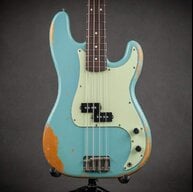
You hit the nail on the head.Sorry, but having been in record wholesale/retail for almost 30 years(in the US), in the 90’s it was reduced to strictly a novelty item, if carried at all at retail. There were no parallel releases of major titles in all formats, in fact cassettes were being phased out at that time as well. As early as 1990, major label title availability on a variety of desired titles, old and new, started drying up.
As that happened, complaints about the situation were very few and far between. Everybody went out and bought a CD player; it became a premium feature for cars.
I worked a lot in new/used situations during that time period, and we would pay next to nothing when vinyl would come in, it was a low priority/rummage sale item. Certain items, like limited edition or promo only items would fetch good money, but that was for the oddball collector/fanatic market.
The ‘revival’ was another round of record company shenanigans. Having finally realized that the pooch was screwed with Napster and all the other downloading, they seized on an underground trend happening in the early 2000’s where DIY punk bands of the time were releasing singles on vinyl as a big “FU” to the majors(a time honored punk tradition)and also just to be weird. As sales of CDs started to slip due to downloading, they jumped on vinyl again as a way to sell your music collection to you all over again, with the typical knee jerk “let’s make something uncool cool again” trendiness factored in, just like how you couldn’t give away Jazzmasters and Jaguars after 1964 untill Costello and Television made them
inversely hip around 1977.
I find this current obsession over vinyl regressive, just nostalgic fetishism, just like the great vintage/tube amp vs Class D or no amp debate here. Vinyl had so many limitations when it was all there was, and when digital came along, I shed not a tear, as did plenty of other people. With “the kids” so focused on downloads, one song at a time, that in itself has destroyed the concept of the album as a complete work of art, maybe even the capacity to enjoy a lengthy collection of music. Album sales are an exercise in trendiness, like wearing a Tshirt of a band you know nothing about and have never heard, just because somebody else said it was cool.
Vinyls are physical objects. People like to own things. I still prefer owning mp3s over using Spotify.
Vinyls can be issued in limited editions for collectors, just like those fancy sneakers.
And since downloading has killed albums, vinyls allow you to put on an album and chill, peruse the liner notes, look at the pictures etc.
I won't speak about the sound quality and mechanical issues of turntables because I've never had one but sound quality is obviously not a priority these days. Mp3s killed that too.
Comparing turntables to tube amps is wrong. Good tube amps sound better than good solid state amps, even when they're perfectly clean. And if they're hand-wired they will last a very long time. I will die on this hill

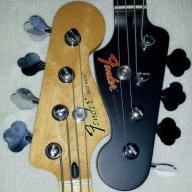
Never got the attraction to vinyl records, the instant CDs arrived on the scene I was sold. No scratches, no pops, no annoying background noise, no needles wearing out. I listened to records for YEARS (first 45 I bought was Proud Mary by CCR), listened to the sound degrade over the life of the recordings, listened to the skipping on a bad pressing and to tell the truth - not impressed.
What I do miss about vinyl is the labels, Capitol and Fantasy (LPs, the singles had a lot of color) with the dark blue background and silver text. Really bugged me when Columbia went from the flat red label to the new '3D' label with the CBS text in the background. Atlantic, classic red and black. ETC.

Why didn't they combine stuff? A compact record player might just fit under the strings of a bass. Sunburst, of course.

I had exactly the same feeling - though I have to say my old CD's tend to sound better than my new ones, no doubt due to the Loudness Wars, and a lot of my new vinyl records sound better than a lot of my new CD's as well.Never got the attraction to vinyl records, the instant CDs arrived on the scene I was sold. No scratches, no pops, no annoying background noise, no needles wearing out. I listened to records for YEARS (first 45 I bought was Proud Mary by CCR), listened to the sound degrade over the life of the recordings, listened to the skipping on a bad pressing and to tell the truth - not impressed.
What I do miss about vinyl is the labels, Capitol and Fantasy (LPs, the singles had a lot of color) with the dark blue background and silver text. Really bugged me when Columbia went from the flat red label to the new '3D' label with the CBS text in the background. Atlantic, classic red and black. ETC.
However, when I returned to the vinyl fold a few years ago, I got a bit of a surprise - my old records sounded much better than they used to. It's probably due to my equipment being better than in the 70's. Now, I'm not an audiophile by any means, but I do like my recorded music to sound good, and to be free from stuff that distracts from the musical experience. I find that this is fairly easy to achieve these days, no matter what the medium, be it vinyl records, CD's or streaming. That being the case, vinyl wins hands down because of the physical playing experience, as well as the album covers (I'm getting too old to read CD booklets with their tiny type). Besides, there's something about going to the record store and buying physical albums.

Fender has taken a look at Harley-Davidson and figured "Yeah, milking that sweet boomer money is where it's at." Absolutely not surprised by the product nor the pricetag.

It doesn't matter... it's a limited edition run. They have all sold out!
I had exactly the same feeling - though I have to say my old CD's tend to sound better than my new ones, no doubt due to the Loudness Wars, and a lot of my new vinyl records sound better than a lot of my new CD's as well.
However, when I returned to the vinyl fold a few years ago, I got a bit of a surprise - my old records sounded much better than they used to. It's probably due to my equipment being better than in the 70's. Now, I'm not an audiophile by any means, but I do like my recorded music to sound good, and to be free from stuff that distracts from the musical experience. I find that this is fairly easy to achieve these days, no matter what the medium, be it vinyl records, CD's or streaming. That being the case, vinyl wins hands down because of the physical playing experience, as well as the album covers (I'm getting too old to read CD booklets with their tiny type). Besides, there's something about going to the record store and buying physical albums.
I've fallen into the Vinyl revival trap and have purchased a few Grateful Dead releases that were special/limited runs.
Only turntable I have here is an old Sansui something or other thats been in the garage for over 2 decades now, and I won't be using that to play these but for Christmas I plan on buying myself a Pro-ject turntable. Just need to clear some space for it.


