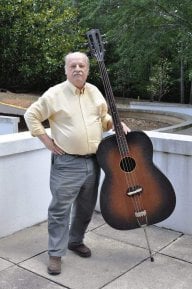
Grizzled old coot (born in '49) chiming in here. I'm going to offer my comments as bullet points, for clarity's sake in response to so many posts.
1) Gibson basses, new from the store, cost more than Fenders partly because of the name and partly because of the workmanship. Gibsons were more artisanal in construction, Fenders more industrial (as per Leo's original intent). In the collector market, the name game has been reversed; Fender on the headstock commands a much higher price than Gibson.
2) Even in the sixties, where I lived (Shreveport, LA) it was much rarer to find a store that did not stock Fender than it was to find one that stocked Gibson. This was by Gibson's intent, based on brand snobbery. It cost a lot to have the Gibson franchise. Now nearly every American manufacturer, including Fender, is playing that game to the extent that very few stores, especially mom & pops, can carry the line.
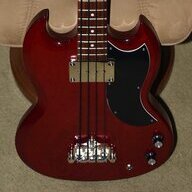
3) The "mudbucker" slam is based largely on the recordings of Jack Bruce with Cream and Felix Pappalardi with Mountain and yes, the EB-3 and EB-1 are both crazy distorted. But by then we were into the era of arena rock and the volume had gone stupid loud in nearly all venues. Run an EB-2 or Rivoli into a B-15 and the result is quite different. Youtube some stuff by the Animals, Yardbirds,
Nashville Teens, Mitch Ryder and the Detroit Wheels, or even the McCoys or the Gentrys and tell me *that* is indecipherable mud.
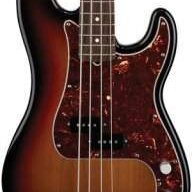
4) Gibson did not promote their basses as much because they had less riding on them. Before Fender even came on the scene, Gibson had a half-century of marketing the full spectrum of stringed instruments, including acoustic and upright electric basses. Fender was going to sink or swim with the Telecaster and the Precision Bass, so of course Fender was going to heavily promote their basses.
5) Both Fender and Gibson (as well as Gretsch and Guild) became trapped by their early successes, in the sense that their vintage-era product became iconic images of the brand. The G-badged makers tried to break away in the seventies and eighties with little success. No new models stayed in the line as long as product introduced in the sixties or earlier, Gibson's EB series basses being the primary example. Fender tried to get away from its heritage into the new and modern with its Heartsfield and HM lines of the early nineties. We know how that ended. People just *expect* certain things if Fender or Gibson is on the headstock.
Only Rickenbacker seems to have avoided taking the bait; there is not a great deal of visual difference between a 2015 Ric and a 1958 4000. Badges like Dillion and Eastwood are making money off credible copies of not only top-tier vintage models, but second and third tier as well (a phenomenon which I think deserves its own thread).
6) Even though when I was growing up, having a Precision or Jazz was the status symbol that you had "made it" as a bassplayer, I was so little that I had to begin with short-scale basses; and that meant Epiphone or Gibson. I was past thirty before I got my first Precision. And even though my most recent bass purchase is a 2013 Mexi-P, I still have a partiality for Gibson-ish basses.
I am an endorser of my own personal checks or those made payable to me.







 Although, I did own two RD Artist guitars from the mid '70s and made some great recordings with them. I also owned, for a very short time, a Ripper that I bought new in '77.