• TalkBass has been independent since 1998. Add your voice.
    Create a free account to reply to discussions, view embedded media, and browse with fewer display ads.
    Join freeLog in
    Want zero display ads or expanded classifieds tools? Compare plans.

Novel take on "dead spots"

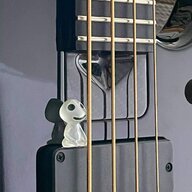
Most of these posts seem to be about adding weight to the headstock. What is missing from the discussion is how much weight and where do you add it. It's not just about adding weight, it's also about enhancing or suppressing vibrational nodes. I have found that with 2+2 headstock basses, the fat)finger works best when placed at twelve o'clock high on the headstock. I found that for four-in-lines, three o'clock, just above the nut produces good results, and that is my default starting point for those type headstocks.

This being said, on one bass the three o'clock position was not getting the job done at all. I walked that fat(finger all the way around the perimeter of that headstock; turns out the sweet spot was at seven o'clock, just below the E tuning machine.

A further revelation was that, as I walked the f)f around, different notes went dead and some became undead. NEVER experienced that before.

And what I have yet to see addressed in any of these dead spot threads is, how tightly do you clamp down the fat)finger? Does the amount of pressure affect the dead spot? It will take somebody with more science than I've got to answer that one.
 
Most of these posts seem to be about adding weight to the headstock. What is missing from the discussion is how much weight and where do you add it. It's not just about adding weight, it's also about enhancing or suppressing vibrational nodes. I have found that with 2+2 headstock basses, the fat)finger works best when placed at twelve o'clock high on the headstock. I found that for four-in-lines, three o'clock, just above the nut produces good results, and that is my default starting point for those type headstocks.

This being said, on one bass the three o'clock position was not getting the job done at all. I walked that fat(finger all the way around the perimeter of that headstock; turns out the sweet spot was at seven o'clock, just below the E tuning machine.

A further revelation was that, as I walked the f)f around, different notes went dead and some became undead. NEVER experienced that before.

And what I have yet to see addressed in any of these dead spot threads is, how tightly do you clamp down the fat)finger? Does the amount of pressure affect the dead spot? It will take somebody with more science than I've got to answer that one.


Always curious about mass placement. Someone suggested approaching it as you would a loaded marimba tone bar.

Riis
 
I've posted it elsewhere, but I have a working theory that 4-in-line headstocks, being asymmetrical, are partially to blame. Different string attachment points, coupled with different string tensions, creating some sort of tiny torsional twist in the neck that introduces things like this.

I'd be interested to hear from anyone with a reverse headstock Fender neck - does the G string still have the dead spot somewhere around frets 5-8? Do new dead spots get introduced elsewhere?
I've read that theory in a different thread (maybe from you, I can't remember).

I was looking at my P and wondering... I wouldn't do it, but wonder if someone ever attempted to modify the headstock so as to bring the G string tuner down, like a MM headstock...
 
I play an Alembic, what are these "dead spots" you speak of...? :whistle: ;)

Seriously though, it amazes me how bad P-basses can sound by themselves yet they're still in such high demand and possibly considered the industry standard because of how they sit in the mix. :thumbsdown:
I suspect things would be different if the dead spots typically occurred on the same frets of the E or A string.
 
That explains why my 1st ever bass, an Ibanez Axstar, a headless 4 string bass, which I strung BEAD for the longest time, never had a dead spot.

i had a warmoth body/moses neck headless bass that a prominent dead spot. right there on 'c' on the g-string. also, a maple thru-neck carvin with a mohogany body, same thing. both of these were 4-stringers.

4 things that have helped mitigate dead spots on my basses: neck bolts with threaded body inserts for bolt-ons, lighter tuners and bridges, 32" scale necks, and tuning to d-standard.
 
  • Like
Reactions: Raman
i had a warmoth body/moses neck headless bass that a prominent dead spot. right there on 'c' on the g-string. also, a maple thru-neck carvin with a mohogany body, same thing. both of these were 4-stringers.

4 things that have helped mitigate dead spots on my basses: neck bolts with threaded body inserts for bolt-ons, lighter tuners and bridges, 32" scale necks, and tuning to d-standard.
I'm looking at something like that presently.

The thing is, I noticed the dead spot after I did a series of operations on the bass. Namely, I changed the tuners, changed the bridge, changed the strings for a different gauge and adjusted the neck tension.
I can't say for sure that the dead spot wasn't there at all before I did all this, but it would have been less noticeable, because it sure jumped right in my face after.

So, I'm going to reverse all of those things. I will play with tension, change back the strings and the bridge, and see with each step if there's any amelioration. If all of that fails to help, I will play with the neck bolts, as you and several others suggest.
 
So, I'm going to reverse all of those things. I will play with tension, change back the strings and the bridge, and see with each step if there's any amelioration. If all of that fails to help, I will play with the neck bolts, as you and several others suggest.

best of luck!

I can't say for sure that the dead spot wasn't there at all before I did all this, but it would have been less noticeable, because it sure jumped right in my face after.

i have traveled that path. seems like once i noticed it, i always noticed it ... maybe even started imagining it! [atoz emoji]
 
  • Like
Reactions: Raman
A design flaw? Maybe, though Status Graphite has been in the game a while. It does, regardless, prove that headless basses can have dead spots.

Of course they can. From Status' own webpage:

Screen Shot 2022-05-11 at 10.14.39 AM.png
 
  • Like
Reactions: Raman
Alright. We all know it’s been over discussed:
The dreaded “dead spot”.

I’ve been blessed for 30 years. I played bass without suspecting the existence of “dead spots”.
My 1st bass was headless. For many years, I strung it BEAD. My next main bass was an Ergodyne 5-stringer. And finally, I’ve mostly played a G&L L-2500. All have been completely free of “dead spots”.

Then, I entered the realm of the P bass. And suddenly, “dead spots” were a thing.

Let’s go over the common knowledge about the phenomena:

-“Dead spots” appear most frequently on the G string, between the 3rd and 7th fret.
-They consist in a note played on that part of the neck that dies prematurely.
-The note at that fret plays softer and dies faster, quickly going into decaying harmonic frequencies.
-A “dead spot” has to do with the bass vibrating in a way that absorbs the fretted string’s frequency.
-Playing the same note on the D string, rather than on the G, will not trigger the same “dead spot”.
-The problem is not confined to a few basses: it’s very common.
-Changing strings (lighter gauge) and neck tension is often mentioned as a solution.
-Adding weight to the headstock is often quoted as a possible solution too.
-Most solutions involve “moving the dead spot” around the neck, rather than resolving it.
-As the theory goes, playing with the weight and mass of the instrument has an effect.

And last but not least:
-Most bassists learn to live with “dead spots”, so should you.
-You don’t need that one note to sustain forever.


I was discussing all of this with a luthier friend of mine. He told me: “Sure! You can also simply hollow out a bit of the bass’ body. Pick somewhere that’s hidden by the pickguard. Take out some mass at the center and you’ll give more relative weight to the headstock. That should move your dead spot

That’s a novel idea... What do you think?

Or, do you have any novel idea about resolving a “dead spot” that’s not been mentioned already?
Two most important items to understand about the famous Fender dead spot(s):

- It is not a quality control problem. It’s simply a design “feature” of the typical FSO.
- Everyone else’s FSO has the same issue as yours does.

That’s an easy way to think about the dead spot in terms of whether to try one of the fixes. And how to keep away the dead spot anxiety disorders if you decide not to, and just enjoy your FSO as-is.

It’s kind of like masturbating - it may make you a little happier for a bit, but it won’t accomplish anything. I usually elect to just play the bass as-is; I’m no worse off than anyone else, at least.

L
 
  • Like
Reactions: Raman
Two most important items to understand about the famous Fender dead spot(s):

- It is not a quality control problem. It’s simply a design “feature” of the typical FSO.
- Everyone else’s FSO has the same issue as yours does.

That’s an easy way to think about the dead spot in terms of whether to try one of the fixes. And how to keep away the dead spot anxiety disorders if you decide not to, and just enjoy your FSO as-is.

It’s kind of like masturbating - it may make you a little happier for a bit, but it won’t accomplish anything. I usually elect to just play the bass as-is; I’m no worse off than anyone else, at least.

L
What does FSO mean?

As for the state of my anxiety... In my original post, I did include the following :
And last but not least:
-Most bassists learn to live with “dead spots”, so should you.
-You don’t need that one note to sustain forever.

I've not been worrying about it since I posted this thread. I've been playing the bass and realizing that it's not really an issue unless I decide to focus on it obsessively.

It may be that the next time I change the strings, or the bridge, or adjust the neck... that it will improve. Or maybe not, we'll see. But I decided I'm not going to try to "fix" it.
 
  • Like
Reactions: Lobster11
I've not been worrying about it since I posted this thread. I've been playing the bass and realizing that it's not really an issue unless I decide to focus on it obsessively.

I find that a lot of issues which plague the minds of bass players really exist only in our own heads, when the only thing we should really fixate on, is playing, and improving as players. I find when you do that, most all else falls into line without even consciouly thinking about it (aside from major technical failures, like a busted truss rod or a fried amplifier or something likewise extreme.)
 
  • Like
Reactions: Raman