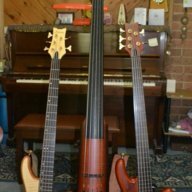
My advice is to try out teachers, with a focus on those who'll work remotely. Zoom, pre-recorded video, whatever you're both willing and able to work with. Live is better, because the feedback loop is tighter, but pre-recorded is still more effective than trying to figure it out for yourself.My problem comes when I cross the strings with bow. Most of the time I make contact with the adjoining strings.
In different times, I would probably try to find a teacher but that isn’t on my agenda right now.
I am also a little worried that a teacher might have a lot of bias towards these instruments.
Some people absolutely do have bias against these instruments, including a few on this forum. However, not all do; my teacher is one of those that don't.
What timezone are you in? If you have good enough overlap with Amsterdam's evening, I can check whether he has space in his roster.
General advice, from my own experience with the same issue:
Make sure the bow is actually perpendicular to the strings; it's easy to let it droop when you're focused on other things, and that really doesn't help with this. PORA can be helpful here, where you focus on different things in turn instead of trying to fix everything at once.
Try bowing further down towards the bridge, where the strings are further apart. This also helpfully reduces the difference between bowing open strings and bowing fingered/fretted notes. The latter used to give me trouble, by reducing the height between the string of interest and its neighbours.
Lastly, I can recommend a boringly simple exercise that's worked pretty well: leave the left hand out of it, and just bow open notes, moving from one string to the next. Work down from G/C to E/B, then back up again. Once you have that nailed, move on to fretted notes in the lowest register you can sustain, where the height-difference between open and fretted strings is least.