I think the 19mm thing may have a bit to do with it, though the Zons with full-width spacing don't actually sell any faster or for more cash. I think is there something to be said for that argument, since it tends to be that adults who buy more expensive basses like 19mm, and narrower spacing tends to be associated with cheaper instruments and a younger crowd, but based on the numbers I've kept there is only a very, very weak correlation between spacing and resale. (Yeah, I've actually kept numbers on this...)
I don't think it's the adjustment rod thing, either. People wonder about it, but they tend to sell anyway. I have a theory that that may be why a certain Zon has been resold here (for increasing prices each time) over and over and over, but the basses that have adjustment rods are newer, and "new" was only mildly correlated with resale.
If anything, I think the strongest factor in the low resale is the price bracket. Stuff in the $3000-5000 range just has terrible resale, unless you are Ken Smith or a high-end Jazz bass. These all tend to go for less than $2000, and the ones that are above only really sell because they are a rare model or have rare features, and they take forever (see for example, Oteil Burbridge Modulus).
Get above that price range, and stuff suddenly has resale power.
I've started to keep a running data set on Alembics, because they are the weirdest example. Sometimes they go for really cheap, and sometimes the 20 year old cheap models still sell for $3000.
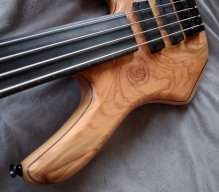
Yeah, they're made the same way. His bubinga-topped Sonus "Hyperbass" a regular fingerboard, but since it's pretty old it was built before they started using the phenowood with the woodgrain-like pattern on it. Most old Zons have fingerboards that look like that. My '92 Sonus looks like it has a jet black ebony fingerboard, but it's the same material as they are using currently.
His actual Hyperbass has a black lacquer finish on it, which you can still order today (mine has it, too). He doesn't do it standard anymore, though, because he thinks the tone of the unfinished board is more attractive. This finish will make the fingerboard look jet black even with the current grain-appearance phenowood.
I don't think it's the adjustment rod thing, either. People wonder about it, but they tend to sell anyway. I have a theory that that may be why a certain Zon has been resold here (for increasing prices each time) over and over and over, but the basses that have adjustment rods are newer, and "new" was only mildly correlated with resale.
If anything, I think the strongest factor in the low resale is the price bracket. Stuff in the $3000-5000 range just has terrible resale, unless you are Ken Smith or a high-end Jazz bass. These all tend to go for less than $2000, and the ones that are above only really sell because they are a rare model or have rare features, and they take forever (see for example, Oteil Burbridge Modulus).
Get above that price range, and stuff suddenly has resale power.
I've started to keep a running data set on Alembics, because they are the weirdest example. Sometimes they go for really cheap, and sometimes the 20 year old cheap models still sell for $3000.
I had the opportunity to see Michael Manring's ZONs up close at a clinic this summer and the fingerboards on his hyperbasses do not seem to have the phenowood grain that my ZONs have. I just wondered if they are made the same way? Does anyone know?
Yeah, they're made the same way. His bubinga-topped Sonus "Hyperbass" a regular fingerboard, but since it's pretty old it was built before they started using the phenowood with the woodgrain-like pattern on it. Most old Zons have fingerboards that look like that. My '92 Sonus looks like it has a jet black ebony fingerboard, but it's the same material as they are using currently.
His actual Hyperbass has a black lacquer finish on it, which you can still order today (mine has it, too). He doesn't do it standard anymore, though, because he thinks the tone of the unfinished board is more attractive. This finish will make the fingerboard look jet black even with the current grain-appearance phenowood.