If you have an amp that has both 8 and 4 ohm options and you run two identical 8 ohm cabs , does the amp push 8 ohms or 4?

TalkBass has been independent since 1998. Add your voice.
Create a free account to reply to discussions, view embedded media, and browse with fewer display ads.
Join free Log in
Want zero display ads or expanded classifieds tools? Compare plans.


Amps do not "push" ohms. Ohms is measurement of the resistance to current flow (in this case how much your cabs hooked up "resist" current from the amplifier). The numbers on your amp is how much power the amp can push at a given resistance. If the resistance of your cabs is too low for the amp, the amp will flow too much current and be in danger of burning out.If you have an amp that has both 8 and 4 ohm options and you run two identical 8 ohm cabs , does the amp push 8 ohms or 4?
Is this a tube amp (likely to have options for different speaker impedances) or solid state (which usually won't have a way to select impedance)?If you have an amp that has both 8 and 4 ohm options....

I modded my amps to use Siemens instead. No problem.

Fenders are more tolerant than Marshall’s.for example. A tube amp will prefer a 6 inch nail as a load as opposed to open circuitIs this a tube amp (likely to have options for different speaker impedances) or solid state (which usually won't have a way to select impedance)?
If it's a tube amp, it's best to match exactly. Some tube amps tolerate a mismatch, others could be damaged.
Amps do not "push" ohms. Ohms is measurement of the resistance to current flow (in this case how much your cabs hooked up "resist" current from the amplifier). The numbers on your amp is how much power the amp can push at a given resistance. If the resistance of your cabs is too low for the amp, the amp will flow too much current and be in danger of burning out.
The tricky part is adding cabs. Adding two 8 ohm cabs in parallel actuallly reduces the resistance (ohms) the amp sees by half. So two 8 ohm cabs in parallel (by far the most common way cabs are attached) gives you a 4 ohm load seen by the amp. Adding two 4 ohm cabs to an amplifier will result in the amp seeing a 2 ohm load. This will be too low for most of the amps available on the market.
If you have an amp that has both 8 and 4 ohm options and you run two identical 8 ohm cabs , does the amp push 8 ohms or 4?
Yes, just trying to keep it simple for the OP.Just to be pedantic, change the word resistance to impedance, and you have a great post.
Both resistance and impedance are measured in ohms, but resistance does not vary with frequency.
Impedance is a combination of resistance and reactance. The reactance can be capacitive, inductive, or both. Because of the reactance, impedance varies with frequency.
As an example, here is the frequency response and impedance curve of an Eminence 2512.
View attachment 5068249
This is an 8 ohm driver, but notice the impedance is not fixed at 8 ohms. 8 ohms is the nominal impedance (Znom).
AFAIK Eminence does not post minimum impedance (Zmin) specs. My guess is it's in the range of 6.5 ohms to 6.6 ohms.
Per the spec sheet, the resistance (Re) of the 2512 is 5.17 ohms. So the Zmin is a bit higher than Re.

That Ohms Law wheel would make a bitchin tattoo. I'd remove the words and just keep the letters and symbols...In general, solid state amps try to hold the voltage constant regardless of the impedance.
Here is the AC Ohm's Law Formula Wheel
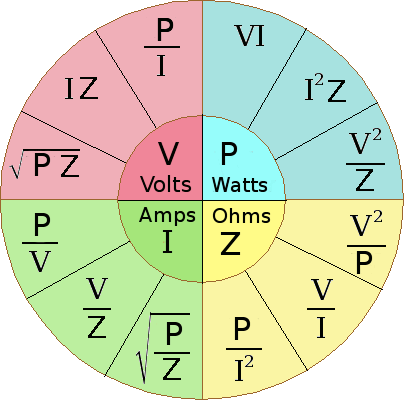
If you know Voltage and Impedance, the relevant formula for Power is
P = (V^2)/Z
The formula indicates that if V stays constant and you decrease Z, the power goes up.
Let say V = 20V
If Z = 8 ohms
P = (20^2)/8 = 50W
If Z = 4 ohms
P= (20^2)/4 = 100W
So if the amp can hold the voltage constant, the power doubles when the impedance is cut in half.
Tube amps work a bit different. They use a transformer that matches the high impedance of the tubes to the low impedance of the speakers. The idea is the amp will make the same power as long as you show it the expected load.
If you have 100W amp with 4 and 8 ohm output taps, the transformer will change the voltage and current so you get 100W at either 4 or 8 ohms.
We already figured that we need 20V for 100W at 4 ohms.
To figure out the current let's use
I = sq rt (P/Z)
I = sq rt(100/4) = 5A
To confirm these results give us 100W
P = V x I
P = 20 x 5 = 100W
To figure out the voltage for 100W at 8 ohms we use:
V = sq rt(PZ)
V = sq rt(100 x 8) = ~28.84V
Now we will find the current.
I = sq rt(100/8) = ~3.54A
The proof
P = ~28.84 x ~3.54 = ~100W.
I used "~" to mean approximate values because I rounded the answers. If you use all of the digits for the calculation, you get exactly 100W.
Summary for 100W Tube Amp:
Impedance: 8 ohms
Voltage: ~28.84VImpedance: 4 ohms
Current: ~3.54A
Power: 100W
Voltage: 20V
Current: 5A
Power: 100W

Minimum impedance of a speaker is cabinet dependent. Actually, impedance of a speaker in general is cabinet dependent below ~500Hz.Just to be pedantic, change the word resistance to impedance, and you have a great post.
Both resistance and impedance are measured in ohms, but resistance does not vary with frequency.
Impedance is a combination of resistance and reactance. The reactance can be capacitive, inductive, or both. Because of the reactance, impedance varies with frequency.
As an example, here is the frequency response and impedance curve of an Eminence 2512.
View attachment 5068249
This is an 8 ohm driver, but notice the impedance is not fixed at 8 ohms. 8 ohms is the nominal impedance (Znom).
AFAIK Eminence does not post minimum impedance (Zmin) specs. My guess is it's in the range of 6.5 ohms to 6.6 ohms.
Per the spec sheet, the resistance (Re) of the 2512 is 5.17 ohms. So the Zmin is a bit higher than Re.