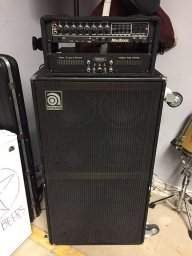
Oh yeah, for sure. The real rabbit hole is when they try to figure out which one sounds better!Never given it much thought, but off the top of my head the latter case has a disadvantage: if one driver fails, it takes the other of its series pair off the circuit, while (if I'm not mistaken) all three remaining speakers would keep working in the former wiring.

Enjoy the benefits of a premium membership!
Upgrade Account
-
TalkBass has been independent since 1998. Add your voice.
Create a free account to reply to discussions, view embedded media, and browse with fewer display ads.
Join free Log in
Want zero display ads or expanded classifieds tools? Compare plans.
You are using an out of date browser. It may not display this or other websites correctly.
You should upgrade or use an alternative browser.
You should upgrade or use an alternative browser.
Ohms and Watts. Sorry. Really sorry.
- Thread starter bassistheplaceofcourse
- Start date
More options
Who Replied?
I'll suggest the use of the term "underpowering" to mean putting the amp on the floor, and the cabinets on top. That way we can have a term that makes sense, and a discussion about it. My position: It won't blow your speakers, but as this can disrupt cooling, it might hurt the amp.
Discuss.....
Discuss.....


Sound is a hearing mechanism's interpretation of external air presure changes, and as such only exists if there is a hearing mechanism present ie attached to something living. If there is no one there to perceive the vibrations in air as sound then they are just vibrations. Possibly good vibrations, although not for the tree.
From the dictionary....
"vibrations that travel through the air or another medium and can be heard when they reach a person's or animal's ear."
Note the phrase "can be heard". In other words, any vibration that can be heard is a sound. It doesn't have to have already been heard before the term "sound" is applied. If a tree falls in the woods, it makes a sound that "can be heard" if someone were there to hear it, whether that someone it there or not.

We call that someone who needs to buy a new amp. That clipping will not, all by itself, destroy the high-power handling speaker. And *that's* why underpowering is myth.So what do we call this then: an inefficient/high-power handling cabinet being driven by a low-powered amp that clips before it produces usable volume with that speaker?
D
Deleted member 165050
Guest
From the dictionary....
"vibrations that travel through the air or another medium and can be heard when they reach a person's or animal's ear."
Note the phrase "can be heard". In other words, any vibration that can be heard is a sound. It doesn't have to have already been heard before the term "sound" is applied. If a tree falls in the woods, it makes a sound that "can be heard" if someone were there to hear it, whether that someone it there or not.
I'm going to disagree with the dictionary... until it's heard by someone, it's just vibration... it's being heard that makes it sound. That's why vibrations outside of the hearing range are just vibrations. I thinking of studying pedantry for my old age hobby


Sweet rigGK MB500, supplying 250 watts evenly into two Neo 212 II cabs rated at 600 watts each...
View attachment 1097643
... I didn't even have it at 1/4 power, and my shot glasses were doing the 'electric football player' dance, atop their perch...
... if this is 'underpowered', I can assure the wife the south wall of our walkout will remain intact...
... for now.
I'm going to disagree with the dictionary... until it's heard by someone, it's just vibration... it's being heard that makes it sound. That's why vibrations outside of the hearing range are just vibrations. I thinking of studying pedantry for my old age hobby
Just because YOU can't hear them, that doesn't mean they aren't heard. Sounds outside of the human hearing frequency range are still sounds. My wife can hear sound I can't. (Or at.least she sends me.out into the woods looking for thing she heard and I didn't.) So does that mean the sounds she heard are both sounds and "just vibrations" at the same time because she heard them and I didn't? Or is the "rule" as long as one human hears it its a sound?


I don't even think they are vibrations. Even the concept of vibrations need human minds to perceive of them. However, any wooded area will have some fauna with ears, so the waves are heard by something. The question is no different functionally than "does anything exist outside of conscious perception"? I would claim there is not, since the limits of the universe are the exact same as any one person's perception of it. Even the most enlightened astrophysicist has a finite limit on how he perceives the universe, which is functionally infinite. And that limit defines for everyone what the universe is.I'm going to disagree with the dictionary... until it's heard by someone, it's just vibration... it's being heard that makes it sound. That's why vibrations outside of the hearing range are just vibrations. I thinking of studying pedantry for my old age hobby
Sorry, I waked and baked this morning.


THERE IS NO SUCH THING AS UNDERPOWERING CABS.I've looked at the amp FAQs, and tried to search. Sorry to ask something that seems basic, but I'm just looking for a simple confirmation here.
If my amp output is 250W @ 4 ohms, and I daisy chain two 8 ohm 300w power handling cabs, do I have two cabs each getting 125W? Or effectively one larger combined cab getting 250W?
I just trying to make sure I would not be underpowering the two cabs.

Whoa. I can't even begin to fathom the variables involved in determining the answer...Oh yeah, for sure. The real rabbit hole is when they try to figure out which one sounds better!
An addendum to the failing driver scenarios: while it's true that in the case of two parallel pairs in series the remaining three would go on making sound (assuming same impedance for all 4 drivers, the total impedance of the cab would go up 50%, and the power received down), the parallel companion of the broken one would become a weak link, suddenly getting more power (double the watts the other pair would receive, which itself would be less than before the failure) and potentially also croak: this, in turn, might cause shutdown or failure of the amp, depending on its operating specs and the presence of (an)other cabinet(s), because the half-working cab would now present half the original impedance.
All of which gets even more complicated if the amp has an output transformer (that is to say, in the overwhelming majority of cases, a valve amp)...
So two parallel pairs in series is safer for performance's sake (a cab with one failed driver would make more noise than if it had the other possible wiring) but riskier for the whole system.

Al Kraft
Supporting Member
- May 2, 2016
- 10,768
- 40,440
- Disclosures
- Mesa Boogie beta product tester and player support
...or else you'd blow speakers every time you turned the volume down before shutting your amp off, or worse yet after you turned the amp off - the ultimate "under-power condition".THERE IS NO SUCH THING AS UNDERPOWERING CABS.
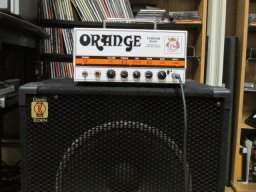
Daisy chaining is simply linking amp to cab then cab to another cab.
Electrically it is the same as using the twin outputs on the amp aside from the one jack and cable carrying double the power when daisying. With a 500w amp that is getting significant with 1/4" gear.
so it is better from a cable power load point of view to use 2 cables, both from the back of the amp, 1 to each cab....makes sense, I'll do that from now on...I've always heard, as stated here and elsewhere either option is fine
..I just never made the leap that the 1st cable in the chain is dealing with the full load.

I always thought 'Ohms & Watts' was a law firm, in downtown Cincinnati...
(tag line)... "If you have met up with some resistance in your life, we have the power to help!".
Please, don't drink and drive, and don't forget to tip the waitstaff...
"....and be sure to try the Veal"....

Sweet rig
Thanks, D! The shot glasses are pretty sweet, too... as long as they stay in place.
Al Kraft
Supporting Member
- May 2, 2016
- 10,768
- 40,440
- Disclosures
- Mesa Boogie beta product tester and player support
I think you could make that argument within a specific context, however, typically "sound" is something differentiated from the rest of the EM spectrum as "requiring a medium through which to propagate". Ultrasound is great example of something that can be proven to be present, propagating, and detectable via the right combination of sensors and processors - and your ears and brain don't qualify as the right equipment to hear/detect "sound" in this frequency range.until it's heard by someone, it's just vibration... it's being heard that makes it sound.

That's not "daisy chaining" them, that's plugging them into the back of your amp. Daisy Chaining is plugging one speaker cab into the amp and then plugging second cab into the first cab. With very few exceptions, the result is the same because the standard connectors on amp outputs and also on cab outputs are parallel connection. Not always though as I have an old Sunn cab that has both parallel and serial ouputs. That's very unusual.My amp has two outputs. I plug the two cabs into them.
So plugging them both into your amp, or plugging one into your amp and the second one into your first speaker cab, is going to result in a 4 ohm load on your amp regardless of which way you hook it up.

So what do we call this then: an inefficient/high-power handling cabinet being driven by a low-powered amp that clips before it produces usable volume with that speaker?
Oh, I get it now! This is called "an over-speakered amp"!


