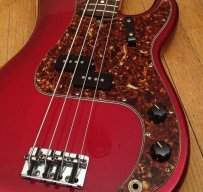
dissimilar pickups mixed V/V/T will always cause greater or lesser undesirable artifacts. Usually, the controls are simply unusable, as they are in the archetypal P/J, the Fender HRPB.
Ok, I could swear I've seen you say this in about five threads over the past few days.

Redundant threads get the same answer. That's my story and I'm sticking to it.
VVT is the most common way to wire a PJ.
I'm aware of that and I'm also aware that it usually works like ****, too, whether or not it's bad enough for the player to recognize the problem or not.
If the pickup qualities are such that they will mix with fewer gross artifacts you may not immediately notice the problem, but it's there to some degree, effing-up the sound of the individual pickups with a bunch of peaks and cancellations. This is one of the two reasons why people who take P and J bass sound seriously
hate P/Js, the other being that P/J pickup sets are typically so bastardized in the attempt to narrow the output differential that they screw up the individual trademark sounds of the originals.
In some cases, like the HRPB, the volume controls just flat won't work in tandem except full-on/full/off. There's nothing different about the HRPB's wiring, it's just that the particular set of pickups (unique to the HRPB) are are among the worst available for this mix function.
For a P/J to really work in sounding like a P and a J , you have to do this:
Get the best pure Precision pickup you can find.
Get the best pure Jazz bridge pickup you can find.
Wire them to a
switch and a single V/T pair.
Forgo the geekly mixing obsession.
Accept the differences in output.
Play the bass as a P
or a J, accepting the P+J third switch position as a crapshoot that probably won't sound that great.