• TalkBass has been independent since 1998. Add your voice.
    Create a free account to reply to discussions, view embedded media, and browse with fewer display ads.
    Join freeLog in
    Want zero display ads or expanded classifieds tools? Compare plans.

Phil Lesh Appreciation Society: Enter the Philzone...

Status
Not open for further replies.
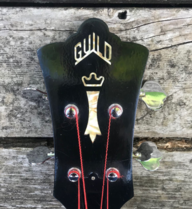
To be more specific... I have always been partial to the sound of "The Godfather" Guild Starfire bass he used on Europe 72 and that was the sound I was always looking for.

But I really dig the Modulus sound as well.
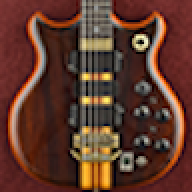
Yes, I liked that sound as well, those basses sound great to this day at much lower volumes than the bands began to perform at. I dig graphite necks, but I prefer wooden basses myself.

The graphite necks really helped the GD achieve the kind of live hi fi control they were searching for, especially with Owsley's wall of sound....the bass being the fulcrum of the band meant that every note needed to be evenly heard as well as felt.. with crisp harmonic content, in any venue.

 
The graphite necks really helped the GD achieve the kind of live hi fi control they were searching for, especially with Owsley's wall of sound....the bass being the fulcrum of the band meant that every note needed to be evenly heard as well as felt.. with crisp harmonic content, in any venue.

The first graphite-necked basses weren't made until a few years after the wall of sound had been retired but I do agree about the bass being the fulcrum of the Dead's sound and that there was on ongoing quest to make sure the bass could be heard clearly (and felt) in any venue.
So much of the technology for what is now considered standard sound reinforcement was pioneered by the Dead and their affiliates.

Rick Turner told me 10 years ago that he still felt the bass reproduction of the wall of sound was the best he had ever heard.
 
The first graphite-necked basses weren't made until a few years after the wall of sound had been retired but I do agree about the bass being the fulcrum of the Dead's sound and that there was on ongoing quest to make sure the bass could be heard clearly (and felt) in any venue.

That's right, the graphite neck was the next evolution in the search for the perfect bass sound..those guys were exploring lots of possibilities. Once Phil moved to 6 strings, the graphite made even more sense for experimenting with tonal possibilities of the extended range. It seems that graphite has become much more common as a material integrated into instrument building now. It's more common to encounter a wooden bass neck with graphite reinforcement rods than a solid graphite neck shaft. I'm not sure if a wood board on a graphite neck makes a lot of tonal difference (prolly some), but the ones I've played with wooden boards felt better under the fingers than the early graphite necks.

 
That's right, the graphite neck was the next evolution in the search for the perfect bass sound..those guys were exploring lots of possibilities. Once Phil moved to 6 strings, the graphite made even more sense for experimenting with tonal possibilities of the extended range. It seems that graphite has become much more common as a material integrated into instrument building now. It's more common to encounter a wooden bass neck with graphite reinforcement rods than a solid graphite neck shaft. I'm not sure if a wood board on a graphite neck makes a lot of tonal difference (prolly some), but the ones I've played with wooden boards felt better under the fingers than the early graphite necks.

The early graphite basses I've played felt great. The first ones were collaborations with Alembic in the mid-70s and there was a high end bass shop in Boston on Boylston St. for a while that had a few of them. They were way past my budget as a high-school kid, but I used to love going in there to play them. Looking back on it, they were very generous to let me do that considering I had no skills and no chance of buying one.

I wonder how it would sound to put graphite reinforcement into a Starfire. I've thought about getting an ebony board for my Starfire and that would be the time to do it, but I'm kind of at the "if it ain't broke" point with it these days. My favorite tone of Phil's Starfire was late '72 and it still had the original rosewood at that point.

I also think that the bass was always a point of interest for the band. There are descriptions of the very early days where they had a huge rubber subwoofer they got from some guy who made them in Oakland for DJs. It pretty much only reproduced one note but gave a lot more low end than any of the other bands had back then.
 
I'm really liking the tone with the Q-tuner pickups.
Hey folks,
Great thread. So I have been emailing back and forth with Erno from Q-tuners and have been told that, "The production of neodymium Q-tuners has been discontinued because we couldn't cope with the increase in demand for the product. A new production line is under construction."
He went on to say,
"I can't remember which Q models Phil is using, in fact, he contacted me last year to order another set. I'll keep you updated."
and then sent this:
"Phil uses Matched pair BL-6 Q-tuners."
Looks like they are a few months off from the new line coming out. I found Phil using a completely passive system to be interesting, being he was one of the pioneers with active electronics. That being said the Q-tuners are said to be "State of the Art", so perhaps that is why Phil checked them out.
On another note, I play in a Grateful Dead tribute band, had the whole Eden thing going on and recently switched to a GenZ Benz Stuttlemax 9.2 with a Fearless F215 Slim built by
Mark "Duke of Rock" Robertson of BNA Audio, whose name I got from the Greenboy.us speaker enclosure site. This is truly THE best sounding rig I have owned to date.
Still trying to figure out what strings Phil is using? I know about the flats, the half-rounds and the slicks of past years, but just wondering what he is currently using. I heard nickel rounds. Peace.
 
Well, if you were going to fix something that ain't broke on the Starfire, you could start by hot rodding the electronics.... adding some magnets to the bottom of the pickups (assuming they are the originals with the black covers), and some active electronics that didn't require carving the instrument up. Tearing off the original fingerboard sounds kinda scary...not to mention the cost!
 
Well, if you were going to fix something that ain't broke on the Starfire, you could start by hot rodding the electronics.... adding some magnets to the bottom of the pickups (assuming they are the originals with the black covers), and some active electronics that didn't require carving the instrument up. Tearing off the original fingerboard sounds kinda scary...not to mention the cost!

LOL! You obviously haven't seen Edwin's Starfire, have you!:D
 
"Phil uses Matched pair BL-6 Q-tuners."
Looks like they are a few months off from the new line coming out. I found Phil using a completely passive system to be interesting, being he was one of the pioneers with active electronics.

I definitely prefer active mode with my BL-4s, FWIW.
 
LOL! You obviously haven't seen Edwin's Starfire, have you!:D

No....but I just to a look at it on his web page!:D Very cool.

Now, I did have a bass with a broken truss rod once, and since the board was coming off any way for the repair, I had graphite rods added. It was an expensive repair, adding the graphite rods was tricky I was told. It's hard to tell if the rods made a big difference, because the new truss rod is much more substantial than the old one. I will say that the neck is much stiffer, and more stable than it had been previously, and I love it!:)
 
Still trying to figure out what strings Phil is using? I know about the flats, the half-rounds and the slicks of past years, but just wondering what he is currently using. I heard nickel rounds. Peace.

He is not using nickel rounds currently. I was at Terrapin Crossroads this past summer for one of shows in the Grate room and there was a meet and greet and I specifically asked him what strings he uses and I said "Roundwounds?" and he said pondered for a moment and "they are strings from a company in *Germany, they are in between" and I said "Like halfrounds?" and he said "there you go". I'm surprised he just didn't say "halfrounds" and instead said "in between".

*I think Germany was the country he mentioned. If not, somewhere in Europe.
 
He is not using nickel rounds currently. I was at Terrapin Crossroads this past summer for one of shows in the Grate room and there was a meet and greet and I specifically asked him what strings he uses and I said "Roundwounds?" and he said pondered for a moment and "they are strings from a company in *Germany, they are in between" and I said "Like halfrounds?" and he said "there you go". I'm surprised he just didn't say "halfrounds" and instead said "in between".

*I think Germany was the country he mentioned. If not, somewhere in Europe.

Yep, that seems to confirm Ritters, which is what I've heard as well (and mentioned earlier in the thread). Maybe someone should email Jens Ritter and ask him. Whatever they are they're not nickel rounds, that's for sure - Ken Smith Slick Rounds do a fine job for me.
 
I think he mentioned "Ritters" now that I think of it. Are Ken Smith Slick rounds similar to Ritters half rounds?


I've never used any of Ritter's string sets, but the Slick Rounds are a groundwound (like D'Addario Half Rounds). About any groundwound will get you close, but I prefer the Ken Smiths to the D'Addarios. GHS also makes Brite Flats - I've read here on Talkbass that GHS makes Ken Smith Slicks, they're just rebranded (and one has a tapered "B" string and one doesn't), and SIT makes Power Flats - all groundwounds. I want to grab a set of the SIT's to try with my next string order since they're a local company. Compression wounds are a similar flavor as well - Ken Smith Compressors, SIT Silencers, GHS Compression Wound, etc. - all will do a better Phil than rounds.
 
Well, if you were going to fix something that ain't broke on the Starfire, you could start by hot rodding the electronics.... adding some magnets to the bottom of the pickups (assuming they are the originals with the black covers), and some active electronics that didn't require carving the instrument up. Tearing off the original fingerboard sounds kinda scary...not to mention the cost!

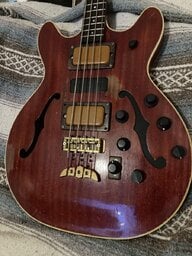
You mean like this? :hiding:
 

Attachments

  • IMG_1770exp.jpg
    IMG_1770exp.jpg
    54.4 KB · Views: 358
  • Like
Reactions: Bassman8416
Status
Not open for further replies.