• TalkBass has been independent since 1998. Add your voice.
    Create a free account to reply to discussions, view embedded media, and browse with fewer display ads.
    Join freeLog in
    Want zero display ads or expanded classifieds tools? Compare plans.

Physics behind "growl"

Pickup placement and wood.
The Thumb build has the pickups very close to the bridge which gives them a lot of mid range and articulation. The active pickups themselves compress certain frequencies that would normally be considered "clanky".
Then you have a very dense body. People will argue until dooms day about tone wood, but I 100% believe in it. I have two identical Spector basses, except for the body wood. Even the drummer in my band can hear the difference between them. Anyway, that dense wood also rolls off that clanky tone, accentuates the low mids, and adds a glassy sheen to the highs. Choice of neck woods impacts the tone a little, and the bell brass frets add to the snappy articulation.
 
Is there a program/utility/device that you can use to assist with this?
The example of employing a filter based preamp is an extremely powerful method of directly altering an instruments observed tonal character.

But it is not always a good choice. Every player and bass is different. Aguilars are great preamps in the right bass/player. Just like Wicks arent for everyone.
ie: I cant play a Ric.
ie: everyone wants a Wal. Then when they get one they realize that manipulating that type of pre takes some thoughtful consideration.
Its like a box of chocolates
 
  • Like
Reactions: BigThumps
Pickup placement and wood.
The Thumb build has the pickups very close to the bridge which gives them a lot of mid range and articulation. The active pickups themselves compress certain frequencies that would normally be considered "clanky".
Then you have a very dense body. People will argue until dooms day about tone wood, but I 100% believe in it. I have two identical Spector basses, except for the body wood. Even the drummer in my band can hear the difference between them. Anyway, that dense wood also rolls off that clanky tone, accentuates the low mids, and adds a glassy sheen to the highs. Choice of neck woods impacts the tone a little, and the bell brass frets add to the snappy articulation.

This is the way!

I like that you mention "even the drummer can hear it".
It must be true
 
  • Like
Reactions: socialleper
Scoop the mids....
....go to jail.
:bassist:

Good thread, too bad the OP did not specify what type of growl we are talking about here.
Also, kinda mind-boggling that a lot of people talk about the setup here - I get it, but I do not think this is the case with Wicks. Fretless wicks growl for days as well and they got no frets to fret over, for example... as it was mentioned above.

Eh.
:rolleyes:
 
  • Like
Reactions: Lardass5000
I did not read the entire thread but I would put to you that some may be ascribing “growl” to what I call “rasp”.
Rasp=controlled fret buzz, low, action and the players ability to control it…

Growl=In part is pickup placement, cut/boost ranges, overtones and player technique. To me it’s a combo of low end grit (overdrive) and some top end sheen.

Sorry if this has been mentioned already.
 
  • Like
Reactions: BlueTalon
The example of employing a filter based preamp is an extremely powerful method of directly altering an instruments observed tonal character.

But it is not always a good choice. Every player and bass is different. Aguilars are great preamps in the right bass/player. Just like Wicks arent for everyone.
ie: I cant play a Ric.
ie: everyone wants a Wal. Then when they get one they realize that manipulating that type of pre takes some thoughtful consideration.
Its like a box of chocolates
Can you recommend anything? I'm pretty new to base and still chasing my sound. Never heard of a filter-based preamp. Assume it is likely on-board, but I have a passive bass. Any suggestions?
 
So warwicks are known for their "growl" (especially the thumb), but I want to know is what causes that sound, and why it doesn't sound, say like a jazz bass, I mean they've got the same pickups, what separates a Thumb BO4 from an American Professional Jazz.
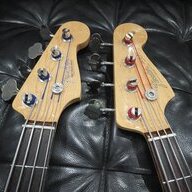
I'm not sure of the physics behind it but with my passive '82 Jazz all I have to do is dig into the strings over my Bridge pickup. My '82 certainly growls more easily than my '65 did (bought in '66 stolen in '76, toured with it for 3-years in the early 70's). My '82 has a couple of differences from my Jazz. It has the 70's era pickup spacing of 4" center to center instead of the 60's and current spacing of 3.6" center to center. The difference in the spacing is that the bridge pickup is .4" closer to the bridge. Overall it has a slightly brighter sound than my '65 did.

It also has an all-maple neck, which might give it a touch more brightness too, but I really attribute that all maple neck for the better sustain than my '82 has compared to the sustain my '65 had with the maple neck and rosewood fretboard.

One other thing that might come into play is that I optimize my gain before playing. I use DNA and Eden amps, which were both designed by David Nordschow and the gain works almost identically. I set the gain so my "set level" light, as its called on the Eden WT and the DNA amps, flashes at my loudest, lowest notes. My Eden TN226 calls the same light a clip light for the gain. Here's what David says in his WT500, 600, 800 amp manual about it:

Set Level Indicator –
Lights to indicate
that the preamp is sitting right on the sweet
spot of the gain balance and is at optimum
signal to noise as well as best overall head
room.
Digging into the strings above the bridge pickup really does set that light to dancing and my sound to growling! I'm guessing that might be pushing the gain to where the signal has some slight distortion or break-up on it? These amps are otherwise have a crystal clear and clean sound. It can't be the tube in the Eden hybrid amp though because the tube is in the impedance matching section, not in the gain section. And it does that with all my class D Eden amp as well as my DNA class D amp.

I'll let you guys figure it out, but that's I how trigger the growl in my passive '82 Jazz with the 70's era pickup spacing.
 
Contrarian voice here. I don't think growl has anything at all to do with pickup location, or the angle of the pickups. I don't think it has anything to do with fret buzz (I would call that more "grit" than "growl" -- but then we start getting into subjective descriptive vocabulary, which can get messy to pin down). In my experience, it has to do with how hard the strings are being manipulated. I don't know why that is, which is why the thread title attracted my attention. But to demonstrate my point, I'll link a couple of audio clips from a recording from a few years ago. In both clips, the bass being played is my passive 3-pickup jazz currently in my avatar (not the P bass in the SoundCloud photo). I used no effects, and plugged straight into the board. In the first clip, I played normally, although the bass sound gets a little weird in this clip because the strings were getting grippy in the middle of that song.


The day this second song was recorded, I noticed that my strings were more worn than I like. I would have changed them, but I didn't want to deal with strings stretching and going out of tune in the middle of the song. So I didn't change them. To compensate, I pounded the ever-loving snot out of the strings as I was playing (fingers). That's the difference between the two clips. Same bass, probably the same strings, same board, same player, different day.

This-Paul.gif


That second sound snippet is what I consider growl - Bass sounds GREAT on that @BlueTalon . First snippet has the bass too low in the mix for my taste and I don't detect any of the growl that you got on the second one.
 
Thanks for posting this!
While I agree that there is fret noise, I hear OD as the bigger component of growl is this example.
We have differing definitions of growl. I don't call that sound snippet growl. I call the second snippet of @BlueTalon's post (post #23) growl. Play that next to the one from @Chickenwheels post (#21) and they are, at least to my ears, vastly different sounds.
 
Can you recommend anything? I'm pretty new to base and still chasing my sound. Never heard of a filter-based preamp. Assume it is likely on-board, but I have a passive bass. Any suggestions?
Read Rip Van Den and Sociallepers posts first.
Filter based preamps are a bit down the road. Get other basic stuff tuned up first. I had been playing bass 38 years before I really got into them. An example is Lusithand/ Wal/ Alembic.
 
  • Like
Reactions: mrperkolator
It depends on what you call Growl. There are 2 types.. A Warwick will give you low down growl but thats its natural tone. Or the growl that comes from a certain height of the strings from your frets. Its a physical attack nuance from your fingers. A seen in this Marcus Miller vid. His is my favorite type because it takes alot more actual physical musical expression to achieve it. Added pressure on certain parts of his playing.

Pre hat!

:)
 
By definition, "growl" means: (of a thing) make a low or harsh rumbling sound.

From there we can say that a bass with growl means that its sound is very present, and that has alot of articulation in the bass/low midrange frequencies. Listen to this video:
Thats a Thumb NT, now compare that to the jazz bass that comes earlier in the video, the jazz sounds more treble-y and bright, while the thumb sounds more bassy/midrange and has a tad bit more definition on the lower notes than the jazz bass.
 
  • Like
Reactions: DJ Bebop
View attachment 5027107
That second sound snippet is what I consider growl - Bass sounds GREAT on that @BlueTalon . First snippet has the bass too low in the mix for my taste and I don't detect any of the growl that you got on the second one.
Thank you! In fairness to the engineer, the mix on that first cut was from very early in the process. I was in Ukraine at the time, and I was pestering my guitar player to send me some cuts so I could play them for my girlfriend. He sent me a total of three, from which the two cuts I posted here were taken. The engineer didn't want to send them at all, and was embarrassed to do so because of how unfinished they were. So any flaws in the mix are, directly or indirectly, my fault, not the engineer's.

But at any rate, you fully got my point about the two different bass tones. I really like the tone in the first clip, it's just too bad you can't really hear it most of the time (that song actually does get a little bass grit during a one-measure bass solo right at the end, but for most of the song, the word I'd use to describe it is "transparent"). But I also really like the tone on the second clip, and I'm thankful it can be heard clearly.
 
Last edited:
The definition of “growl” varies by person. @Bruce Johnson did an excellent job describing what is basically controlled fret buzz, used by a lot of well known players. There’s also a version of “growl” referred to by many that is not derived from fret buzz only, and is much more related to tone / harmonic content. It’s not exactly distortion, but could be close to distortion in a specific frequency range. This version of growl generally includes the term “low-mids” somewhere in the discussion & description. Some classic P-Bass tones are often described as having “growl”. It can also be related to specific amp / speaker combinations (example; Ampeg SVT & 810 cab) and in this case is very much likely to be distortion and/or certain harmonics that stand out above others.
I think you are referring to the growl related to low-mids & related harmonics.

Listen to this beginning at 3:30 for an example of tone related growl.


Hey Tim;

I agree with you that there are other sounds that are often called Growl too. They are very low frequency rattle, created by a distortion circuit in a pedal or a tube pre-amp. Then that rattle is mixed in with the rest of the sound, and the whole mix is usually EQ'd to be heavy in the low-mids. The actual rattle is, of course, a sub-low frequency. This creates an electronic somewhat-replica of the mechanical fret-buzz growl that I described above. It's not the same sound. In particular, it doesn't vary as much dynamically with the player's input as the mechanical growl. It's a synthetic growl. I'm sure there's a button for it on a keyboard too.

In the fingers of a skilled player, I think mechanical growl is much more interesting sounding. It's like a controlled rasp in a singers' voice.
 
  • Like
Reactions: mrperkolator