• TalkBass has been independent since 1998. Add your voice.
    Create a free account to reply to discussions, view embedded media, and browse with fewer display ads.
    Join freeLog in
    Want zero display ads or expanded classifieds tools? Compare plans.

Post your "Money Shot" plain grain finish.

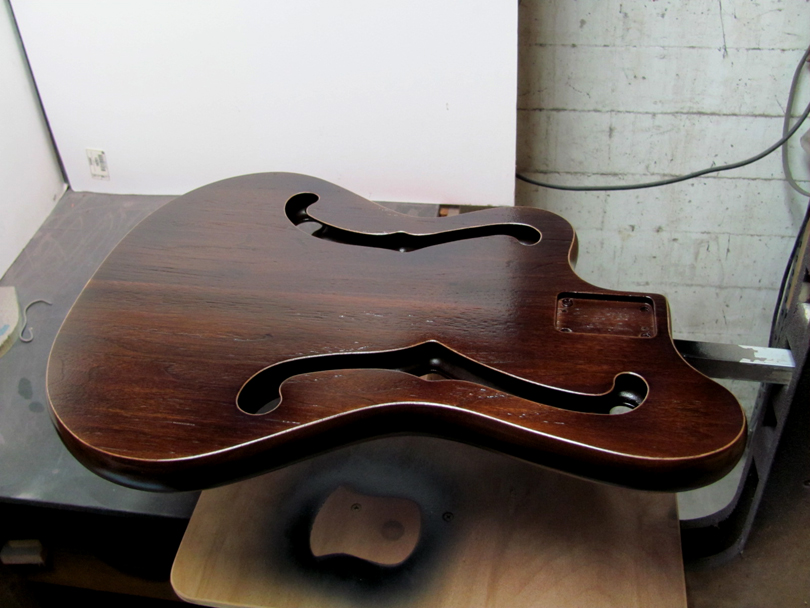
This is how I finish my walnut Scroll Basses. The wood is chosen specifically for its straight grain, and the overall color and styling theme is to look like it was made in the 1940's. Your Grandpa would have played it proudly in a Swing Jazz band. If he had an amp....
IMG_6983B.jpg


It's actually a fairly simple finish, all done with Varathane Ultimate Water-Base Polyurethane. Dark brown-tinted base coats to sink into the open grain, sanded back. I deliberately don't fill the grain up to the surface, leaving some grain texture. Then several coats of poly with a small percentage of dark brown tint. Some light sanding to deliberately make the color patchy, as if it had been rubbed on. More coats of dark-tinted poly around the perimeter, making a subtle sunburst. The thin pinlines around the edges are made by gently filing a tiny bevel through the color coats. Then two or three light coats of clear over everything. Lightly level sanded and buffed up to a semi-gloss.
IMG_6985B.jpg


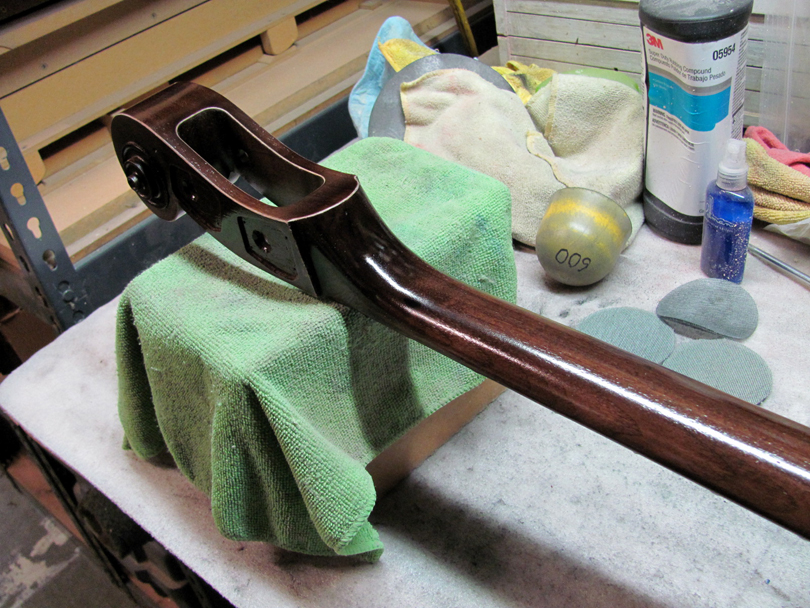
The neck gets the same treatment. It looks like old walnut, with decades of hand-rubbed finish on it. That's the idea.
 
Your decision is: Do you want an "invisible" finish that shows off the wood, just as if it were a bare board? Or, do you want an Enhanced Natural Wood finish that's more dramatic and colorful?

Here's the difference:

IMG_4641B.jpg


Here's my first Walnut AMB-2. I went with a mostly All Natural Wood look, because I thought that would be best. A couple of coats of clear poly, only a little bit of tint added around the perimeter. Scrubbed to satin. The finish is nearly invisible. That's what walnut looks like. It's pretty, but it's kind of bland, really.

IMG_7214B.jpg


Here's a Walnut AMB-2 from a few years later, with the Enhanced Natural Wood finish. Same walnut as the one above. But I've:
  • Emphasized the grain with a dark base coat, back-sanded
  • Several mild brown tinted color coats to darken it
  • Rubbing the color coats to make them a little patchy
  • A subtle dark sunburst around the perimeter
  • The bevel-edging highlights.
These are the kinds of things you can do make a "natural wood" finish look more interesting than natural wood.
 
Last edited:
@Bruce Johnson both examples are beautiful! I'm leaning toward something like your later example, emphasizing the grain with a dark base coat. It will still be at least a week before I get to the point where I apply the finish, so I'll have plenty of time to weigh my options and do some research.
I make skateboards as a little side hustle/hobby and I've dyed some average-looking maple with some bright water-based dye and have had some good results, but the color tends to fade pretty quickly and the finish looks good from far but far from good. :laugh:
 
Is there enough grain to do a colored grain fill type finish? AKA “dog hair”.

View attachment 5374153 View attachment 5374154
I've done a grain fill finish in the past. Looked amazing, fun to do as well.
I used black chalk paint for the filler, really easy to get the finish I was after, but found (on test pieces luckily) that some clear's turn chalk paint into it not-black (green's, brown etc.).
So do a test piece first!
 
  • Like
Reactions: mikewalker
I'll admit I've always been a little intimidated by intense dyes/stains, always seems like they end up blotchy and uneven for me, undoubtedly because I'm doing it wrong. Anybody got a good thread or tutorial on how to get an even looking finish with dyes? I did an ebony stain, Minwax right out of the can years ago on an ash body with a poly top coat. I got to black eventually... after something like 20 coats of ebony stain. I ws utterly clueless.
 
I can't offer any advice on how to achieve a certain look, but I absolutely adore wood-grain finishes, and despite the apparent "plain-grainness" of your bass, I think it'd look awesome if you were able to stain it in a way that exaggerates the contrast in the grain. There's plenty of grain there, it's just low-contrast. If you could make it just a few shades darker and increase the contrast, I think it'd look awesome!
 
General Finishes (https://generalfinishes.com/) is a good alternative to Varathane, and with a wide variety of compatible products and colors that may suit what you have in mind to give that Paulownia the look you desire. Some of their water-based polyurethanes are amber, some are water-white (clear).

@Bruce Johnson's tinting method is very good for getting depth and translucence in a finish. Having the tint in successive coatings is a production method that, I think, grew out of a glazing process. Also, if the color is not going in the intended direction, you can push it around a little. Is the brown not rich enough? Add a touch of blue... .

With glazing, a stained (or not) wood is sealed and coated with the finish (conventionally, this would be done with nitrocellulose lacquer). A glaze made of naphtha or mineral spirits, tinted with Japan Oils (finely ground pigments in oil), is applied and dry-brushed for consistent coverage, or can be manipulated for effects. The glaze usually has much less pigment than a stain. The goal is a result of no brush marks. Once this is dry, a coat of lacquer is sprayed. The process is continued until the desired result is achieved. This can be followed by some number of clear coats, determined by whether the piece is going to be rubbed out to a particular sheen. Very old school, and doubtful there are any regular practitioners any more. But, it's a very good method for matching an existing finish for repairs/touch-up.
 
  • Like
Reactions: SpeakerBoxxx