
Hipshot doesn't offer a 6 string trem. Kahler does, however.
How many semitones up and down do the Hipshot and Kahler's do?
How many semitones up and down do the Hipshot and Kahler's do?

TalkBass has been independent since 1998. Add your voice.
Create a free account to reply to discussions, view embedded media, and browse with fewer display ads.
Join free Log in
Want zero display ads or expanded classifieds tools? Compare plans.

TheEmptyCell said:Hipshot doesn't offer a 6 string trem. Kahler does, however.
How many semitones up and down do the Hipshot and Kahler's do?
ai4281 said:only a step up and down??? i thought you can do half an octave up, and an octave down...

My four & 6 string. Like I said earlier the 6 string is a mother to move with the heavy strings. the 4 is sweetness.

The Gizmo (sometimes called The Gizmotron) was an effects device for the electric guitar, invented ca. 1975 by English rock musicians Kevin Godley and Lol Creme while they were members of the British rock group 10cc.
The Gizmo first featured on 10cc's second album, Sheet Music (1974) on the track Old Wild Men, and its ability to create a wide range of sounds was central to the production of Godley and Creme's first post-10CC project, the 1977 triple-LP concept album Consequences.
According to Paul Gambaccini's sleeve notes for the album, 10cc were unable to afford an orchestra for their early albums, so Creme and Godley imagined an effects unit that would enable a guitar to produce violin-like sounds (this was some years before the introduction of the polyphonic synthesiser and long before the development of digital sampling).
The resulting device, a small box which was attached to the bridge of the guitar, consisted of six small motor-driven wheels, whose continuous bowing action was activated by pressing one or all of keys located on the top of the unit. Pressing one key would bow one string, pressing three would bow three, and so on, while the other hand remained free to fret single notes or full chords.
John McConnell, then a senior lecturer in Physics at the University of Manchester's Institute of Science and Technology (UMIST) assisted Godley and Creme in the development of the prototype. He considered it critical that the instrument retain the natural decay of a note rather than the sharp cut-off often experienced with an electronic synthesizer.
Other Godley & Creme albums featuring the Gizmo include L and Godley & Creme. The Gizmo can also be heard on This Mortal Coil's recording It'll End in Tears (4AD), where it was played by Simon Raymonde of Cocteau Twins. The Gizmo is also featured on The Church's Violet Town where it is played by Marty Willson-Piper.
One of the faults with The Gizmo was that is was very tempremental, and affected by conditions such as humidity and tempaurature. Gizmotron, the company set up to produce The Gizmo, was eventually driven bankrupt as The Gizmo was released at the same time as cheap synthesizers and was unable to find a market.
My four & 6 string. Like I said earlier the 6 string is a mother to move with the heavy strings. the 4 is sweetness.


custom vibrola

Clips of the RD here- The pig in Pigdog is mostly the RD / Kahler
Link Removed



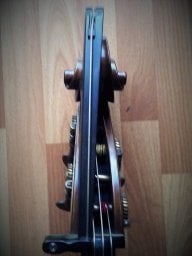

tung made this......yes,a 12-string with a whammy bar.


