@TommyKnocker, I love the black/tort color combo.
Thanks, John. Appreciate the compliment. From one mediocre bassist to another.
The tort guard makes a great seg from the black body to the old dark rosewood board.

TalkBass has been independent since 1998. Add your voice.
Create a free account to reply to discussions, view embedded media, and browse with fewer display ads.
Join free Log in
Want zero display ads or expanded classifieds tools? Compare plans.
@TommyKnocker, I love the black/tort color combo.

I was under the impression that the 5 was not the day but the neck style or profile or something.
Like on my Jazz it's stamped 7 NOV 62 A and I'm told the 7 stands for Jazz Bass or something to that effect.
Is the 5 for a P?
It would be Nov. 7, 1962 the "A" is for a 1.500 nut width
It would be Nov. 7, 1962 the "A" is for a 1.500 nut width
TommyKnocker said:I have to add here, since this is a pre CBS thread that, up to the point that I bought the 66 Precision neck,
I had been searching with serious intent for a pre CBS bass.
I had the coin to spend and it was burning a hole in my pocket.
I was open to a Jazz or Precision, but it had to be a real clean all original slab board bass. Or possibly something in the transition era.
I was visiting a music store in North Jersey with an incredible inventory of vintage guitars basses and amps.
Specifically stopping by there while on a delivery for my employer to see an old Precision.
The purchase of the neck didn't specifically halt my search for that old Fender bass. But it did give me some time to be even more critical in my selection of basses.
And after recently watching the thread get crazy about the windfall find of the custom color '62 Fender and seeing pics of
what can be done to bring junked up old Fender bodies to a point where they pass for correct looking aged originals,
frankly I have been scared away from seeking that holy grail pre CBS Fender.
As much as i would love to have and hold and play what I believe to be a wonderful Fender bass as old as me,
I just can't risk buying one and finding that it's not real.
I can now enjoy the feel of playing a 60's Fender bass and not have to deal with the mind-numbing intensity of the whole vintage authenticity thing.



I'm amazed here. This is my '64 P Bass. Look at the neck information. It's the SAME day as yours, Dave. Also, our basses look like Twin Brothers. So Strange. I bought mine in 1970. It's been through a few wars, seemingly like yours ...
The information I posted was given from Herbie Gastelum, long time neck sander at Fender Guitars and also a personal friend. He could be wrong, it has been many years since Fender has stamped dates like this on necks.Incorrect, sir.
You would soon find after looking at every Jazz neck you could find,
that they were all, according to your post, made on the 7th day of the month.
Precision necks of those date stamp years all bear the number 5 before the month/year.
And yet there are examples of B and C widths all through the late 60s as Fender transitioned away from the C width.
Try to imagine Leo thinking that it was a good idea in a mass-production environment
to change the date stamp tooling daily instead of monthly.
Any Fender historians/experts want to chime in here?
My first bass and least favorite of all time.
 BTW. if you still have it, send it to me, and I'll see that it is properly destroyed.
  It is/was a beautiful bass, and possibly my favorite color scheme.
Now that my teeth are back in my mouth, let me be the first to say WOW!Here's a shot of my '64. Great bass that I purchased in 1971.
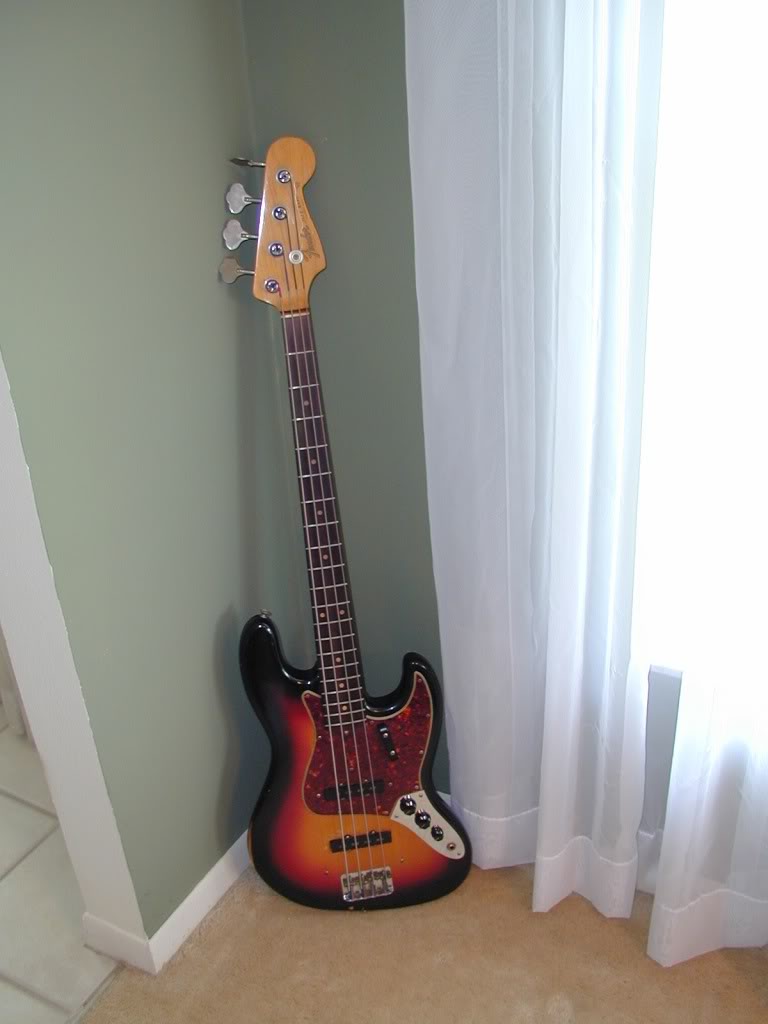


Munjibunga said:Here I am playing my '65 P Bass. My first bass and least favorite of all time.
Now that I've removed them and had the chance to play w/o em I honestly can't see why anyone would ever want to have them on there.1bassplayin said:The individual mute system was on some of the earlier 62RI Jazz. I've seen a few like that. I think it was an option. Usually there was a piece of foam rubber glued inside of the ashtray cover. A lot of players would take the ashtray covers off and stick piece of foam or a sponge under the strings to mute them with similar results. There seems to be a revival for those shiny covers.