• TalkBass has been independent since 1998. Add your voice.
    Create a free account to reply to discussions, view embedded media, and browse with fewer display ads.
    Join freeLog in
    Want zero display ads or expanded classifieds tools? Compare plans.

Pre-Slotted/Pre-Radiused Fingerboards

I have only bought them pre slotted, but not radiused. I can't justify building a fret slotting jig for a few builds, and the CNC cut boards are going to be more accurate than you can cut by hand. I got mine from LMI, didn't have them radius because I did inlays and binding that had to be radiused also, but if the FB was plain, id have it radiused too. Its cheap insurance that the bass will intonate correctly (unless you screw up bridge placement).
 
I don't see any mention of compound radius, worth a phone call. It does say they can do ANY scale between 8" and 40", so that about covers it. It says the fingerboard thickness is limited to 5/16", but they slotted my 3/8" thick bubinga board, I guess that's only a radius limitation. If you are doing a lot of basses, probably worth building a jig, but as a hack amateur, I'll take all the help I can get!
Fingerboard Slotting/Radiusing Service
 
  • Like
Reactions: chinjazz
I don't see any mention of compound radius, worth a phone call. It does say they can do ANY scale between 8" and 40", so that about covers it. It says the fingerboard thickness is limited to 5/16", but they slotted my 3/8" thick bubinga board, I guess that's only a radius limitation. If you are doing a lot of basses, probably worth building a jig, but as a hack amateur, I'll take all the help I can get!
Fingerboard Slotting/Radiusing Service

I'm with you on that :)

I always get a bit ahead of myself. I was thinking it would be cool to make a radius jig, and then I realized I needed to concentrate on one bass at a time because I'm still learning a bunch of things.
 
As far as intonation goes, I would not be too worried about the precision of your fret slot placement. Straight frets are actually just an approximation of where the true notes are on the various strings, as far as I understand anyway. True temperament frets are actually at a slightly different distance from the nut for each string.

slider2-GTR8.png


I was not able to easily find a pic for a bass with true temperament frets, this is because the minimally sharp or flat notes are not really noticeable unless you're playing chords, so not really needed on a bass...

There's one best way to learn, IMO, that is by doing! Have at it :):thumbsup: Of course there are other ways you can f-up your slot cuts (don't ask how I know ;), but a simple miterbox should do ya), and it is possibly a lot quicker to have someone else do it for you, but where's the fun in that?
 
  • Like
Reactions: chinjazz
As far as intonation goes, I would not be too worried about the precision of your fret slot placement. Straight frets are actually just an approximation of where the true notes are on the various strings, as far as I understand anyway. True temperament frets are actually at a slightly different distance from the nut for each string.

slider2-GTR8.png


I was not able to easily find a pic for a bass with true temperament frets, this is because the minimally sharp or flat notes are not really noticeable unless you're playing chords, so not really needed on a bass...

There's one best way to learn, IMO, that is by doing! Have at it :):thumbsup: Of course there are other ways you can f-up your slot cuts (don't ask how I know ;), but a simple miterbox should do ya), and it is possibly a lot quicker to have someone else do it for you, but where's the fun in that?

Ok, so those frets are bugging me out. Like they're under water.

I hear what your saying. I'm just getting to a place where I phase in how much fun and learning I want to do in a given project.

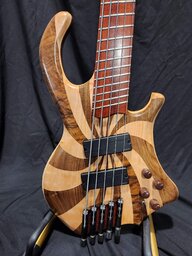
So for my last bass, I learned how to retro fit an already made neck into a body I made. Many ways to do it but one of my friends suggested making a plaster of paris mold out of the neck end to then make a Router template for the neck pocket. A bit of "reverse engineering" I suppose. That bass came out really nice, even with my lessons learned (aka screw ups).

bassbody.jpg
 
I think even @Bruce Johnson buys his boards slotted from LMII, to me it's well worth the money. I've slotted boards, it's not hard, but it's time consuming and has to be perfect.

No, I buy almost all of my fingerboards from LMII, but in blank form. I have my own radiusing and slotting rigs, and I prefer to radius and slot the boards after they are glued onto the neck.

But, for those of you who don't have those tools and fixtures (yet), buying pre-radiused, pre-slotted boards from LMII is a good option. Their boards are cut accurately and reasonably priced.
 
Is that bass intonated? The string saddles don't seem to be in their normal spot - especially the G. (nice looking bass BTW!)

It is. Long story, but it's a 35" scale zero fret neck that I did some reshaping on.
This gets into my lessons learned. The bridge holes and placement was completely wrong, and basically I moved it back and essentially ran out of space. It was all an experiment basically. Next time will no doubt be a better bass. Thanks for the compliment.
 
  • Like
Reactions: Beej
No, I buy almost all of my fingerboards from LMII, but in blank form. I have my own radiusing and slotting rigs, and I prefer to radius and slot the boards after they are glued onto the neck.

But, for those of you who don't have those tools and fixtures (yet), buying pre-radiused, pre-slotted boards from LMII is a good option. Their boards are cut accurately and reasonably priced.

Thanks Bruce! I have seen your amazing array of Router jigs, and I'm in awe of your mastery! I saw another thread here in LC and it got me thinking about the pre- slotted aspect and wondered after glue down could things get dicey with Bow (plus or minus). I can probably ask the LMII folks about that also.