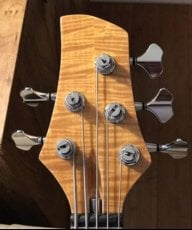
I think 99% of builders have said that at some point. I know I have...
Must translate to admitting I have a problem. Mine is rooted in now not being able to afford those basses I used to lust after. Now I want to make my own


TalkBass has been independent since 1998. Add your voice.
Create a free account to reply to discussions, view embedded media, and browse with fewer display ads.
Join free Log in
Want zero display ads or expanded classifieds tools? Compare plans.
I think 99% of builders have said that at some point. I know I have...

I'm thinking a thicker rw fretboard on my 83 L2000 might solve some of the stability and action issues that arose after a refret, is that possible or do some basses just need set up more regularly than others?
I think there are so many possible factors including where your bass lives - humidity levels.

Thanks Bruce! I have seen your amazing array of Router jigs, and I'm in awe of your mastery! I saw another thread here in LC and it got me thinking about the pre- slotted aspect and wondered after glue down could things get dicey with Bow (plus or minus). I can probably ask the LMII folks about that also.
that's true the canyons north of LA have wild temperature and humidity shifts
If the replacement frets had a different tang thickness that can make a big change because the difference builds up over 20+ frets.I'm thinking a thicker rw fretboard on my 83 L2000 might solve some of the stability and action issues that arose after a refret, is that possible or do some basses just need set up more regularly than others?
You bring up a good point. If you buy a pre-radiused pre-slotted fingerboard, and glue it onto your neck, it will probably still need to have the surface touched up. It's difficult (not impossible, but difficult) to glue a radiused fingerboard onto a neck and have it end up true and straight. Having it pre-radiused gets the shape close, but you should still lightly level it along the string paths to make sure that it doesn't have any lumps or dips. You can do that with a straight flat block; you don't need a radius block.
I added a fine centreline mark at both ends of the board and drove a couple of very fine brads through a slot at each end just into the neck wood to establish the location of the board because glue will make it slide all over the place and the last thing you'd want is a radiused board glued on crookedly. I hand planed and then block sanded the radius in after glue up. You always have to think about what could possibly go wrong unfortunately.Thanks! I'll heavily inspect it after glue and let it sit for a week or so, and run a straight flat block lightly as needed.
I wonder if it would be wise to leave it clamped up for a few days or up to a week?
I was very worried that I would run into the problems you described. If I was in your shoes I would've gone with the pro setup. I'm pretty sure mine is a slotting saw not the jewelry one. I even contemplated grinding some of the teeth off in case it didn't work too well but at the depth I was cutting it worked like a charm. I used it only for that purpose and only the minimum depth required. I did have to grind out the center hole to fit the saw arbor with a dremel grinder, which sounds sketchy, but it actually worked perfectly. It probably wasn't cutting on every single tooth but that may have been a bonus lol. I live in Canada so it's much more Important for me to be self sufficient because ordering from the states basically doubles my costs. I did EI and Madagascar rosewood and figured maple. I'll try to find the blade tomorrow and some slotted boards and put up a picture. I keep it in a cd case for protection.A technical note for those of you who are thinking about making up your own fret slot sawing rig:
The reason that the circular slotting blades at Stew-Mac and LMII are expensive is that they are custom ground set-tooth blades. The Stew-Mac blades, which I use on my slotting saw, start out as standard 6" dia x 1/16" (0.063") wide slotting saw blades, which are commonly available at machinery supply places. Then the outer perimeter (about 1/2" wide) is ground down to 0.020" thick. This leaves about 5" diameter of the blade at the full 0.063" thick to keep it stiff.
Finally, the teeth are set. That is, the individual teeth are slightly bent alternately to the left and to the right, to bring the width of the slot that the blade will cut out to 0.023". If you aren't aware of it, most saw blades have set teeth. If you lightly pinch most saw blades, you'll feel that the ends of the teeth are wider than the blade itself. This is particularly important in saw blades made to cut wood. Wood heats up as you cut it, and without set teeth, it will tend to pinch on the blade and bind up, causing squealing, more heating, and often distorting the slot.
That's why the Stew-Mac blade is more expensive; it's ground thinner and has set teeth. A standard metalworking slotting saw does not have set teeth; it's ground flat on the sides. Can you use a non-set slotting saw to cut fret slots in a fingerboard? Yeah, kind of. I tried one when I was building my first slotting saw. It cut okay on soft woods, but it was miserable on hard woods like ebony and cocobolo. Cocobolo is one of the toughest woods to slot.
These days, I have two of the Stew-Mac blades, which I swap back and forth on my saw as they need resharpening. I resharpen and reset the teeth on them myself. It really isn't that hard to do, and only requires a small file, a smooth-jaw machinist's vise, and feeler gauges. You can adjust the set of the blade to cut anywhere in the range of 0.021" to 0.030", whatever you like. I set mine right at 0.023" which is good for most standard fretwire.
I did a quick tutorial on another forum on how to sharpen and reset the Stew-Mac blades. If some of you are interested, I'll repost it here on TB.
Fender Bender: If you want to use a slotting saw, I recommend that you get a 0.020" coarse-tooth blade (a Slotting Saw, rather than a Jeweler's Slotting Saw), and then set the teeth to make it cut 0.023". It will be a much more pleasant sawing experience.

Most of my basses need some adjustment at least once a year here in Fl. It gets crazy hot and humid and my house is sufficiently air cond.
Love pre-slotted LMII boards! I use a radius block to put a 20" radius on mine, doesn't take too long.
It gets crazy hot and humid here too, same climate. But I never have to adjust any of my necks. Might be because they're typically three-piece laminated with rather thick fingerboards and rather generous carves. At this stage in my hobby, I consider one-piece necks inherently risky and therefore not worth the trouble.
On another note, if you have to get a radius block, I'll suggest the Stewmac aluminum ones at 24" length. Overpriced, of course, but you can get double duty out it of for leveling frets. I used a 24" wood one, and I'm pretty sure it flexes imperceptibly in use. The aluminum ones are completely rigid. Obviously makes sense to.decide what radius you prefer and just keep flogging it for all your builds. I like 10" radius, but that's just me. Some people use the shorter radius blocks, which I don't get. Seems like you want a beam that spans the whole fingerboard.
[Invalid or Expired Link Removed]


