I am considering building a 40 inch scale bass that is capable of playing ultra low notes. It seems that there are many obstacles on the electronics end with rig choice. Right now I just have a rumble 40 and don't want to start the build until I can figure out what I am up against gear wise to make the most of the future instrument. Thank you in advance for anyone sharing their solutions to what seems like a complex problem.

Enjoy the benefits of a premium membership!
Upgrade Account
-
TalkBass has been independent since 1998. Add your voice.
Create a free account to reply to discussions, view embedded media, and browse with fewer display ads.
Join free Log in
Want zero display ads or expanded classifieds tools? Compare plans.
You are using an out of date browser. It may not display this or other websites correctly.
You should upgrade or use an alternative browser.
You should upgrade or use an alternative browser.
Rig for ultra low notes around 20 hertz
- Thread starter SerfBassie
- Start date
More options
Who Replied?


The problem is not so much in the amplifier side of things, but the speakers. You're going to have a hard time finding a speaker cab that would reproduce 20 Hz with any kind of volume.

Just curious, what’s the point? Other than that, haven’t you looked at PA subs? In addition, why would you want that on stage, when it’s the PA’s job to deliver those kinds of frequencies anyway. IF that’s desired.

- Feb 12, 2006
- 61,013
- 5
- 220,866
- Disclosures
- Development Engineer-Mesa Boogie, Development Engineer-Genzler (pedals), Product Support-Genz Benz
The challenge with the speaker side is the need for very large enclosures and costly drivers and a lot of power to achieve any meaningful volume at 20Hz. It’s an incredibly complex challenge with a lot of significant and costly obstacles for what’s almost certainly questionable value. It’s very, very difficult to discern pitch information below ~40Hz as well.

Passinwind
I know nothing.
- Dec 3, 2003
- 23,066
- 46,000
- Disclosures
- Designer/Toaster Tech @ Passinwind Electronics
There are many many threads in the Amps FAQ and elsewhere on TB addressing this subject, prepare for a long read!I am considering building a 40 inch scale bass that is capable of playing ultra low notes. It seems that there are many obstacles on the electronics end with rig choice. Right now I just have a rumble 40 and don't want to start the build until I can figure out what I am up against gear wise to make the most of the future instrument. Thank you in advance for anyone sharing their solutions to what seems like a complex problem.
Passinwind
I know nothing.
- Dec 3, 2003
- 23,066
- 46,000
- Disclosures
- Designer/Toaster Tech @ Passinwind Electronics
Yep. I helped Skip Fantry work on some rigs for his 20Hz and 12Hz Knuckle Basses, he was looking at eight very expensive 118s plus a bunch of top boxes, and around 20kW total power. Custom DSP controllers, on and on. He had one of the 118s at his NAMM booth one year, with a 12/6 cab on top, and although it was quite impressive it still mostly just making harmonics. His interest is/was more in ambient effects than pitched playing per se though, which IMO and IME is a much more realistic ask.The challenge with the speaker side is the need for very large enclosures and costly drivers and a lot of power to achieve any meaningful volume at 20Hz. It’s an incredibly complex challenge with a lot of significant and costly obstacles for what’s almost certainly questionable value. It’s very, very difficult to discern pitch information below ~40Hz as well.

I don't think you need 40" scale to produce ultra low frequencies. If loosen a bass string enough, you can get a bass string to vibrate at subsonic frequencies. You can't hear it and reproducing electronically, the question becomes why? Movie soundtrack for an eruption, or tectonic plate movement might be one application.
As has been pointed out, very difficult, if not impossible to reproduce on just about every system.
Good luck achieving your goal.
As has been pointed out, very difficult, if not impossible to reproduce on just about every system.
Good luck achieving your goal.
- Feb 12, 2006
- 61,013
- 5
- 220,866
- Disclosures
- Development Engineer-Mesa Boogie, Development Engineer-Genzler (pedals), Product Support-Genz Benz
Correct, though harmonic distribution changes quite a bit with string tension versus scale. It also affects playability.I don't think you need 40" scale to produce ultra low frequencies. If loosen a bass string enough, you can get a bass string to vibrate at subsonic frequencies. You can't hear it and reproducing electronically, the question becomes why? Movie soundtrack for an eruption, or tectonic plate movement might be one application.
As has been pointed out, very difficult, if not impossible to reproduce on just about every system.
Good luck achieving your goal.

The big rigs that touring acts use have subwoofers that won't fit in your car, they take thousands of watts (each) to drive to a decent level, and you need a couple dozen (OK, maybe for a club, half a dozen would work). If you have a couple friends with full sized vans (and you have a van yourself) you can probably move your rig around in 3 vans. When you get to the club, just inform them of your power needs (Hint: you can't plug your rig into a 20 amp 120 volt circuit, you'll need real power).
Oh yeah... those only go down to 30 Hz. For 20 Hz, you're gonna need an even bigger rig.
Oh yeah... those only go down to 30 Hz. For 20 Hz, you're gonna need an even bigger rig.

The fundamental is not as fundamental as you may think
A good bass guitar signal that is audible, articulate and musically understandable
is NOT going to arise form the chunk of the EQ spectrum below 100 Hz
It is not a strong fundamental that makes a good bass signal, but the upper harmonics.
For me a bump around 300-500 hz sound like "Phat bass" - that huge Reggae tone
others prefer higher mids for their "good" bass signal
It would be much more wise to play a bass through a graphic EQ
and use your ears to find what frequency actually sounds like "more bass"
you may be surprised at how far above the fundamental the "bassyness" shows up
A good bass guitar signal that is audible, articulate and musically understandable
is NOT going to arise form the chunk of the EQ spectrum below 100 Hz
It is not a strong fundamental that makes a good bass signal, but the upper harmonics.
For me a bump around 300-500 hz sound like "Phat bass" - that huge Reggae tone
others prefer higher mids for their "good" bass signal
It would be much more wise to play a bass through a graphic EQ
and use your ears to find what frequency actually sounds like "more bass"
you may be surprised at how far above the fundamental the "bassyness" shows up
Last edited:
Here is a rig that will actually do what you want. I actually know Tom Danley (the guy who developed this). Note that the size is... a shipping container. It comes with it's own diesel generator, which solves the power problem (40,000 watts in this case). Now the challenge is how it fits (or not) in the venue. The point is that what you are asking is...probably ridiculous, unless you're playing very big places, have a very big budget, and a big crew to move your rig. And you can't forget to add fuel to the subwoofer before every show. It's probably a good idea to have a diesel mechanic on your crew, just in case..
In March 2007, DSL produced the Matterhorn, a single subwoofer made from an intermodal shipping container. Danley designed the Matterhorn to meet a military specification, to produce a low frequency sound in the range of 15 to 20 Hz, to be measured at 94 decibels at a distance of 250 meters. To accomplish this, Danley arranged forty 15-inch MTX subwoofer drivers in a tapped horn configuration, each driver powered by its own 1,000 watt amplifier. A diesel generator was included inside the container for operation in the field.[22] The subwoofer has a flat frequency response from 15 to 80 Hz, and is down 3 dB at 12 Hz.[23][24] The Matterhorn has been called the World's Biggest Subwoofer.[25]
Matterhorn
[edit]In March 2007, DSL produced the Matterhorn, a single subwoofer made from an intermodal shipping container. Danley designed the Matterhorn to meet a military specification, to produce a low frequency sound in the range of 15 to 20 Hz, to be measured at 94 decibels at a distance of 250 meters. To accomplish this, Danley arranged forty 15-inch MTX subwoofer drivers in a tapped horn configuration, each driver powered by its own 1,000 watt amplifier. A diesel generator was included inside the container for operation in the field.[22] The subwoofer has a flat frequency response from 15 to 80 Hz, and is down 3 dB at 12 Hz.[23][24] The Matterhorn has been called the World's Biggest Subwoofer.[25]



One day I decided to hear what 20 hz actually sounds like. Using a pair of 400 watt Yamaha PA speakers with 15" drivers, I generated a 20 hz tone (sine wave) in my DAW and played it back. I could see the woofer cones moving in and out - waaay out - and could barely hear anything at all. Next I tried it using a synthesizer, with a saw wave added to hte sine wave, and I was able to hear some tone but I found out I was onloy hearing the 40hz armonic - still not hearing the fundamental.
In all my musical experience, the lowest note I can claim to being able to hear is a 32hz pedal tone from a very large pipe organ.
My opnion is that 20hz is not a musical note that humans can hear. It strictly for effect, like in the movie "Earthquake"
In all my musical experience, the lowest note I can claim to being able to hear is a 32hz pedal tone from a very large pipe organ.
My opnion is that 20hz is not a musical note that humans can hear. It strictly for effect, like in the movie "Earthquake"

I played a few of Skip's basses, but when I decided to have him build me one, I chose a 36.5 inch scale, standard tuning with low B. I do have a friend with one of his Quake basses. The amplification side is definitely the hard part of that equation.

Meyer Sound VLFC will get you 13Hz-35Hz, your standard rig should handle everything else. The VLFC is only $13k. Depending on your rig, you may need two. Heh

Kilomax gets close in a big box (-3dB at 28hz)
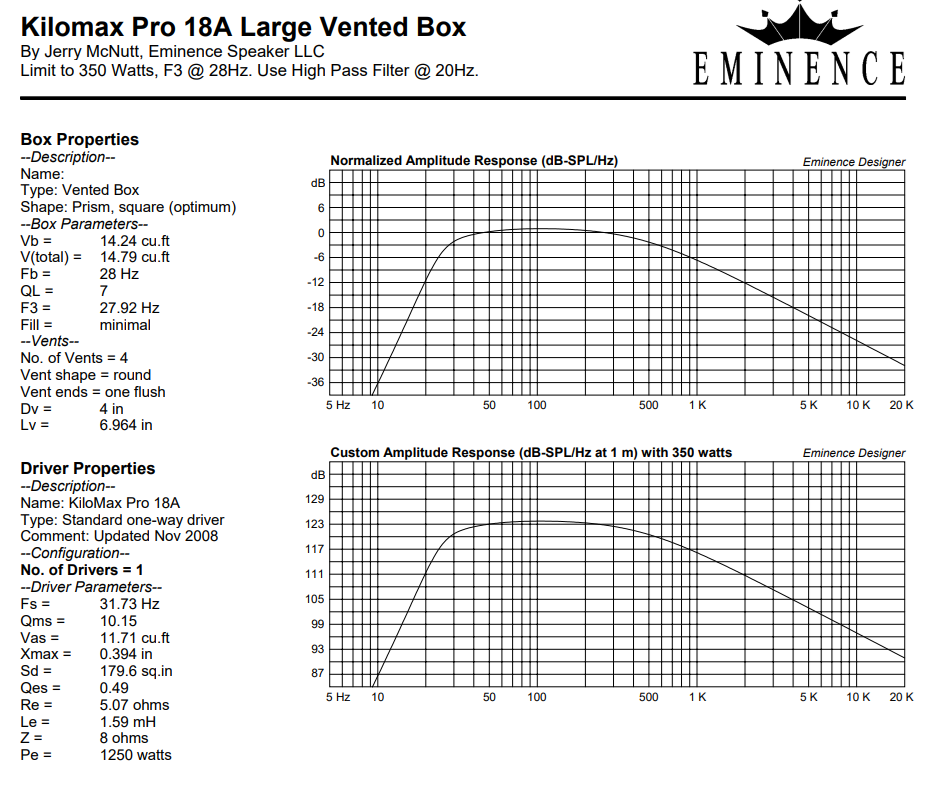
Our ears are not very sensitive at 20hz. So you will probably need several of these "big" boxes if you really want to hear and feel 28hz.
Phon is a measure of perceived loudness. Decibel is a measure of actual loudness. The Fletcher Munson curve shows how they compare. The point is to chart required decibel levels for equal perceived loudness at different frequencies.
120dB at 28hz (red circle) is equivalent to about 100 phons.
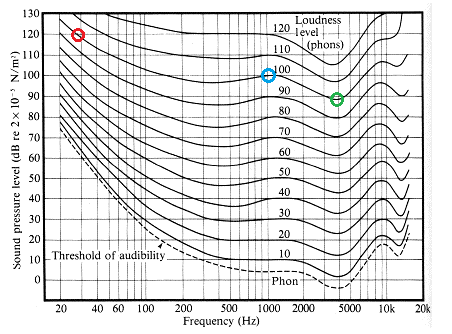
At the blue circle (~1K) you only need 100dB for 100 phons. At the green circle (~3.8K) you only need about 88dB for 100 phons
Our ears are not very sensitive at 20hz. So you will probably need several of these "big" boxes if you really want to hear and feel 28hz.
Phon is a measure of perceived loudness. Decibel is a measure of actual loudness. The Fletcher Munson curve shows how they compare. The point is to chart required decibel levels for equal perceived loudness at different frequencies.
120dB at 28hz (red circle) is equivalent to about 100 phons.
At the blue circle (~1K) you only need 100dB for 100 phons. At the green circle (~3.8K) you only need about 88dB for 100 phons
First of all, as you will hear over and over on here, producing frequencies that low in a performance situation is counterproductive.
Second, as you'll hear over and over, most basses, even one with a 40" scale don't even produce that 20 Hz fundamental. You get most of your pitch cues from harmonics of the fundamental. That Rumble 40 probably doesn't reproduce the 40 Hz fundamental of your E string.
Creating notes that low are best used for special effects. My favorite example of this is Yes's And You And I off of the Keys To Ascension album, where in the middle section Squire used Moog Taurus pedals (or some variation thereof), but in that section he only plays long notes, and that's only down to 40hz Too much low bass simply muddies up your stage sound. There's a section of Herbie Hancock's Butterfly off of the Thrust album that reaches down there, but is nearly mastered out. This example is also long notes. Some hip-hop goes down that far, usually with 808s and synthesizer, and once again, minimal notes.
If you're hardheaded like me and insist on going that low, the Acme B210 and other cabinets will reproduce fundamentals down to about 30 Hz. They are, however, power hungry, and must be used carefully. Also, if you've got that kind of money, (lots of money) the Bag End Elf cabs and processors will go that low, but you'll need additional equipment to cover from 80 Hz up.
Once again, all that low end will turn into mud in a performance situation, especially if you are a busy player. Even reggae bass doesn't often get that low, and once again, those are not usually busy lines.
Second, as you'll hear over and over, most basses, even one with a 40" scale don't even produce that 20 Hz fundamental. You get most of your pitch cues from harmonics of the fundamental. That Rumble 40 probably doesn't reproduce the 40 Hz fundamental of your E string.
Creating notes that low are best used for special effects. My favorite example of this is Yes's And You And I off of the Keys To Ascension album, where in the middle section Squire used Moog Taurus pedals (or some variation thereof), but in that section he only plays long notes, and that's only down to 40hz Too much low bass simply muddies up your stage sound. There's a section of Herbie Hancock's Butterfly off of the Thrust album that reaches down there, but is nearly mastered out. This example is also long notes. Some hip-hop goes down that far, usually with 808s and synthesizer, and once again, minimal notes.
If you're hardheaded like me and insist on going that low, the Acme B210 and other cabinets will reproduce fundamentals down to about 30 Hz. They are, however, power hungry, and must be used carefully. Also, if you've got that kind of money, (lots of money) the Bag End Elf cabs and processors will go that low, but you'll need additional equipment to cover from 80 Hz up.
Once again, all that low end will turn into mud in a performance situation, especially if you are a busy player. Even reggae bass doesn't often get that low, and once again, those are not usually busy lines.
Last edited:
This gets trotted out every time the subject of reproducing fundamentals comes up. There is actual research (done in the early telephone and military radio days) that led people to realize that, to get good intelligibility, you didn't have to reproduce the speech fundamentals - 300 Hz is OK for that. But it isn't natural sounding, and for a long conversation (a one hour meeting), having at least 100Hz reproduction for speech is a very good idea.The fundamental is not as fundamental as you may think
A good bass guitar signal that is audible, articulate and musically understandable
is NOT going to arise form the chunk of the EQ spectrum below 100 Hz
It is not a strong fundamental that makes a good bass signal, but the upper harmonics.
When it comes to music, yes, you can play a 4 string bass through a bass cab that doesn't reproduce the low E fundamental well, and it'll sound "OK" - An SVT (and pretty much every other bass cab on the market) does that. However, it's not as impactful as a rig that actually reproduces the low notes' fundamentals. If you get a chance to play a 5 or 6 string bass through a rig that reproduces 30 Hz well (I get to do that on a regular basis), you 'll quickly realize that having a well reproduced fundamental is a VERY good thing.
Big Tours have line array main speaker rigs that go down to 60 Hz, no problem. But they all carry subs that go down to 30 Hz - why? If you're playing the low B, the mains can do every part of the signal but the fundamental - is it worth it? They spend a LOT of money to rent, carry, set up, and drive those speakers - there is considerable expense necessary to reproduce that fundamental. Why do they do it? Because the added impact is worth it.
- Feb 12, 2006
- 61,013
- 5
- 220,866
- Disclosures
- Development Engineer-Mesa Boogie, Development Engineer-Genzler (pedals), Product Support-Genz Benz
Note that this alone (or in multiples) isn't going to work, this is a very low frequency tuned resonant system with a very limited high frequency response (limited by active processing to 35Hz), it's intended as a fill-in element to conventional subs, and contains very sophisticated frequency adaptive limiting and processing. It also takes a LOT of power to achieve 125dB peak SPL with a crest factor of ~10.Meyer Sound VLFC will get you 13Hz-35Hz, your standard rig should handle everything else. The VLFC is only $13k. Depending on your rig, you may need two. Heh
It's also large and weighs 300 lbs (each).


