It was not that long ago that there were no bass guitars. I am just exploring as a guitar builder to see where the gaps are. Hearing experts.....I don't think this is accurate -- if a double contrabass flute is an octave below the contrabass, its lowest note would still only be C1, or 32 Hz. And of course, there wouldn't be much fundamental present.
I'm with some of the others, that there isn't much useful musical information down at 20Hz -- it can be perceived, but it's hard to actually hear. I guess it could be useful as a sort of effect, much as it was used in the Earthquake systems, but it doesn't seem to me to serve much in the way of a musical function. But hey... knock yourself out; it's inspiring to have a quest. [Music cue: fade up "Impossible Dream" from The Man Of La Mancha under this.]

Enjoy the benefits of a premium membership!
Upgrade Account
-
TalkBass has been independent since 1998. Add your voice.
Create a free account to reply to discussions, view embedded media, and browse with fewer display ads.
Join free Log in
Want zero display ads or expanded classifieds tools? Compare plans.
You are using an out of date browser. It may not display this or other websites correctly.
You should upgrade or use an alternative browser.
You should upgrade or use an alternative browser.
Rig for ultra low notes around 20 hertz
- Thread starter SerfBassie
- Start date
More options
Who Replied?
- Feb 12, 2006
- 61,014
- 5
- 220,866
- Disclosures
- Development Engineer-Mesa Boogie, Development Engineer-Genzler (pedals), Product Support-Genz Benz
Except that to produce 20Hz via integration correction greatly limits the volume at 20Hz.The active Bag End 18” infrasonic sub has served me well producing the fundamentals down to low A. Not sure about 20Hz though. That’s at the limit of our perception.
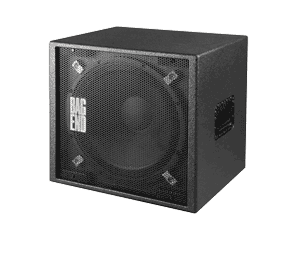
IPS18E-BN Infra Processed self powered infra series subwoofer
IPS18E-BN Infra Processed and Self Powered Nebula Coated Single 18" Extended Low Bass Musical Instrument Speaker. Bag End Loudspeakersbagend.com
For example, with the 12dB/octave integration slope, the rated power handling falls by 12dB/octave which is more than a factor of 10. This is why successful low frequency extension at any significant volume requires multiples of this platform.

- Feb 12, 2006
- 61,014
- 5
- 220,866
- Disclosures
- Development Engineer-Mesa Boogie, Development Engineer-Genzler (pedals), Product Support-Genz Benz
There are no cheap miracles.It is a daunting frontier. I think I will start small and see if a woofer changes how I like the sound effect. Seems like to do it right takes a lot of cash and I don't know if I'm up for that. Would be happier I think if I learned to play better and band or something. Connecting with people...
Thanks for the suggestion. Looks like a good unit. I am always hoping for cheep miracles but I don't think these rare items.

Thanks for going into depth. I feel like this is a different approach to explaining the phon graph someone posted. Looks like this is a tougher nut to crack than I first expected.
It's actually two separate factors: actual loudness VS perceived loudness by frequency. For an actual loudness of 125dB at 20hz you need about 16 SE18E-R subs.
If you are concerned with equal perceived loudness across the spectrum, 125dB at 20hz is near the 100 phon line.
For equal perceived loudness of 100 phons, you need about 125dB at 20hz, 103dB at 100hz, 100db at 1kHz, and 89dB at 4kHz.
If the target is 100 phons, a single S18E-R can will easily give you the required 103dB/100 phons at 100hz. But you need about 16 S18E-R for 125dB/100 phons at 20hz.

The Servo drive stuff was good at putting out loads of volume, but... there was a catch. At lower levels, the motor and belt system had a "resting position" that it liked to be in - think of parking a car on soft ground/mud - your car will sink in a bit, and when you try to move it, it'll take a bit of extra oomph to get it out of the holes where the tires have dented the ground. If you go back and park there again, it'll drop into the holes as you get close. The pulleys in the woofer motors did some of this with these subs - the rubber took a "set" at the place where the woofer rested. Woofers have to pass their rest position on every cycle - it's crossover distortion (for those familiar with a poorly biased Class AB amp, but here it's done mechanically).There are still some Bass Tech 7 Servo Drive sub-woofers to be had. They were advertised to be flat to below 32 Hz and definitely had significant output down to 20 Hz. Here's a link to someone trying to sell a package of 12: Great deal on some low end.
And here's some other info about them. As I say, they're still around. Any PA company that still has some would probably be glad to unload them on you, IMHO.
Link Removed
What this meant in practical terms was that on the tail of a note, as it faded out, the fundamental would drop off. This probably wasn't that big of a deal on a big tour - there was a lot goin' on when things got loud, so people probably didn't notice it too much. However, with a bass amp, you're not making as much noise, and you are probably more sensitive to losing sustain on your fundamentals. We tried to use some Servo drive subs for Home theater use, and that effect was pretty obvious - a lot of film soundtracks have low rumble going on for effect in many scenes, and when the woofer isn't handling that well, it's pretty obvious that something isn't quite right.
Last edited:
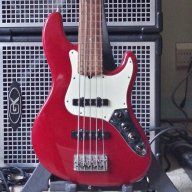
You might try Booty's rig. Hallelujah!
Amps and Cabinets
- two Crown Micro 5000 and 3600 power amps
- Crown 300 power amp (in the past)
- eight custom-made cabinets with Electro-Voice speakers: two 4x18s, two 4x15s, and four 8x10s
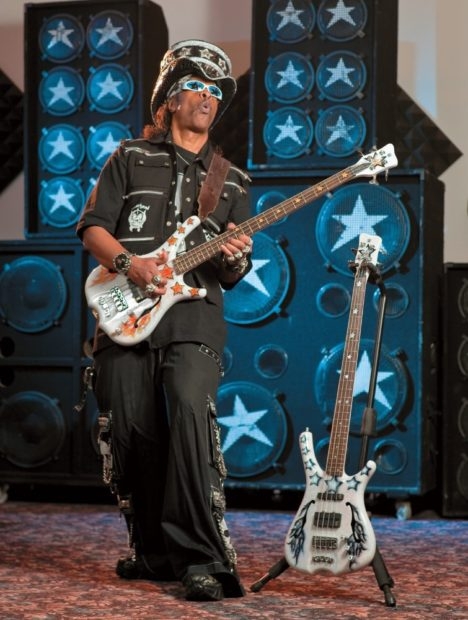
Amps and Cabinets
- two Crown Micro 5000 and 3600 power amps
- Crown 300 power amp (in the past)
- eight custom-made cabinets with Electro-Voice speakers: two 4x18s, two 4x15s, and four 8x10s
Amazing.
Looks like he takes being a star very personally.
I like that he still has fun. The people who came up in the late 60s were on another level.
I am thinking of trying a subwoofer that is responsive to 16hz. Surprisingly movies have low signal sounds in their music scores and the kids would like it for games. If I can get it integrated for movies games sterio systems and bass amp complimenting it wont feel like as much of a waste of money as this actually is.
Looks like he takes being a star very personally.
I like that he still has fun. The people who came up in the late 60s were on another level.
I am thinking of trying a subwoofer that is responsive to 16hz. Surprisingly movies have low signal sounds in their music scores and the kids would like it for games. If I can get it integrated for movies games sterio systems and bass amp complimenting it wont feel like as much of a waste of money as this actually is.
I could not hear it. If I get a subwoofer I will try it again.It's not long enough to be perceived as a single note or tone. But it creates the impression of the Genie being out of the bottle. Quite effectful.
Another rabbit hole is that a lot of movies tend to score soundtracks with use of low frequencies. Strange how this is such a controversial subject when it has been Hollywood for decades.
Very inspired by this. Just found a subwoofer that goes down to 16hz. Feel like it would be a moving experience.16Hz lowest note. Eight 15" speakers in a true infinite baffle (back wave dumped into the basement) Each one driven by a chassis with a pair of KT88s, so that would be about 500 watts.. Sine wave generator triggered by the pedals of a pipe organ, Unless a higher harmonic stop was pulled, couldn't hear it, just felt a throbbing pressure deep in the body. That feeling was what inspired me to play bass in a band when everyone else wanted to play guitar or drums, and playing the organ for Mass doesn't attract girls.
This was in the 60s, Father said the contra-bass plays directly to the soul. Learned that electronic sub-bass was common on the organs in smaller churches, it worked as the congregation effectively was seated inside a huge speaker cabinet.
Thanks to everyone for contributing very interesting posts. I still dont get half the science but appreciate the chance to learn from all who shared. Since it will be used for other things in the house like movies, music listening, gaming as well as boosting my silly but enjoyable rumble 40.
I am going to give this a try since it goes down to 16hz, I dont think it is loud enough for stage use but to try low bass experiments at home I think I will give it a try.
[Invalid or Expired Link Removed]
I am going to give this a try since it goes down to 16hz, I dont think it is loud enough for stage use but to try low bass experiments at home I think I will give it a try.
[Invalid or Expired Link Removed]
- Feb 12, 2006
- 61,014
- 5
- 220,866
- Disclosures
- Development Engineer-Mesa Boogie, Development Engineer-Genzler (pedals), Product Support-Genz Benz
Not strange at all, the low frequency extension channel is typically at least 3dB down at 30Hz and 27dB down at 15 Hz best case. It’s also heavily limited in post production. In a 500 seat auditorium, three are usually between 4 and 6 x 18” vented subs, large enclosures.I could not hear it. If I get a subwoofer I will try it again.
Another rabbit hole is that a lot of movies tend to score soundtracks with use of low frequencies. Strange how this is such a controversial subject when it has been Hollywood for decades.
It will take at least 6 - 8 of these to match the max SPL of a single Subway 115. There is a LOT of processing that’s done to achieve this LFE also.Thanks to everyone for contributing very interesting posts. I still dont get half the science but appreciate the chance to learn from all who shared. Since it will be used for other things in the house like movies, music listening, gaming as well as boosting my silly but enjoyable rumble 40.
I am going to give this a try since it goes down to 16hz, I dont think it is loud enough for stage use but to try low bass experiments at home I think I will give it a try.
[Invalid or Expired Link Removed]
I am really curious what my little subwoofer will do.Not strange at all, the low frequency extension channel is typically at least 3dB down at 30Hz and 27dB down at 15 Hz best case. It’s also heavily limited in post production. In a 500 seat auditorium, three are usually between 4 and 6 x 18” vented subs, large enclosures.
It will take at least 6 - 8 of these to match the max SPL of a single Subway 115. There is a LOT of processing that’s done to achieve this LFE also.
Strangely this thread also makes me want to see movies in theaters again so I can listen to the bass system. They should use the PAs more for co concerts in cinema halls since movies are slowing down. Or video game contests.
- Feb 12, 2006
- 61,014
- 5
- 220,866
- Disclosures
- Development Engineer-Mesa Boogie, Development Engineer-Genzler (pedals), Product Support-Genz Benz
There is very little difference these days between cinema systems and PA systems, they are mostly designed and manufactured by the same companies. The LOCATION of the speakers is different (behind the screen) is what makes up the primary difference.I am really curious what my little subwoofer will do.
Strangely this thread also makes me want to see movies in theaters again so I can listen to the bass system. They should use the PAs more for co concerts in cinema halls since movies are slowing down. Or video game contests.
It isn't similar to crossover distortion cause you are (in this case) might be be attempt just discussing transient noise spectrum rather than sinusoidal waveform spectrum.it's crossover distortion (for those familiar with a poorly biased Class AB amp,
Some "experts" may argue that
Signal A
sounds more musical versus
Signal B
Those "experts" may argue the very sharp edge at the (initial) beginning with signal B does generate artifacts similar like inappropriate bias.
The truth is, both signals A and B do sound just the same, both signals do generate just the same transient (noise) spectrum at their very beginning.
Of course servo drive woofers do suffer on some issues, yet these issues regarding servo drivers have got nothing to do with issues such as "well known" bias artifacts.
Last edited:

It's actually two separate factors: actual loudness VS perceived loudness by frequency. For an actual loudness of 125dB at 20hz you need about 16 SE18E-R subs.
If you are concerned with equal perceived loudness across the spectrum, 125dB at 20hz is near the 100 phon line.
View attachment 7025994
For equal perceived loudness of 100 phons, you need about 125dB at 20hz, 103dB at 100hz, 100db at 1kHz, and 89dB at 4kHz.
If the target is 100 phons, a single S18E-R can will easily give you the required 103dB/100 phons at 100hz. But you need about 16 S18E-R for 125dB/100 phons at 20hz.
16 cabs? I’d love to play through that. Just not carry it.
A stack of sixteen 18" subwoofers will play through you.16 cabs? I’d love to play through that. Just not carry it.
This driver in a proper enclosure would get you close with some usable output level. Not going to be cheap!!!
M-Force Technologies
M-Force Technologies
Jazzdogg
Less barking, more wagging!
I'd be looking at a small PA setup with a stick & sub. Just make sure you don't lose any frequencies that are important to you in the corossover range.I am considering building a 40 inch scale bass that is capable of playing ultra low notes. It seems that there are many obstacles on the electronics end with rig choice. Right now I just have a rumble 40 and don't want to start the build until I can figure out what I am up against gear wise to make the most of the future instrument. Thank you in advance for anyone sharing their solutions to what seems like a complex problem.
You haven't said what kinds of venues you intend to play, or how loudly, but if the venues provide good PA support, you shouldn't need a huge rig on stage.
Good luck!

Last edited:
- Feb 12, 2006
- 61,014
- 5
- 220,866
- Disclosures
- Development Engineer-Mesa Boogie, Development Engineer-Genzler (pedals), Product Support-Genz Benz
The driver alone is roughly $4k and requires a special power amp to drive it due to the very low impedance.This driver in a proper enclosure would get you close with some usable output level. Not going to be cheap!!!
M-Force Technologies
I’m not sure where you got those waveform pictures, but what you’re showing is clearly not an illustration of crossover distortion. I stand by my earlier statements. When I talked to Tom Darnley about it, he was the one that first used that terminology to describe what I had observed in the prototype we were working with.It isn't similar to crossover distortion cause you are (in this case) might be be attempt just discussing transient noise spectrum rather than sinusoidal waveform spectrum.
Some "experts" may argue that
Signal A
View attachment 7026955
sounds more musical versus
Signal B
View attachment 7026956
Those "experts" may argue the very sharp edge at the (initial) beginning with signal B does generate artifacts similar like inappropriate bias.
The truth is, both signals A and B do sound just the same, both signals do generate just the same transient (noise) spectrum at their very beginning.
Of course servo drive woofers do suffer on some issues, yet these issues regarding servo drivers have got nothing to do with issues such as "well known" bias artifacts.


