
Is there a specific reason why the Roscoe bridge is so much thicker than the standard Hipshot?

Enjoy the benefits of a premium membership!
Upgrade Account
-
TalkBass has been independent since 1998. Add your voice.
Create a free account to reply to discussions, view embedded media, and browse with fewer display ads.
Join free Log in
Want zero display ads or expanded classifieds tools? Compare plans.
You are using an out of date browser. It may not display this or other websites correctly.
You should upgrade or use an alternative browser.
You should upgrade or use an alternative browser.
Roscoe Club
- Thread starter JOME77
- Start date
More options
Who Replied?

Is there a specific reason why the Roscoe bridge is so much thicker than the standard Hipshot?
Keith had Hipshot design it so the varied thickness of the base plate followed the 16” radius of the fingerboard. The theory here would be if the entire bottom of the saddle contacted the bridge base plate you would maximize sustain. Which is great if the angle of the neck pocket is exactly correct. The problem is that if the angle of the neck pocket is too low in the deepest end then the saddles bottom out with higher action than some players desire. Then you either have to shim the neck, scribe then neck pocket or switch to the standard Hipshot bridge with the thinner base plate (which allows the saddles to be lowered more).
Last edited:
Keith had Hipshot design it so the varied thickness of the base plate followed the 16” radius of the fingerboard. The theory here would be if the entire bottom of the saddle contacted the bridge base plate you would maximize sustain. Which is great if the angle of the neck pocket is exactly correct. The problem is that if the angle of the neck pocket is too low in the deepest end then the saddles bottom out with higher action than some players desire. Then you either have to shim the neck, scribe then neck pocket or switch to the standard Hipshot bridge with the thinner base plate (which allows the saddles to be lowered more).
And I can't hear any difference in tone or sustain between the standard and Roscoe bridge. If there is any it is very minimum.
Mark

Joe didn’t mention his beloved pin router by name… they must be on the outsKeith had Hipshot design it so the varied thickness of the base plate followed the 16” radius of the fingerboard. The theory here would be if the entire bottom of the saddle contacted the bridge base plate you would maximize sustain. Which is great if the angle of the neck pocket is exactly correct. The problem is that if the angle of the neck pocket is too low in the deepest end then the saddles bottom out with higher action than some players desire. Then you either have to shim the neck, scribe then neck pocket or switch to the standard Hipshot bridge with the thinner base plate (which allows the saddles to be lowered more).

Joe didn’t mention his beloved pin router by name… they must be on the outs
Lol
I love the pin router Matt but since I can purchase a new Hipshot Standard Type A bridge for the cost of shipping one way. The Pin Router fix is to costly.
Last edited:

I am also looking for one of the older grey undercover bags in good condition if anyone wants to part with one. Thanks!
So the bridge swap was fast and easy and made a huge difference
Action is nice and low and the saddles still have room to move in either direction
Thanks @scubaduba
Action is nice and low and the saddles still have room to move in either direction
Thanks @scubaduba
Shouldn’t the ground wire be coated and spreadable? Never seen one like this. And this bass does have EMI noise
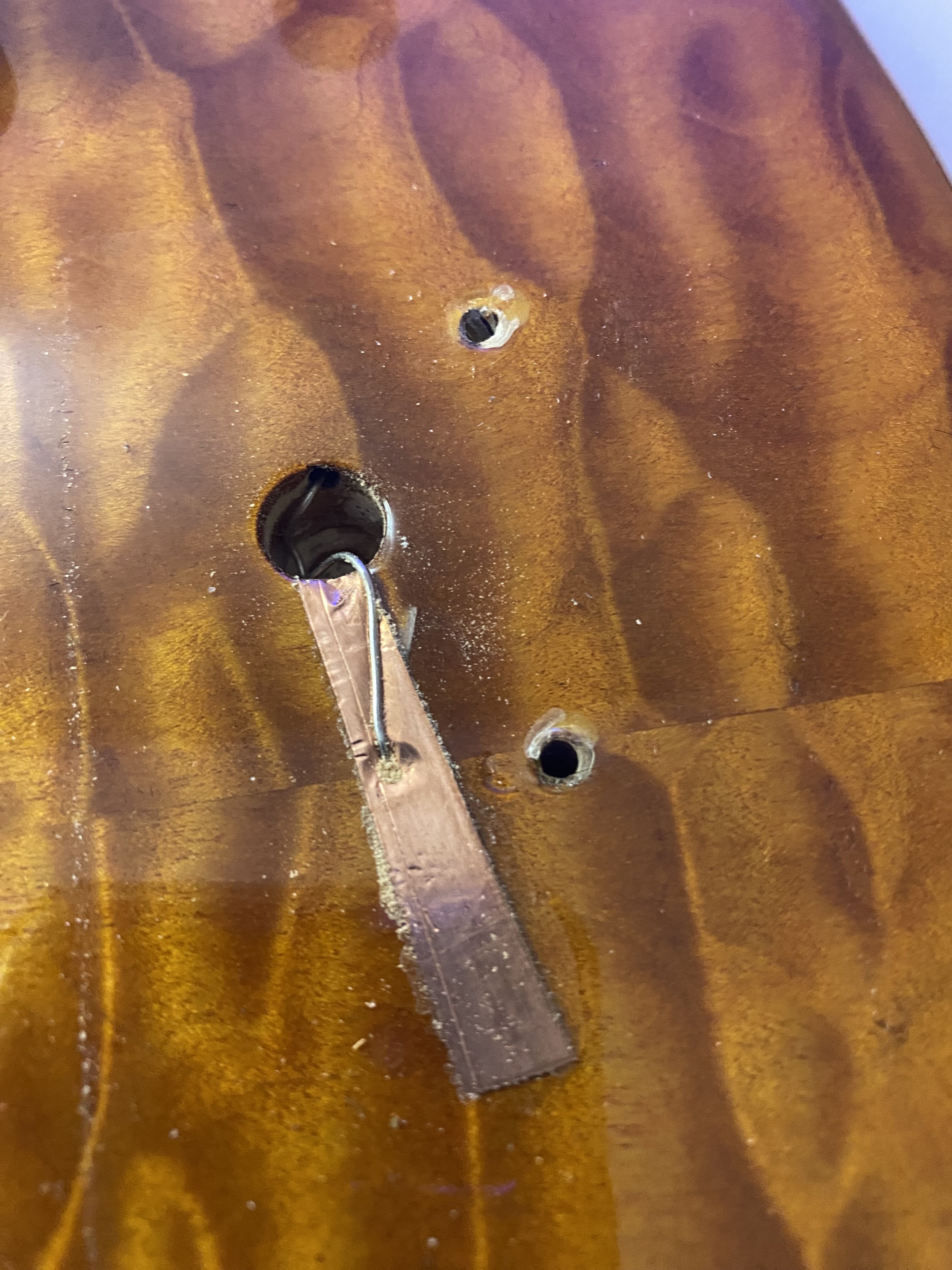
Shouldn’t the ground wire be coated and spreadable? Never seen one like this. And this bass does have EMI noise View attachment 5281256
As long as there’s continuity between the bridge/strings and ground at the pots and shielded cavity you’re fine. I always check it with a VOM.

[Invalid or Expired Link Removed]
Headless, unlined fretless LG5.
That's a cool bass, for sure, but the price seems high for Standard Plus type neck construction. Also, I really think the headless Roscoe is a better bass at the Custom or Signature levels. "More" (bling) is needed for less of a bass (headless) in my experience.
However, if I played that "Custom Standard Plus" and loved it, I'd probably go for it in a heartbeat. It's a great feeling when a Roscoe exceeds expectations, and I've been fortunate for that to be the case many times. And, a headless Roscoe is an extremely special bass.
That actually has a carved body. I'd say it is a Custom (other than the 3 piece maple neck (which Pedulla and Fodera use or used on their basses) which was probably at the request of the customer. Not a bad price if you want a headless Roscoe.
Dang, I came in here to post that bass, but Steve beat me to it... the GAS burns strong in him 
Dang, I came in here to post that bass, but Steve beat me to it... the GAS burns strong in him
May the force be with him!

It does burn, but I think realistically, I probably have all the Roscoes I'll have. They have just gotten too expensive. Even used. Some are a bit overpriced, but for all basses of this calibre, they are just expensive. I will always love the 2 Roscoes I have, but I may have to set my sights just a little bit lower for a fretless (or any other addition) and that's ok. Like I tell my students, and my own son, there are many quality instruments out there that won't break the bank. Roscoe fretless basses are the best for sure, but I can probably find something very playable for 1/2 the price.

So true Steve, I used to be all boutique all the time, still have a Signature SKB3005 Roscoe, my avatar custom built Dingwall SJ5XXX, CS NOS '59 P, and a second owner '66J, but I have discovered the fun of designing and having parts basses built. I sold a Lull T5, and it has financed 4 builds (all under $1k) and I also play Epiphone Thunderbirds which are all $500 or less. My band says I sound like me on all of them.
Last edited:

I bought an inexpensive older Yamaha 5 string and had it defretted….I use it when I sub at Wicked on Broadway and I get compliments on it all the time. I adore hand made masterpieces for sure, but we don’t need them to do the job….especially if it’s not an instrument that’ll get a lot of use.It does burn, but I think realistically, I probably have all the Roscoes I'll have. They have just gotten too expensive. Even used. Some are a bit overpriced, but for all basses of this calibre, they are just expensive. I will always love the 2 Roscoes I have, but I may have to set my sights just a little bit lower for a fretless (or any other addition) and that's ok. Like I tell my students, and my own son, there are many quality instruments out there that won't break the bank. Roscoe fretless basses are the best for sure, but I can probably find something very playable for 1/2 the price.
Just remember, if our wives didn't compromise/settle, a lot of us would be single 
This is my #1, my most expensive build at just under $1k, it is my main gigging bass, my backup is an Epiphone Vintage Pro Thunderbird I paid $400 for and is used for 1 set each gig, displaced the white Thunder J.So true Steve, I used to be all boutique all the time, still have a Signature SKB3005 Roscoe, my avatar custom built Dingwall SJ5XXX, CS NOS '59 P, and a second owner '66J, but I have discovered the fun of designing and having parts basses built. I sold a Lull T5, and it has financed 4 builds (all under $1k) and I also play Epiphone Thunderbirds which are all $500 or less. My band says I sound like me on all of them.
[Invalid or Expired Link Removed]
Headless, unlined fretless LG5.
Super, super cool. But would def be a luxury purchase.


