• TalkBass has been independent since 1998. Add your voice.
    Create a free account to reply to discussions, view embedded media, and browse with fewer display ads.
    Join freeLog in
    Want zero display ads or expanded classifieds tools? Compare plans.

Roscoe Club

Or, line em up at the bridge, your choice and no big deal:

Bridge Jazz.png
 
Last edited:
Re-scaling the bodies for the string's scale length actually skews the visual accuracy. For an accurate comparison, you will need to line up the bridges.

So Gardfather,

Two bits of info please.

First bit: are all Century bodies the same size (length), all SKB bodies the same size and all LG bodies the same size? Bottom line is does the body size change at all based on the scale length?

Second bit: are there any adjustments made to the position of the bridge (relative to the end of the body opposite the neck) for differing scale lengths (is the bridge the same distance from the end of the body on a 32" four string LG as it is on a 35" six string LG) ?
 
I'm looking at all three and you can see the differences from each to the next. (I'm assuming it's 34", 32", and 30").

Hey Freddels

Yep, you got it!

Here is a vague representation on a 34" vs. 35" Roscoe with my 32" medium thrown in for great measure. Probably half a dozen reasons why this isn't 110% accurate, but it is based in Illustrator on the SCALE length. That is - all three basses are true in length from the nut to the 12th fret. The one on the left is exactly 16" from nut to 12th fret, the one in the middle is exactly 17" from the nut to the 12th fret and the one on the right is exactly 17.5" from the nut to the 12th fret. Everything else being equal (it's not) that makes the one on the left a 32" medium scaler, the one in the middle a 34" long scale and the one on the right a 35" scale. Obviously, I scaled it way down from there in order to post. Both lined up at the nut and bridge versions: Both 4 stringers because I am a 4 string guy.

NUT R4.png
Bridge R4.png


By the way YES - these are actual photos left to right of Roscoe Medium 32" scale, 34" scale and 35" scale.
 
Last edited:
So Gardfather,

Two bits of info please.

First bit: are all Century bodies the same size (length), all SKB bodies the same size and all LG bodies the same size? Bottom line is does the body size change at all based on the scale length?

Within a few millimeters, yes. (they are hand-shaped and finished, so there is minor variation), there is no change in size due to scale length, but the neck pocket does move slightly as do the pickups.

Second bit: are there any adjustments made to the position of the bridge (relative to the end of the body opposite the neck) for differing scale lengths (is the bridge the same distance from the end of the body on a 32" four string LG as it is on a 35" six string LG) ?

Yes, the bridge is indeed in different locations based on the scale length. A shorter scale length will bring the bridge slightly closer to the neck pocket.

Invalid Link Removed

The top photo is a 34" scale length LG Custom 5, the bottom is a 35" scale length LG Custom 5, and while the photos are not exactly to scale, you can easily see the difference between the two as to where the bridge is located - particularly in the upper rear corner of the bridge, you can see how much more "real estate" there is in the top photo when compared to the bottom one. :) The neck pocket is cut slightly forward and the pickup routs as well, to compensate for the difference in overall length.
 
So Gardfather,

Two bits of info please.

First bit: are all Century bodies the same size (length), all SKB bodies the same size and all LG bodies the same size? Bottom line is does the body size change at all based on the scale length?

Second bit: are there any adjustments made to the position of the bridge (relative to the end of the body opposite the neck) for differing scale lengths (is the bridge the same distance from the end of the body on a 32" four string LG as it is on a 35" six string LG) ?

Actually one more question will settle this for me. I know that the end of the upper horn on my Century is at the 12th fret. If you built a 34" scale Century four string, would it's upper horn also end at the 12th fret?
 
  • Like
Reactions: JOME77
Actually one more question will settle this for me. I know that the end of the upper horn on my Century is at the 12th fret. If you built a 34" scale Century four string, would it's upper horn also end at the 12th fret?

Not exactly the same size photos, but you can see that the strap button ends up in essentially the same location on both a 34" 4 string and a 35" 5 string, right at the 12th fret. This is because of the adjustments in how construction is done with them, demonstrating the whole "moving both ends to the middle" method of adjusting scale length so that they feel balanced no matter what the scale length might be. This starts to fall off a bit at greater changes (we've even made a 30" 6 string! o_O), as other considerations start to enter into the picture from an engineering standpoint.

Invalid Link Removed
 
  • Like
Reactions: evilgus and JOME77
Within a few millimeters, yes. (they are hand-shaped and finished, so there is minor variation), there is no change in size due to scale length, but the neck pocket does move slightly as do the pickups.


Yes, the bridge is indeed in different locations based on the scale length. A shorter scale length will bring the bridge slightly closer to the neck pocket.

Invalid Link Removed

The top photo is a 34" scale length LG Custom 5, the bottom is a 35" scale length LG Custom 5, and while the photos are not exactly to scale, you can easily see the difference between the two as to where the bridge is located - particularly in the upper rear corner of the bridge, you can see how much more "real estate" there is in the top photo when compared to the bottom one. :) The neck pocket is cut slightly forward and the pickup routs as well, to compensate for the difference in overall length.

So, assuming that a 35" scale Roscoe will require the same "reach" as a 35" scale Fender is not valid. The Fender design increases the body length (same pocket length) and increases the neck length. Both directly resulting in having to reach farther for the first fret.

A 35" scale Roscoe is the same overall body length, a longer neck pocket, and a repositioned bridge. The last two directly counter-acting the increased "reach".

Like I said originally, not all 35" scales are created equally. :cool:
 
So, assuming that a 35" scale Roscoe will require the same "reach" as a 35" scale Fender is not valid. The Fender design increases the body length (same pocket length) and increases the neck length. Both directly resulting in having to reach farther for the first fret.

A 35" scale Roscoe is the same overall body length, a longer neck pocket, and a repositioned bridge. The last two directly counter-acting the increased "reach".

Like I said originally, not all 35" scales are created equally. :cool:

Hey Johnny

As far as I know, I wasn't disputing anything with reference to Roscoes vs. Fenders? My point went completely misunderstood apparently. Pacman posted a rather hard to understand version of the difference between the reach of a 34" Roscoe vs. a 35" Roscoe which only showed a small portion of the fingerboard. The point was to illustrate that there was a very insignificant difference between the two.

I was simply trying to provide a better view. For me showing a portion of the fingerboard says nothing about the "reach" of a Roscoe 34" scale vs. the "reach" of a 35". My examples were posted as an attempt to clarify that. If you look carefully at the photo of the Roscoe's with the bridges lined up, you can clearly see that there is a bigger difference between the reach of the two than what Pacman illustrated in his post. I would call the difference significant, frankly. For that reason, I find his post a little misleading.

I brought in the Fender examples because as far as I know - at least Fender Japan - they are one of the few companies who actually scale their bodies - so I thought it made for an interesting comparison. It wasn't my intention to offend anyone.

Back to the Roscoe worship, of which I am a big fan and a big part of.....
 
Last edited:
Not exactly the same size photos, but you can see that the strap button ends up in essentially the same location on both a 34" 4 string and a 35" 5 string, right at the 12th fret. This is because of the adjustments in how construction is done with them, demonstrating the whole "moving both ends to the middle" method of adjusting scale length so that they feel balanced no matter what the scale length might be. This starts to fall off a bit at greater changes (we've even made a 30" 6 string! o_O), as other considerations start to enter into the picture from an engineering standpoint.

Invalid Link Removed

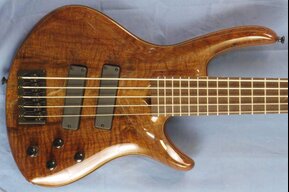
Wonderful scale discussion ....... but I Love the look of that bottom Roscoe top. Is that cocobolo?
 
Actually one more question will settle this for me. I know that the end of the upper horn on my Century is at the 12th fret. If you built a 34" scale Century four string, would it's upper horn also end at the 12th fret?

Good question Johnny and good answer based on Gards photo. As the saying goes "a picture is worth a 1,000 words".

Bottom line, IMO, the position of the strap button on the upper horn (in relation to the 12th fret or maybe more important in relation to the 1st fret) affects how a bass play (ergonomically) more than the 34/35 scale.

Ok Fred, you can now sell the Pedulla 6 and replace it with a 35" scale Roscoe! But you might need a Century model (on account of the fact that you are a bit sensitive). :D

Just kidding Fred! ....
 
Last edited:
Ok Fred, you can now sell the Pedulla 6 and replace it with a 35" scale Roscoe! But you might need a Century model (on account of the fact that you are a bit sensitive). :D

Just kidding Fred! ....
I'm hurt. Hurt I tell ya.

Well, let's add a little more to the pot to stir . . . what about the nodes/antinodes in relation to the pickup placement on the 34"/35" bass. For the sake of discussion, you can ignore the length of the horn. :D
 
I enjoyed seeing and hearing James Cook's (Luke Bryant) Roscoe 5er on Rocking New Years Eve, great tone and playing.

On the whole body versus scale thing, as some Roscoe/Dingwall cross-threaders may know, I went from P5s to Dingwall this year in order to get closer to 8 lb weight. We were breaking in my long time Rock drummer to my Country band, requiring long practice sessions which was causing me some back issues even though my main P5 was only 9.2 lbs. I got an 8.1 lb Dingwall AB1 5er and an 8.3 lb SP5. Problem solved, no more back pain. Then the owner of the SP5 wanted to buy it back, so I let him have it back and have a custom SJ5 XXX on order.

So now, back to Roscoe content. My avatar SKB3005, at 9.2 lbs had been relegated to home use (and eventual gigging use), but I decided to try it for practice while awaiting the SJ5XXX and after 2 long practices realized I wasn't experiencing any back pain. So a 9.2 lb Fender P5 for 2+ hours = lower back pain, 2+ hours with a 9.2 lb Roscoe, no pain! I attribute it to superior Roscoe balance.
 
Spent about 3 hours playing my lined fretless this past Sunday. When I play my fretted bass, my fingers land right behind the fret when I am playing but on my fretless it like I see the side marker and it throws me off a little. On my fretted, I don't have to look down much at all, I am guessing it is because of muscle memory and feeling the frets under my fingers when I move around the neck? I am thinking of blacking out the side marker dots on my fretless to see if this makes a difference at all. Anyone else experience this, is it my vision overriding the muscle memory?

I forgot how sweet a fretless Roscoe sounds as it has been awhile since I have owned or played one. I think I am going to spend 80% of playing time on the fretless over the next month to see how it goes.
 
  • Like
Reactions: JLY
The only problem with that is that once you play the note and your ear hears you're out of tune, everyone else hears it too. Unless you're blind, I am of the opinion that you should use all your senses to play a fretless to play in tune. Some of the best fretless players in the world use visual cues to aid in intonation, there's no shame in it at all. It's also my experience that most fretless players who think they play in tune do not all of the time. I've heard Steve Bailey play many times and of the pro fretless players he has the worst intonation. That's not to say he's always out of tune, not at all, but he's out a good bit.

Don't black them out. Just use your ears more and your eyes less. Don't worry about where your fingers land. I can go from lined fretless to unlined fretless to fretted without much issue.