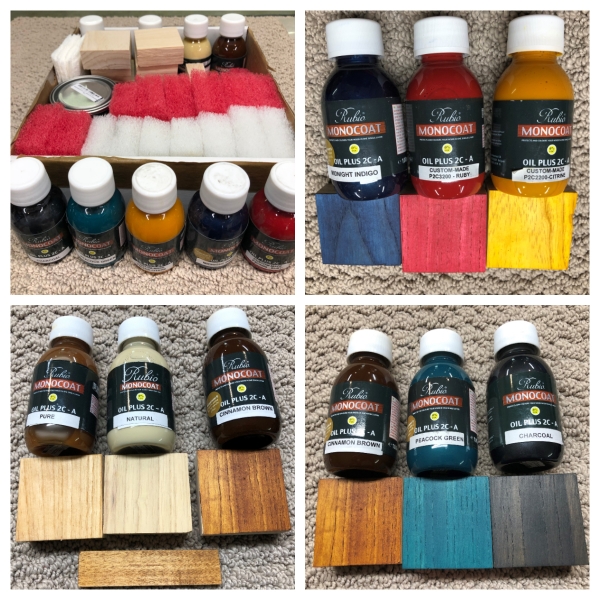
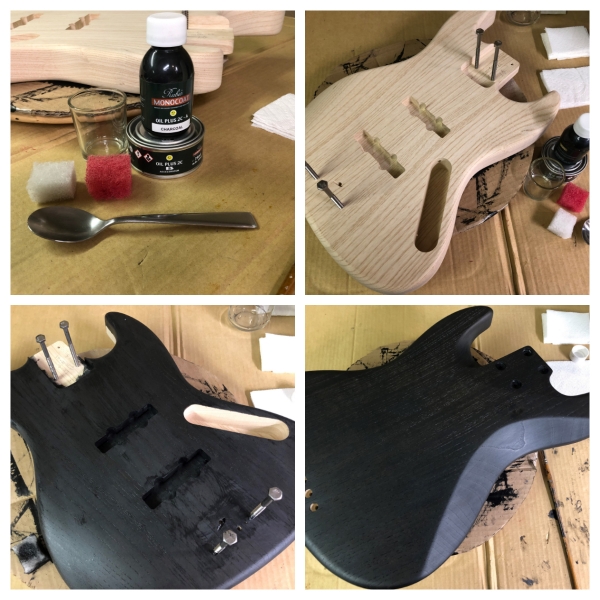
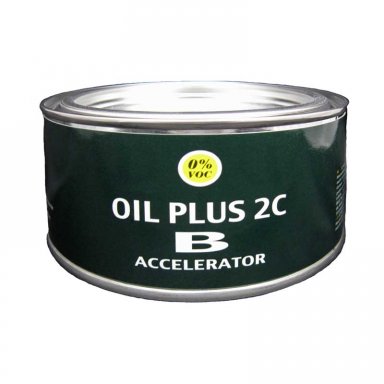
Copying this from the Water-Base Finishes thread. Rudy and Brad above have already provided some of the answers to my speculation:
Hey Rick;
First, I have to state that I have not personally tried Rubio Monocoat. I'm just commenting on what I'm reading from their literature.
What they've made is an improvement on a wax-type finish. They've found a way to make the "wax" chemically harden and bond better to the wood fibers. And it's "natural", that is, not using nasty petroleum-base solvents. All good, a worthwhile innovation. As a side note, their flax-base chemistry is probably quite similar to what Rocklite is using in their synthetic ebony.
Anyway, back up and understand the difference between a wax-type finish and a varnish-type finish.
A wax finish is typically rubbed on with pressure, pushing the finish deep down into the pores. Hardly any of the finish is left on the surface. The wax in the pores seals up the wood and prevents moisture from soaking in and causing swelling and cracking. That's all good. In a traditional wax finish, the wax always stays somewhat soft, and the wood needs to have some more wax rubbed in from time to time.
But the key thing is that a wax finish leaves almost nothing on the surface of the wood to protect it against abrasion and scratches. A wax finish seals up the wood, but it doesn't really mechanically protect it much. Other than the surface tends to be slippery, so things hitting it will tend to slide rather than dig in.
On the other hand, a varnish-type finish sinks into the pores, but it also leaves a coating over the surface. The coating dries hard and has some thickness. It's a full barrier that seals the wood up and covers the surface to protect it from mechanical abrasion. Polyurethane and polyester varnish finishes leave a coat of hard plastic on top of the wood.
The so-called Oil Finishes, such as the classic Tru-Oil, are kind of in-between, because they can be applied either way. If you wipe on a single coat of Tru-Oil, and immediately rub it all off, it pushes down into the pores and leaves almost nothing on the surface. Unlike pure wax, Tru-Oil has some, you know, chemicals in it, so it hardens up in a week or two. Left like that, just a single coat, it's effectively a hardened wax-type finish. It's commonly called an Oil Finish, because the part looks and feels almost like bare wood, but darkened somewhat by the amber tint of the Tru-Oil. As if you'd just wiped the wood with some oil.
Now, if you continue to apply coat after coat of Tru-Oil, then it builds up on the surface and hardens. It becomes a varnish-type finish; a hard coating on top of the wood, which protects it against mechanical abrasion.
Oil Finishes, such as Tru-Oil, Tung Oil Finish, etc., can be applied as a wax-type finish, with no real protection against abrasion. Or, they can be built up into a varnish finish, putting a protective coat on the surface.
Back to the original question about Rubio Monocoat:
From reading their material, it appears that Monocoat is an actual wax-based finish, with some additional (flax-based) chemistry that hardens it to some level. Plus some color pigment added. You wipe it on, it pushes down into the pores, and leaves a very thin coat on the surface, which hardens. So, it's tougher than if you had just rubbed it with colored wax.
They say that a second coat is unnecessary, and not recommended. I think that means that it doesn't bond to itself. Wiping on more, it just wipes back off. What you'd expect from a wax product. Rubbing it in will jam it into the pores, and it bonds to the wood, but it doesn't really bond to itself.
So, you really can't build it up into a varnish, a thicker protective coat on the surface.
My guess (and I haven't tested it) is:
1.) It's very quick and easy to apply, a fast way to color a piece of wood.
2.) It takes a week to a month to fully cure
3.) It has good resistance to moisture.
4.) It has minimal resistance to abrasion. I suspect it easily scratches and dulls.
5.) When it gets scratched, it's probably difficult to touch up or repair. Can you just rub some more on, like Tru-Oil? They don't really talk about that.
6.) If you can't recoat it, can you control the color to get it even or the right shade?
7.) I doubt that you can overcoat it with some other clear varnish like polyurethane. It probably won't bond to it. It's wax-base.
The main point is: When they talk about a wax-type finish being durable, they mean that it keeps the wood sealed up against moisture. Which is the main purpose of a finish.
But durability in terms of resistance to mechanical abrasion, that's what varnish-type finishes are for.
Wax-type finishes are used in some places to protect floors. And they do protect the wood against moisture. But they are abraded and scratched on the surface. That's the style.