• TalkBass has been independent since 1998. Add your voice.
    Create a free account to reply to discussions, view embedded media, and browse with fewer display ads.
    Join freeLog in
    Want zero display ads or expanded classifieds tools? Compare plans.

Sanding the back of a neck

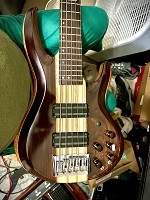
I posted this in the Rickenbacker thread but I didn't get any replies so I hope this is the right place to post: I want to sand the gloss off the back of my Rickenbacker 4003 neck. I've done this before with my Fenders but I'm really scared to try it on my Ric. Some people say use the green scotch Brite pads but I haven't had luck with them. I've used sandpaper in the past. I used 320 grit which I know is probably too much. I don't want to ruin my bass because once I start, there's no going back. Any help would be appreciated.

 
I already have the set of micro mesh pads from Stewmac. Would those be any good? Also, would a finer grade of sandpaper be advisable?
Can't say but here is a link to a write up about the process used with micro mesh (post #4) to remove the gloss, end up with a deep shine and give it the feel of satin neck so I guess it depends on your purpose for getting rid of the gloss…
How do I take the gloss off my guitar neck?
 
How long should the sandpaper soak? How does the drop of dish soap help?

If you're serious about a super-slick neck, I'd make these adjustments to the process:

*1500 grit sandpaper. I use 2000 because I have a ton of the stuff for rejuvenating headlamps...that's another thread.

*Skip the water and dish soap...use mineral oil while wet-sanding.

*Use some naptha on a rag to wipe off the spoil.

You'll get better uniform results using this approach.

Riis
 
  • Like
Reactions: Drredplate
How long should the sandpaper soak? How does the drop of dish soap help?
Long enough to get saturated. The moisture keeps the bit of sandpaper (I usually cut a rectangle 1"x2") against the neck and collects the bits of finish you sand off, and the soap keeps things friction-free. Or you could use some mineral oil as suggested above, but not everyone has that handy, and almost everyone has dishsoap.

An important note: you are merely breaking the gloss finish here, rather than sanding to bare wood or even removing a significant amount of finish. If done correctly, the neck could be buffed back to a gloss with the remaining finish, so you're not really doing something as permanent as it sounds.
 
  • Like
Reactions: RSBBass
ScotchBrite pads are good but you need a finer one than a green. Someone will be along to tell you what color as I don't remember.
Fine grade white #07445 pad

I used what my wife bought the one time I did it. I used the green and just didn't lay into it. Lightly buffed until I got the results I wanted.
 
Last edited:
  • Like
Reactions: RSBBass
If you're serious about a super-slick neck, I'd make these adjustments to the process:

*1500 grit sandpaper. I use 2000 because I have a ton of the stuff for rejuvenating headlamps...that's another thread.

*Skip the water and dish soap...use mineral oil while wet-sanding.

*Use some naptha on a rag to wipe off the spoil.

You'll get better uniform results using this approach.

Riis
I wouldn't use mineral oil. If you break through the finish to the underlying wood, the oil will soak in on that spot
 
  • Like
Reactions: Zooberwerx
I wouldn't use mineral oil. If you break through the finish to the underlying wood, the oil will soak in on that spot

Yeah, I had to google this one given your comment. It's almost a Catch-22 and per the notes: the "cut" of the fine-grit paper and mineral oil is lower than that of other pairings and intended to prevent plowing-thru the finish to the bare wood. That being said, I would hate to attack a stain on any surface...the stuff is tenacious!

Riis
 
I've never used mineral water and I don't think I even know where I would get it so I won't be using that. Lots of great advice here. Thanks everyone!
I never had any worries doing this to my Fenders but I'm so scared to try this on my Ric. I don't know why. Maybe because it's a neck through so I can't remove the neck and I don't want to damage the bass. I'll be giving this a shot soon.
 
I've done this on production necks for friends/clients (the basses I own are ones where I did satin finishes on them, so they don't need this), and depending on the finish, sandpaper in the range of 800 or 400 grit seems to be the sweet spot - it depends on the finish material as to what works best. Start with 800, and if that doesn't do it, try 400.

Important: This should take all of 2 minutes. If it takes longer, you're doing more than is needed. Done carefully, most production basses have plenty of finish on them; so long as you don't overdo it, the risk of going through the finish with a poly finished bass is minimal.