No problem with both, but i preffer bolt on, i think they are more interesting in tone. When it comes to setting up the neck, it is easier with bolt on type.

TalkBass has been independent since 1998. Add your voice.
Create a free account to reply to discussions, view embedded media, and browse with fewer display ads.
Join free Log in
Want zero display ads or expanded classifieds tools? Compare plans.

I just spent months going through unnecessary hell trying to decide on a Stage 1 or LX. Video comparisons didn't really show much and no stores near me have either one so I settled on the LX (for money reasons) and honestly it sounds so "Warwicky" I can't see the extra $1000 for NT making much of a difference. So I am glad I made that decision. Yes, the woods can be different, usually the neck. They both have US Cherry bodies, Stage 1 has maple neck and LX available with Ovangkol.If if does matter I would think contact area between the neck and body would have an impact. I've wondered about this topic myself because a Warwick Streamer LX bolt on is cheaper than a Stage 1 neck through. If there is no difference then why spend the $$. However, there maybe other differences such as type of wood so how do you compare?
Yes and no. For example, Thumb NT has a mids knob while the BO does not. So even comparing while set to passive/EQ bypass, it is sort of irrelevant if the option to tone shape is different simply based on NT/BO. The streamer Stage 1 (NT) has a 4 piece maple neck while some LXs (BO) have ovangkol. On top of that, lol, the LX and Stage 1 have the same electronics package while the Stage 2 has a mids knob.Warwick offers some of their models with each type and it seems to me that would be the way to compare the two configurations.


First of all, they're screwed on, not bolted
Yes, there is a difference.
.


I like the ergonomics of a neck through but prefer the safety of a detachable neck, in case it needs shimming. I had to shim a very cheap bass. Whenever I buy something cheap and unseen, a set neck is a complete gamble.I've never been able to tell the difference--even with just a bass comparison and no other instruments. Surely, no one will be able to tell in a band setting. That includes the audience. I think it simply comes down to personal preference on how one likes his/her bass built.
In my experience, it's there, but depending on the bass, the amount of difference varies somewhat.
The neckthrus tend to carry through to the amp (or put another way, not lose them) the first several harmonics. But that's very dependent on the woods in the laminate and the fingerboard, harder woods being better for this to happen. One of my Alembic fives was rock maple/walnut with their standard 1/4" ebony fingerboard. Hit a low C, and you could hear those first several harmonics almost like a beat or a grinding timbre within the note you'd hear. The BB5000's would do this, but you really had to listen close, it wasn't as in your face as that one particular bass.
Basses with 'separate' necks (screw-on or the rare glue joint instrument) tend to 'interrupt' this process, and I tend to attribute this to the neck joint. Obviously still 'bassy', but more in that 150-300hz range (which is the freq range most of us hear as bass anyway). That those small handful of deep harmonics is possibly missing is no big deal for most, and is so amp- and axe-driven as to be overlooked and not missed in the real world anyway.
Usually the 'sustain is better' idea gets trotted out, and if it's true, I'd think it would show in recording far more than playing on stage. Most loud stages, a $100 flea market find is going to sustain, so for me this was always a non-starter in the real world.
Something to me that gets overlooked in this is wood recipe. When this question comes up, it tends to imply 'Is X-neckthru going to sound different/sustain better/etc., than a Fender?' The neckthrus tend to be more complex wood-wise than the usual alder/maple Fender, and I think there's something to that: Aside from Spectors, there are very few neckthrus that use the 'white' woods, and Spectors still have 'dark' fingerboards like some Fenders, and yet . . . . . most would not think a 4-string NS with a P/J layout sounds like a similarly-equipped Fender.
After all these years, to me the real advantage of neckthrus is that they're 24 frets and IF you want to play up the neck, it's far easier, aided by not having that block at the heel for the neck screws. There's just something 2 cool about that deep cutaway and the extra high notes / room at the end of the fingerboard.
After all three BB5000's and two Alembics, this is my experience with neckthrus. Your results . . . . may vary.
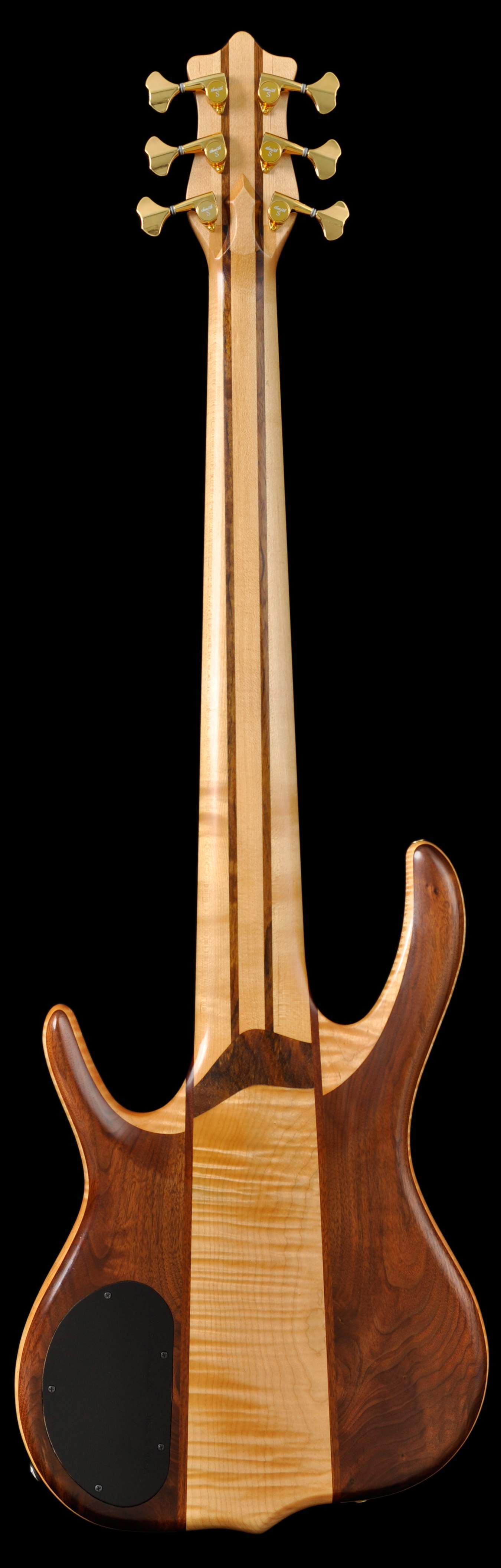
I was skeptical about the difference, but the kicker for me was my first Ken Smith. I could definitely tell the difference with that particular bass. I don't claim to be able to hear the difference on a recording, but neck-through basses can sound different than bolt-ons because of the neck attachment. I think you could build a neck-through that sounds like a bolt-on, but I don't think you could build a bolt-on that sounds and plays like that Ken Smith with all of the laminates.
Which implies that there are measurable differences coming from other sources. Likely the indivuality of the trees cut down to make the things.People have done tests creating through, set and bolt configurations using the same pieces of wood and done signal analysis on the results. There's no consistently measurable difference.
Which implies that there are measurable differences coming from other sources. Likely the indivuality of the trees cut down to make the things.

This implies that the electronics bring in more difference than the construction, which is what ought to be thrown in the face of all tonewood debaters and other hagglers of minuscule, irrelevant things. They are discussing details that do not matter.I feel that bolt ons are indeed snappier while neck throughs have a smoother, rounder sound...but I can only really hear this playing them unplugged.
Once I plug in, I don't hear THOSE particular differences.


There are characteristics that you can recognize when you play a bass. For example, in order to hear the difference between Jazz and Precision bass pickups, you don't have to have two identical basses with each types of pickup. I have owned more than 50 basses thus far, and I have been able to glean characteristics from variations in the designs. Granted, this is anecdotal and not a scientific double-blind peer-reviewed test, you'll have to go elsewhere for that.You heard the difference between b.o and n.t on ONE bass?
How did you do that?
Same response screw-on (bolt-on) neck vs. neck-through, can you hear the difference?Do you have an otherwise identical bass that is bolt on to compare against?
This implies that the electronics bring in more difference than the construction, which is what ought to be thrown in the face of all tonewood debaters and other hagglers of miniscule, irrelevant things. They are discussing details that do not matter.
An 8th of a turn on any potentiometer in the chain makes more difference in sound than all the wood, hardware and construction hype guitar makers or shop holders are selling to the gullible.Possibly.
I think the type of wood used DOES make a difference in sound to some degree, but every little bit of electronic processing starts to cover up that difference.
Once the signal goes from pickups to EQ through a cord into your amp and the sound comes out of the speaker, something has to change. I mean, even a room's size and acoustical properties can change the sound.
To be clear, I'm also speaking about basses with active EQ. I haven't played a passive bass in a long while. And I think active EQ definitely colors the sound, which is why some prefer specific preamps. And of course, pickup placement.


Most people would be able to hear the difference between a P and a J or a Stingray or aThere are characteristics that you can recognize when you play a bass. For example, in order to hear the difference between Jazz and Precision bass pickups, you don't have to have two identical basses with each types of pickup. I have owned more than 50 basses thus far, and I have been able to glean characteristics from variations in the designs. Granted, this is anecdotal and not a scientific double-blind peer-reviewed test, you'll have to go elsewhere for that.