Yeah,I’m 70 so basically grew up with Phil and Casady being my main influences, Phil did start off with a Jazz bass, I think that’s on the first album, and I’ve always been able to get a good Phil sound with my ‘65 Jazz, the secret was to play with a pick in that area between the neck and neck pickup, nice full sound but with a lot of clarity going through 15” D140s and a Dual Showman head.I agree. I'm not a Deadhead, but I've played in bands with Deadheads, so I've ended up playing some of their tracks over the years and I'm now in a short-term Dead cover band. I love playing their stuff largely because it's so fun to develop my own parts while staying faithful to the tracks. I do copy some of Phil's parts, like "Shakedown Street," but I'm usually doing my own thing that's informed by Phil's approach. It's a blast, and my Deadhead bandmates seem totally cool with it.
Some of it feels natural, I think because from 2008 through 2018 I played in an original band whose leader/songwriter/rhythm guitarist and lead guitarist were both hardcore Deadheads. For warmups, I jammed on several Dead songs, sometimes without even realizing it, and now that I'm learning more Dead tracks, I'm seeing how much that songwriter was influenced by the Dead. As a result, some of the approaches I developed for those tracks have been helpful with actual Dead songs.
As far as I know Phil didn't play J-basses much, but I think they're great for the material. I like the treble punch and definition for the melodic parts, and the heavy lows when called for. I've been using a Sandberg California TT-5 Superlight in the Dead cover band, and it's been great IMO. (Heck, Oteil was playing a Sandberg six on the Dead & Co. tour, so I can't be too far off!)

Enjoy the benefits of a premium membership!
Upgrade Account
-
TalkBass has been independent since 1998. Add your voice.
Create a free account to reply to discussions, view embedded media, and browse with fewer display ads.
Join free Log in
Want zero display ads or expanded classifieds tools? Compare plans.
You are using an out of date browser. It may not display this or other websites correctly.
You should upgrade or use an alternative browser.
You should upgrade or use an alternative browser.
Searching for the Phil Lesh Sound
- Thread starter Charlicinco
- Start date
-
- Tags
- grateful dead phil lesh
More options
Who Replied?
Those resonant low pass filters are a unique kind of active preamp, that are most notably at the heart of Alembic and Wal bass tones, but also what went into Phil's modified Starfire for example. The variable resonant peak let's you completely change the voice of the pickup, but if you combine 2 or more broad-frequency responsive pickups with 2 of these resonant filter circuits, that's where the real magic is and so so many different sounds and textures become possible. Very different from a typical active preamp with bass, mid, and treble controls. There's a considerable amount of research that goes into understanding how they work when starting from scratch. Even once you have a bass in-hand with this kind of preamp, it takes quite a lot of experimentation to get a hang of them. Here are the ones I've taken a liking to (plenty of info on the site): [Invalid or Expired Link Removed]
Again though, resonant filters are great to have and can help nail those early Phil tones, but they're not absolutely necessary if you're just trying to get in the ballpark for live gigs.
The reasons I think the Guild would fit the bill so nicely are mainly the short scale and two articulate pickups in the right positions. The aesthetic style and comfortable neck are of course is a nice bonus!
Regarding the Alembic p bass pickup, it will require a fitting a specific type of active preamp to work. These pickups are low impedance so if you were to hook them up to a passive circuit, they would make little to no sound. Alembic circuitry also has a unique kind of grounding that can make them somewhat incompatible with other non-Alembic electronics. If that p pickup comes with the preamp though, they could be the makings of a versatile tone machine.
Very cool, though I solder about as well I ride a unicycle, which is to say poorly to quite poorly. Further to that a battery needs to be secured and I would surely take a fine instrument and make a mess of it.
Is this the sort of thing that people on here would be willing to install, and for a fee would be happy to be a backdoor distiller-installer man?
Full disclosure my Starfire II hasn't even arrived and I know most things are in the approach to the music and not the gear, but a modded Guild would make me feel like I was in the spirit of things.

Very cool, though I solder about as well I ride a unicycle, which is to say poorly to quite poorly. Further to that a battery needs to be secured and I would surely take a fine instrument and make a mess of it.
Is this the sort of thing that people on here would be willing to install, and for a fee would be happy to be a backdoor distiller-installer man?
Full disclosure my Starfire II hasn't even arrived and I know most things are in the approach to the music and not the gear, but a modded Guild would make me feel like I was in the spirit of things.
Hi Jonathan, I would think that any experienced luthier in your area could do the modification for you. That way you can avoid shipping your bass and if any of the connections loosen or you encounter any issues, it will be much easier to get it back on the bench for adjustments. Shipping has gotten so expensive and iffy these days... I think the carriers are just completely overwhelmed with online retail orders. A friend of mine actually sold a flamed maple Newark Street Starfire II bass on Reverb and it literally just disappeared in transit, never to resurface. Shipping insurance claim went through eventually and luckily it wasn't a sentimental and/or vintage instrument, but man is that a frustrating ordeal to go through.
I'm semi-endorsed by Music Man, but not really any basses they have to feel like they would fit the bill, was looking into the 6 string bongo bass tho. Kinda leaning towards the sg bass bc I can't play a guild bass because the one I am looking at is through my rep at sweet water, and its a flamed maple top. :/
Looks like novak makes a guild/hangstrom style bisonic pickup that fits in the mudbucker spot, which would mean no routing, could be perfect? Throw a soap bar in the bridge too maybe? Low pass filters seem important too tho...
Looks like novak makes a guild/hangstrom style bisonic pickup that fits in the mudbucker spot, which would mean no routing, could be perfect? Throw a soap bar in the bridge too maybe? Low pass filters seem important too tho...
Great idea. Novak's pickups are very nice. If you do decide to go that route, I would just ask him to wind the coil to "Dark Star" spec. It's a lighter wind (inspired by how the Alembic team re-wound Phil's Bisonic pickups), which results in an even more articulate, airy tone. I could be wrong, but as long as you're paying full-price for a new pickup, I don't think Curtis would charge you a premium for that request.
As for the bridge, I would recommend just going with a Hipshot Supertone drop-in replacement. It might not look like a Phil bridge, but it's super easy to install using the existing threaded inserts, better contact with the body than the original, and far superior adjustability.
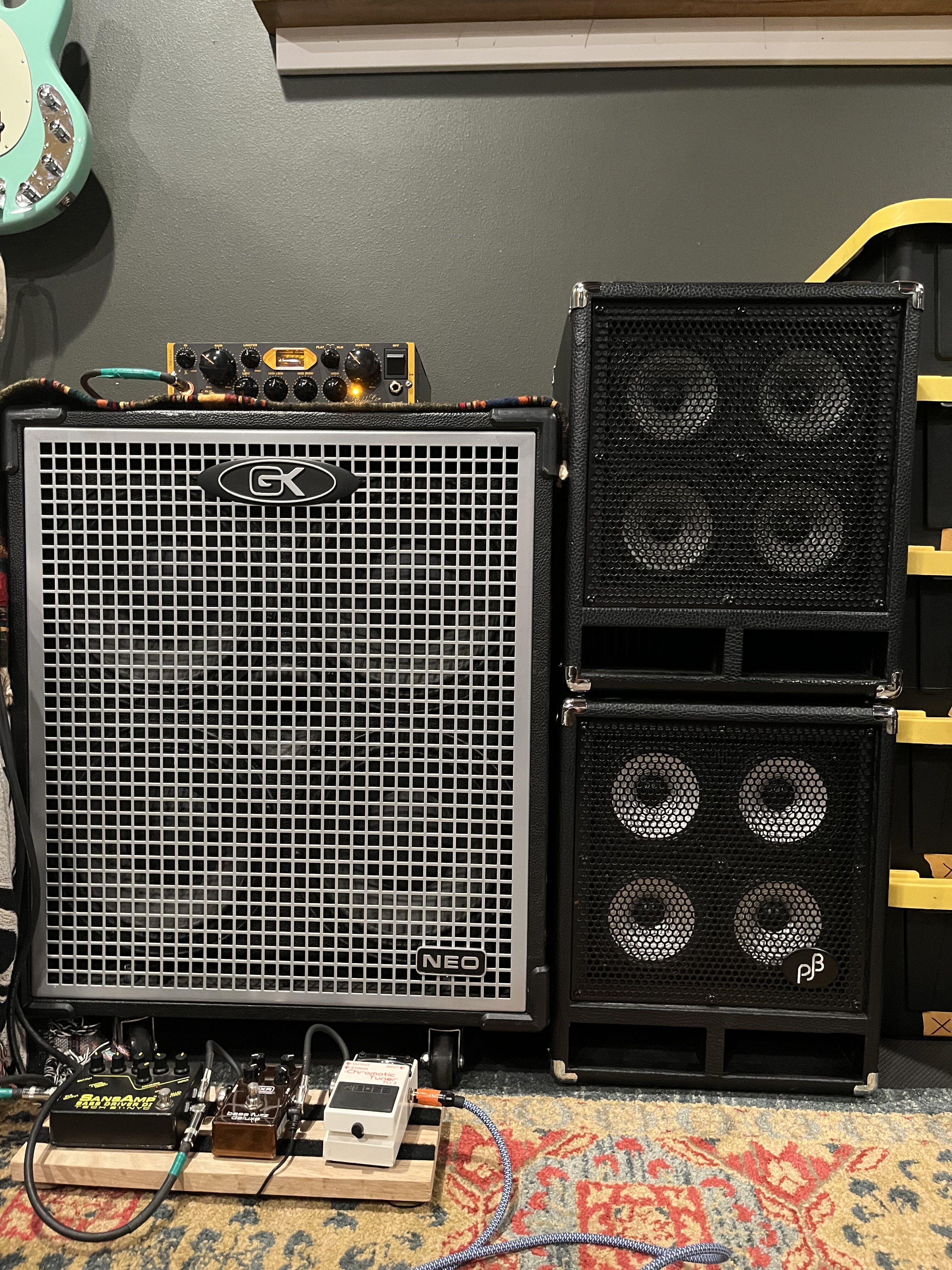
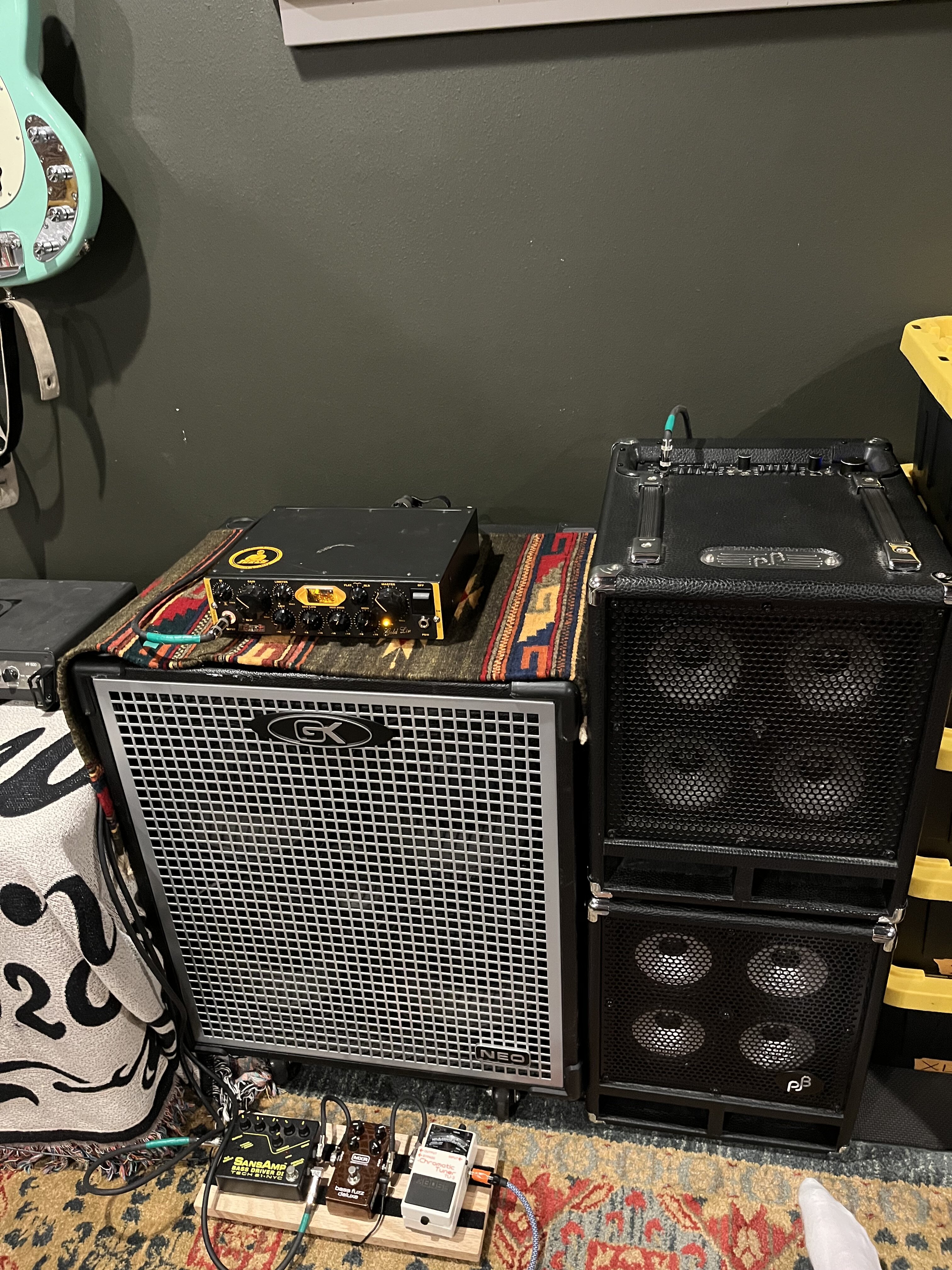
this is the rig I’ve found gets me the closest with what I have, spit signal out of my sans amp one into each stack. But just my mark bass into the pjb ext cab sounds damn good too, aluminum cones on the pjb.
I had 2 Sunn 200s cabs with D140s Clear and Deep BassYou’re right, it WAS 1974! A long time ago, and we also indulged in many mind-altering substances (purely for self-discovery and enhanced consciousness). I wish I still had my Sunn 200S with 2 JBL D140s. Played hundreds of gigs with that and a blackface Bassman head. Those were the days!
That’s funny. Most people think he isn’t a groove player at all. I disagree with that notion, however.Use a pick. And groove.
Here's a formula that has worked for me:
1. short scale bass
2. flatwounds
3. pick, pluck closer to neck
4. stay away from the downbeat of each measure (unless that becomes formulaic)
5. play in the upper octaves (7th fret and above, keep off the E string) - when you play lower, it has more impact
6. play lots of chord tones rather than just roots
7. fat low frequencies, emphasize mids (variably if possible with a low-pass filter)
8. plop the notes right where they belong
9. LISTEN to the whole band
Since you've got a short scale, I think you're a significant part of the way there. I am thinking specifically of Phil's early '70s sound, which is also my favorite time period. I have listened to the Dead since the early 90s - but always hated playing Dead songs because it didn't sound right to me, playing like a "normal" bassist. In the past few years I've dedicated time not just to listening, but trying to analyze Phil's playing. To me, 98% goes against the "rules of good bass playing"!!!
By the same token, Bob didn’t want people to play like him. It never sounded quite right to me, although they were all good players. I think Robin Sylvester in RatDog had a unique style. As much as I love Oteil’s playing, I was not a fan of what he did on the country numbers and the tunes with a shuffle. Phil had that bounce down, because he refused to play what was expected.


