• TalkBass has been independent since 1998. Add your voice.
    Create a free account to reply to discussions, view embedded media, and browse with fewer display ads.
    Join freeLog in
    Want zero display ads or expanded classifieds tools? Compare plans.

Searching for the Phil Lesh Sound

Just last week I was on a three band bill where the headlining bassist was playing a Starfire with a pick and immediately reminded of Phil Lesh. The illusion probably was greatly helped by the snaky melodic lines he was playing. The pick and the musical content was the most important thing.

P.S. I'm no Deadhead and the only Phil I'm familiar with is what he played on Workingman's Dead and American Beauty. Was he using the modded Starfire at that point?
 
I think getting the Lesh sound is less about gear and more about playing lines like Phil.

That said, I think putting your own take on playing Grateful Dead music is a good thing. John Mayer and Oteil Burbridge didn't try and sound exactly like Jerry and Phil with Dead and Company. They put their own spin on the songs. Locally here in Seattle, I've gone to shows with Dead cover bands that take their own liberties too. One such band, The Andy Coe Band did an acoustic version of the entire Terrapin Station Suite that was the best version of the song I've ever heard.

As been stated before, Alembics are a big part of that 70's sound.

Have fun with your journey.

Bones
 
  • Like
Reactions: Nedmundo and lomo
Have you tried 18 18" cabs?

When I saw the Dead in 1975, the Wall of Sound had Phil Lesh playing through 36 Alembic cabs, but they were all loaded with 15” JBL speakers. I don’t believe there were any 18” speakers anywhere on that stage. And it was one of the best bass sounds I’ve ever heard in my life. Modern systems with subwoofers haven’t come close, in my estimation, but that may be due to today’s sound engineers and modern trends in mixing.
 
I think getting the Lesh sound is less about gear and more about playing lines like Phil.

That said, I think putting your own take on playing Grateful Dead music is a good thing. John Mayer and Oteil Burbridge didn't try and sound exactly like Jerry and Phil with Dead and Company. They put their own spin on the songs. Locally here in Seattle, I've gone to shows with Dead cover bands that take their own liberties too. One such band, The Andy Coe Band did an acoustic version of the entire Terrapin Station Suite that was the best version of the song I've ever heard.

As been stated before, Alembics are a big part of that 70's sound.

Have fun with your journey.

Bones
This how I feel too. For a bass player especially, this music encourages experimentation and rule-breaking. Figuring out my own way of interpreting the music was way more fun than trying to mimic Phil, and it made the band as a whole better.
 
When I saw the Dead in 1975, the Wall of Sound had Phil Lesh playing through 36 Alembic cabs, but they were all loaded with 15” JBL speakers. I don’t believe there were any 18” speakers anywhere on that stage. And it was one of the best bass sounds I’ve ever heard in my life. Modern systems with subwoofers haven’t come close, in my estimation, but that may be due to today’s sound engineers and modern trends in mixing.
WOS was '74, and yes, Phil used only JBL D140's 15's (around 75w rms) in custom made 'Hard Trucker' cabs that were around 25" deep. Phil always said the D140 was his favorite bass speaker.

I'm no expert (Agedhorse is the JBL guy), but from what I understand, the D and K series JBL's have unique voice coils and magnets that can no longer be reproduced faithfully due to unavailability of metals since the 80's, and the oem aftermarket recone kits are long gone.
 
WOS was '74, and yes, Phil used only JBL D140's 15's (around 75w rms) in custom made 'Hard Trucker' cabs that were around 25" deep. Phil always said the D140 was his favorite bass speaker.

You’re right, it WAS 1974! A long time ago, and we also indulged in many mind-altering substances (purely for self-discovery and enhanced consciousness). I wish I still had my Sunn 200S with 2 JBL D140s. Played hundreds of gigs with that and a blackface Bassman head. Those were the days!
 
I have five JBL K140's, two D's, and an E (no, I'm not selling any). The D's from the 60's are the most coveted, and have a nice clear wooly sound; the E is deep and powerful; but the K's are my favorite - warm like the D's, but crisper with more wattage.

Not sure if Phil ever got to using the K's, as he switched to non-JBL 18's around 1980. Jerry used JBL D and E120 guitar speakers until he died.
 
Last edited:
I think getting the Lesh sound is less about gear and more about playing lines like Phil.

That said, I think putting your own take on playing Grateful Dead music is a good thing. John Mayer and Oteil Burbridge didn't try and sound exactly like Jerry and Phil with Dead and Company. They put their own spin on the songs. Locally here in Seattle, I've gone to shows with Dead cover bands that take their own liberties too. One such band, The Andy Coe Band did an acoustic version of the entire Terrapin Station Suite that was the best version of the song I've ever heard.

As been stated before, Alembics are a big part of that 70's sound.

Have fun with your journey.

This how I feel too. For a bass player especially, this music encourages experimentation and rule-breaking. Figuring out my own way of interpreting the music was way more fun than trying to mimic Phil, and it made the band as a whole better.

I agree. I'm not a Deadhead, but I've played in bands with Deadheads, so I've ended up playing some of their tracks over the years and I'm now in a short-term Dead cover band. I love playing their stuff largely because it's so fun to develop my own parts while staying faithful to the tracks. I do copy some of Phil's parts, like "Shakedown Street," but I'm usually doing my own thing that's informed by Phil's approach. It's a blast, and my Deadhead bandmates seem totally cool with it.

Some of it feels natural, I think because from 2008 through 2018 I played in an original band whose leader/songwriter/rhythm guitarist and lead guitarist were both hardcore Deadheads. For warmups, I jammed on several Dead songs, sometimes without even realizing it, and now that I'm learning more Dead tracks, I'm seeing how much that songwriter was influenced by the Dead. As a result, some of the approaches I developed for those tracks have been helpful with actual Dead songs.

As far as I know Phil didn't play J-basses much, but I think they're great for the material. I like the treble punch and definition for the melodic parts, and the heavy lows when called for. I've been using a Sandberg California TT-5 Superlight in the Dead cover band, and it's been great IMO. (Heck, Oteil was playing a Sandberg six on the Dead & Co. tour, so I can't be too far off! ;))
 
As far as I know Phil didn't play J-basses much, but I think they're great for the material. I like the treble punch and definition for the melodic parts, and the heavy lows when called for. I've been using a Sandberg California TT-5 Superlight in the Dead cover band, and it's been great IMO. (Heck, Oteil was playing a Sandberg six on the Dead & Co. tour, so I can't be too far off! ;))

1966-67
jazz66.jpg


1981
jazz81.jpg
 
man this is really good info, my local music shop has a Gibson sg bass, short scale. They always get me great deals bc I’ve been shopping there since I’ve been playing (I’m only 17). Might be a good option with some flats on it.
I could be wrong, but I don't think there was any use of the Quadraphonic pickup on the Europe 72 tour. As far as I understood, that pickup was mostly utilized with the "wall of sound" system that they used to tour around the US, with that pickup making it possible to give each string it's own giant column of speakers. My guess is that Europe 72 (given their limitations in terms of how much gear that could bring with them) was likely "just" the two "normal" Alembic pickups, in combination with the filter electronics, being used through one of his modified Fender Showman heads.
My 3 main basses -- 1970 Guild Starfire with Bisonics and filter electronics, 1970 Guild M-85 all stock/passive with Bisonics, and a 1962 Gibson EB-0 with Bartolini and Joe Barden pickups and filter electronics -- all do a good job at hitting Phil tones when played through an amp with a Fender-inspired tone stack. So you don't NEED Bisonics (proven by the EB-0) and you don't NEED a filter preamp (proven by the M-85).
If you're just looking to get a ball-park tone in a live setting but also within a reasonable budget, I would recommend keeping an eye out for a Korean reissue Starfire bass (even though the reissue Bisonics aren't very faithful reproductions, they are nice articulate single coils in their own right), stringing it up with flatwounds, and playing through a Fender-inspired amp; a Yamaha PB-1 preamp is an excellent great budget option there. Then play with a heavy pick over the neck pickup and work in a good amount of staccato notes and syncopation. After all of that, if you still have a couple hundred bucks left over, get a set of JTEX Distiller filters to drop in your bass. They're my favorite resonant filter preamp and what I've settled on after trying multiple ACG/JohnEast and Alembic preamps over the years.
Obviously this is very simplified answer, but it will get you into some clear Phil-esque sounds for a live performance context, without requiring thousands and thousands of dollars to be invested.
 
man this is really good info, my local music shop has a Gibson sg bass, short scale. They always get me great deals bc I’ve been shopping there since I’ve been playing (I’m only 17). Might be a good option with some flats on it.

That would make a great platform for your tone goal, though it's important to note the stock pickups on Gibson SG/EB-0 basses are kind of limited and probably won't be right if you're trying to get Phil tones. The neck pickups on them can be quite muddy and thick, which isn't necessarily a bad thing, but is unlikely to fit the articulate nature of those 72 Europe tones. If you had a shot at a reissue Starfire with Bisonics for the same money or less, it wouldn't really need any modification to get into the Phil ball park, as long as you have the right strings and amp to go with it.
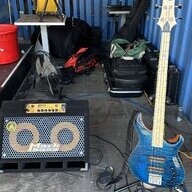
My Gibson got a complete electronics overhaul with a Bartolini neck humbucker, Joe Barden middle and bridge pickups, along with 2 low pass filters, an active semi-parametric mid-control stack, and so on. So just a warning that a stock Gibson will likely require a little extra investment in modifications to get where you're trying to go.


IMG_20230322_203432263~2.jpg
 
I saw an alembic pbass pickup on reverb, was thinking I could throw that in my p bass…
That would make a great platform for your tone goal, though it's important to note the stock pickups on Gibson SG/EB-0 basses are kind of limited and probably won't be right if you're trying to get Phil tones. The neck pickups on them can be quite muddy and thick, which isn't necessarily a bad thing, but is unlikely to fit the articulate nature of those 72 Europe tones. If you had a shot at a reissue Starfire with Bisonics for the same money or less, it wouldn't really need any modification to get into the Phil ball park, as long as you have the right strings and amp to go with it.
My Gibson got a complete electronics overhaul with a Bartolini neck humbucker, Joe Barden middle and bridge pickups, along with 2 low pass filters, an active semi-parametric mid-control stack, and so on. So just a warning that a stock Gibson will likely require a little extra investment in modifications to get where you're trying to go.


View attachment 5182616
 
What exactly do low pass filters do, and why do you need 2 of them?

Those resonant low pass filters are a unique kind of active preamp, that are most notably at the heart of Alembic and Wal bass tones, but also what went into Phil's modified Starfire for example. The variable resonant peak let's you completely change the voice of the pickup, but if you combine 2 or more broad-frequency responsive pickups with 2 of these resonant filter circuits, that's where the real magic is and so so many different sounds and textures become possible. Very different from a typical active preamp with bass, mid, and treble controls. There's a considerable amount of research that goes into understanding how they work when starting from scratch. Even once you have a bass in-hand with this kind of preamp, it takes quite a lot of experimentation to get a hang of them. Here are the ones I've taken a liking to (plenty of info on the site): [Invalid or Expired Link Removed]

Again though, resonant filters are great to have and can help nail those early Phil tones, but they're not absolutely necessary if you're just trying to get in the ballpark for live gigs.

The reasons I think the Guild would fit the bill so nicely are mainly the short scale and two articulate pickups in the right positions. The aesthetic style and comfortable neck are of course is a nice bonus!

Regarding the Alembic p bass pickup, it will require a fitting a specific type of active preamp to work. These pickups are low impedance so if you were to hook them up to a passive circuit, they would make little to no sound. Alembic circuitry also has a unique kind of grounding that can make them somewhat incompatible with other non-Alembic electronics. If that p pickup comes with the preamp though, they could be the makings of a versatile tone machine.
 
Last edited:
  • Like
Reactions: Mosthigh
Ok, have the option between a starfire and an sg bass, both relatively new for similar prices. My gut says go the starfire but man the sg basses are dope too.

Both are sweet! If they're local to you, that's perfect. I'd say try them both out and see which one you prefer. You can certainly play Dead covers with either one as they are, but given the particular sound you're after, the Starfire only needs some flatwounds and the right amp to get close. The SG will need a little extra investment and modification to get there.