• TalkBass has been independent since 1998. Add your voice.
    Create a free account to reply to discussions, view embedded media, and browse with fewer display ads.
    Join freeLog in
    Want zero display ads or expanded classifieds tools? Compare plans.

Double Bass Setting the Sound for an Upright Bass?

Nice article. But if I can set the frequency at which to set the beginning of the cut, and set the slope, e.g., 6 db per octave, don't I have myself a high-pass filter?


Yes but that is not possible on most EQs, including parametric EQs.

Parametric has bandwidth, frequency, and boost/cut. Typically you can boost or cut something like 12dB max. The filter is bell shaped and is symmetrical around the frequency you select.

That is not to say that cutting the lowest bands on a 31-band graphic, or cutting at 20hz with a parametric are not useful.

As an example, take a look at the Q-Strip
QStrip-large.jpg.auto.webp


It has a fixed 12dB/octave, 45hz HPF that you can engaged with a button. Also a fixed 12dB/octave 3khz LPF.

Bass and treble are shelving and you have two semiparamtric mids. No bandwidth or Q control on this one. The manual say Q=1 which translates to ~1.39 octaves per Q factor vs bandwidth in octaves band filter -3 dB pass calculator calculation formula quality factor Q to bandwidth BW width octave convert filter BW octave vibration mastering slope dB/oct steepness EQ filter equalizer cutoff freqiency - sengpielaudio Sengpiel Berlin
 
If the EQ of an amp is set to zero, there is often a coloration (intended to make an electric bass guitar sound better). This can lead to a smaller adjustment range when you found a neutral setting (if possible at all).
Unfortunately, you need to do a lot of reading in the Talkbass DB forum to understand problems and solutions of DB amplification. There are good hints here, but to really understand the problems and what you have to learn is reading through these threads.
Accept that there is no quick solution for you. And you might need to explain to the other and members, that they need to turn down a bit if früh want to hear the bass instead of feedback.

And sometimes it is just something simple as placing the pickup right.
 
When you see Lee Rocker playing loudly through an Ampeg SVT stack, he is using a magnetic pickup, like a Fender. I'm sure he uses more sophisticated gear, like the gentlemen above are suggesting, in the studio. I play in a boogie/blues band and just need to be heard. I use a Krivo magnetic pickup. I can get close enough to true sound for rock n roll. About halfway between my Fenders and my upright unamplified
 
I think the pickup in question is a clip on for use with tuners to replace build in microphone, not a dedicated double bass pickup. But in any case: Using any piezo pickup without preamp with high impedance input directly into a very low impedance amp input (like here only 100K Ohm) spells desaster for the sound.
If you use a microphone or a piezo as a pickup, you will need a matching preamp to use anything with an input not planned for them.
And for me and most others: Bass with solid body can be much louder then any hollow body instrument.
And if you have a resonating (hollow) body: magnetic pickup louder then Piezo-Pickup louder then microphone.
 
Last edited:
  • Like
Reactions: Ric Vice
One minor tip is that a very high pitched feedback could be coming from microphonics in the pickup itself. Most of the pickups designed for bass use have a very solid attachment, so there's no chance the pickup will vibrate on its own. An experiment might be to hold the pickup firmly on the bass with your hand while gradually increasing the volume, and see if it helps at all. Of course a third hand might help. ;)

I used a homemade magnetic pickup on my old Kay, and it's still on there. I could get stooopid loud with the thing. The secret is, it's because each string functions as an ideal bandpass filter for the note being played.
 
  • Like
Reactions: Ric Vice
Wasn't the inability to get high volumes out of an upright bass one of the main reasons for inventing the Precision Bass? Methinks you're using the wrong tool for the job.

From the OPs user name , I am pretty sure he plays rockabilly. No electric bass will cut it, not even electric uprights. You need the twack click for that genre and you need to be able to this to/on your bass

 
Although recently discontinued, the Empress ParaEQ would be a good choice for a utility EQ in a pedal format. The ParaEQ would be considered semiparametric because bandwidth is not continuously variable. Instead you have a toggle for each band that allows you to select narrow, medium, or wide bandwidth filters. The ParaEQ also has a 1 meg ohm input impedance, which is pretty much the minimum you want with a piezo.

01F1E619-DFDE-460B-93DF-4E8ADC9138A6.jpeg


The MegaPara EQ pedal from Sine Effect is an interesting in-production alternative to the Empress. It also has the advantage of being fully parametric—you can dial in the bandwidth or even switch the high and low frequency ranges to shelving EQ. Also 1Meg ohm impedance. I’m surprised I don’t see more mention of it on TalkBass.
[Invalid or Expired Link Removed]
 
What about stuffing the body of the bass with old towels fed through the F holes, then mounting a magnetic pickup? (Obviously this would only work if you had one bass to dedicate only for highly amplified work.)
 
Having trouble getting a good sound out of a Hartke 7000 amp head. I can't seem to get any volume and decent sound without getting feedback. What's the best EQ settings so I can play the upright in a band setting?

Hey OP - I’m legitimately shocked that nobody has recommended this yet... (desire to use a mic notwithstanding) there really are only two options if you’re doing loud “*billy” music - a magnetic pickup with suitable strings a la Lee Rocker (I believe he uses a set of Jargar solo gauge steel strings) OR...

The Shadow RB Pro preamp/pickup system. You’ll have to throw down a couple hundred bucks but (and trust those of us who learned the hard way) it’ll save money and tears in the long run.

It has every gadget you need in one box - low cut, phase flip, etc etc - please please do yourself a favor and read up.

The only beef with the Shadow system is that they’re not real ruggedly built (presumably to keep the price down on such a niche piece of equipment) - so don’t kick it or spill beer on it or anything.

Bottom line is that the Shadow, used with a little skill, will get you as loud as your amp’s headroom can handle. The preamp is also versatile enough that I straight up don’t worry when I’m stuck using a venue’s backline.

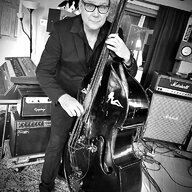
Proof: This is me in a very boomy room, standing right in front of my amp, murdering two guitars (I’m also able to hang with a guitard with a full stack Powerball in an even louder context).

I cannot, however, comment on how to use a mic under similar conditions.
 
The Shadow RB Pro preamp/pickup system. You’ll have to throw down a couple hundred bucks but (and trust those of us who learned the hard way) it’ll save money and tears in the long run.
I have been looking at those. An upright player I know uses this system and swears by it. Can't justify spending $300 right now. Anyway the microphone is working great thanks to Sam Reese.
 
  • Like
Reactions: Sam Reese