• TalkBass has been independent since 1998. Add your voice.
    Create a free account to reply to discussions, view embedded media, and browse with fewer display ads.
    Join freeLog in
    Want zero display ads or expanded classifieds tools? Compare plans.

Show me your compact pedalboard setup

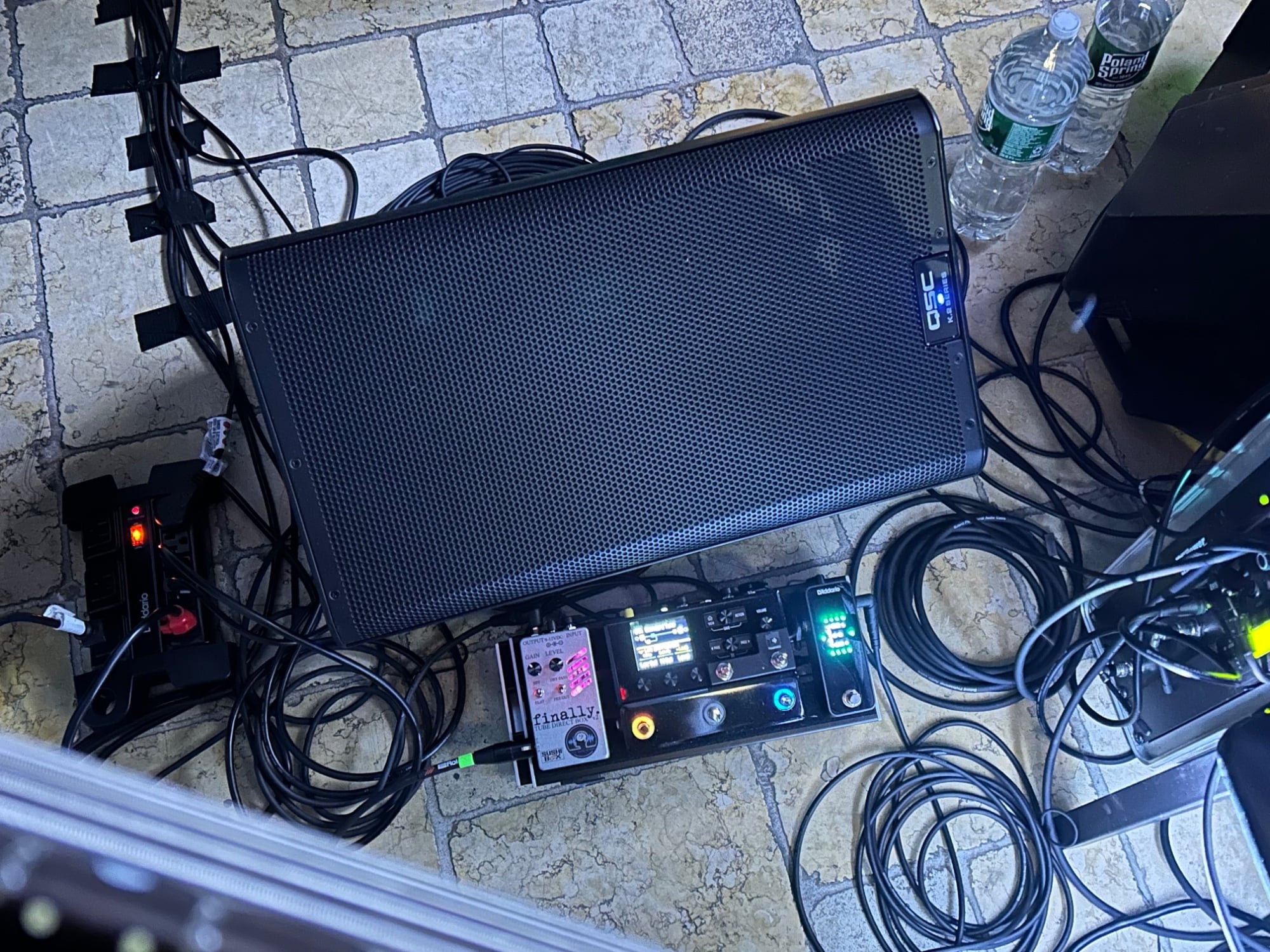
This has been my gigging board lately. Planet waves tuner to save me a foot switch spot on the Line 6 stomp which handles all my compression, fx and amp/preamps, then into a Sushi Box Finally V2 that feeds the foh and my own personal monitor separately. Cioks DC-7 under the board.

I can bump myself up in my own monitor without messing with what’s being sent to the mains. Works great.
IMG_5773.jpeg
 
IMG20250821203322.jpg
IMG20250821203333.jpg

Pedalboard - V2.jpg


Used mainly for local covers bands.

Just one audio processing pedal, the rest are wireless bass, tuner, battery, DI, headphone mixer (bass + whatever's available) into wireless IEMs.
DI outs for Amp (post), IEM server (pre), FoH (pre or post)

* Spaceship 50C (Harley Benton): 500 x 142 mm
* PowerPlant PowerBank+ mk2 (Harley Benton ): 140 x 106 mm
* GigA Pro Pedal Set (the t.bone) : 72 x 77 mm
* Polytune 3 (TC Electronic): 71 x 122 mm
* GP-5 (Valeton) : 42 x 94 mm
* MA400 (Behringer) : 103 x 64 mm
* DI-E (Millenium) : 74 x 104 mm
* IEM 75 (the t.bone) : 212 x 110 mm
 
After almost 40 years of playing, I'm jumping into the pedalboard world. Here's my first attempt at a pedalboard; there's an MXR Iso-Brick hiding under the hood. I'm planning on removing the Silencer and adding a chorus and/or compressor - I'm not sure which way to go yet. A wireless unit in in the plans as well; likely the Xvive A58. This version gets its trial run tonight.

B

Pedalboard.jpg
 
I wanted to update my pedalboard in order to make it smaller than the already small Pedaltrain Nano that I already own but is too big to fit in my gig bag front pocket. I only use three pedals at the moment: SansAmp ParaDriver, MXR M76 compressor and my TC tuner.

I read somewhere online that IKEA chopping boards are a good option for something compact and light. Yes, a chopping board :D .

So there you have it, a very compact pedal board that fits in my gig bag. It might not be pretty but it’s practical.

Due to the MXR’s power input, I had to put it first and then put the tuner second, when I usually put the tuner first (like pretty much everyone). But it’s fine.
Bottom pedals are a bit offset too but that’s due to the limited width and the patch cable…

IMG_0022.jpeg
 
I wanted to update my pedalboard in order to make it smaller than the already small Pedaltrain Nano that I already own but is too big to fit in my gig bag front pocket. I only use three pedals at the moment: SansAmp ParaDriver, MXR M76 compressor and my TC tuner.

I read somewhere online that IKEA chopping boards are a good option for something compact and light. Yes, a chopping board :D .

So there you have it, a very compact pedal board that fits in my gig bag. It might not be pretty but it’s practical.

Due to the MXR’s power input, I had to put it first and then put the tuner second, when I usually put the tuner first (like pretty much everyone). But it’s fine.
Bottom pedals are a bit offset too but that’s due to the limited width and the patch cable…

View attachment 7337851
You win the Compact Pedalboard of the Year Award! Excellent work!
😂😂💪🏽💪🏽🤛🏽🤛🏽
 
  • Haha
Reactions: BrentSimons
I wanted to update my pedalboard in order to make it smaller than the already small Pedaltrain Nano that I already own but is too big to fit in my gig bag front pocket. I only use three pedals at the moment: SansAmp ParaDriver, MXR M76 compressor and my TC tuner.

I read somewhere online that IKEA chopping boards are a good option for something compact and light. Yes, a chopping board :D .

So there you have it, a very compact pedal board that fits in my gig bag. It might not be pretty but it’s practical.

Due to the MXR’s power input, I had to put it first and then put the tuner second, when I usually put the tuner first (like pretty much everyone). But it’s fine.
Bottom pedals are a bit offset too but that’s due to the limited width and the patch cable…

View attachment 7337851

"Speaker simulation is an integral part of the SansAmp Tube Amplifier Emulation circuitry. It is specifically designed for a smooth, even response as would be achieved by a multiply-miked cabinet --without peaks, valleys, and notches associated with single miking and many IRs-- and will complement any type of bass speaker cabinet system."

"3) When you push SansAmp Bass Driver DI to saturation, you get enhanced harmonics, just as you would with an overdriven tube amplifier. Depending on the setting, the unique circuitry limits transient peaks for an even meter reading, so that
outboard compressors or limiters may not be necessary."

"4) Using effects. One of the key attributes of SansAmp is the responsiveness to the dynamics and nuances of your playing technique. Therefore, your time-modifying effects should be placed after SansAmp. If placing a tone-modifying effect before SansAmp, be sure to set the output level of the effect at unity gain with the output level of the instrument."
 

Attachments

This has been my gigging board lately. Planet waves tuner to save me a foot switch spot on the Line 6 stomp which handles all my compression, fx and amp/preamps, then into a Sushi Box Finally V2 that feeds the foh and my own personal monitor separately. Cioks DC-7 under the board.

I can bump myself up in my own monitor without messing with what’s being sent to the mains. Works great.

View attachment 7333631
Does the QSC have multiple inputs / onboard mixing to handle your bass and your monitor return?
 
  • Like
Reactions: gillento
Does the QSC have multiple inputs / onboard mixing to handle your bass and your monitor return?
Yeah, it’s got 2 inputs with independent volume controls for each, but they’re on the back, so not super adjustable on the fly.

So what I do is have monitor mix gointo one, which is pretty much the FOH mix, then the 1/4” out from the Finally on my board goes into the other input.

I can boost the volume of my bass from the Finally into the QSC and it doesn’t effect the FOH mix since the Finally has independent volumes for the 1/4 and XLR. I have a Noble too and it works the same.

I am toying with using something like a Capo or Tone Hammer to go to the FOH and then use a clean boost pedal after (hooked up ti their 1/4” line out) to use as an external volume control for the monitor.

We do our own sound at 99% of our bar gigs and I can’t be bothered to try and adjust my mix through a phone app, so this is what I came up with.
 
  • Like
Reactions: gillento
Yeah, it’s got 2 inputs with independent volume controls for each, but they’re on the back, so not super adjustable on the fly.

So what I do is have monitor mix gointo one, which is pretty much the FOH mix, then the 1/4” out from the Finally on my board goes into the other input.

I can boost the volume of my bass from the Finally into the QSC and it doesn’t effect the FOH mix since the Finally has independent volumes for the 1/4 and XLR. I have a Noble too and it works the same.

I am toying with using something like a Capo or Tone Hammer to go to the FOH and then use a clean boost pedal after (hooked up ti their 1/4” line out) to use as an external volume control for the monitor.

We do our own sound at 99% of our bar gigs and I can’t be bothered to try and adjust my mix through a phone app, so this is what I came up with.
I might add a volume pedal to the bass feed into the monitor to have better control of the mix between the bass and the monitor feed but it appears to be real solid solution
 
  • Like
Reactions: thisSNsucks
"Speaker simulation is an integral part of the SansAmp Tube Amplifier Emulation circuitry. It is specifically designed for a smooth, even response as would be achieved by a multiply-miked cabinet --without peaks, valleys, and notches associated with single miking and many IRs-- and will complement any type of bass speaker cabinet system."

"3) When you push SansAmp Bass Driver DI to saturation, you get enhanced harmonics, just as you would with an overdriven tube amplifier. Depending on the setting, the unique circuitry limits transient peaks for an even meter reading, so that
outboard compressors or limiters may not be necessary."

"4) Using effects. One of the key attributes of SansAmp is the responsiveness to the dynamics and nuances of your playing technique. Therefore, your time-modifying effects should be placed after SansAmp. If placing a tone-modifying effect before SansAmp, be sure to set the output level of the effect at unity gain with the output level of the instrument."


Hmmm ok, what’s your point here?
 
  • Like
Reactions: BrentSimons
Yeah, it’s got 2 inputs with independent volume controls for each, but they’re on the back, so not super adjustable on the fly.

So what I do is have monitor mix gointo one, which is pretty much the FOH mix, then the 1/4” out from the Finally on my board goes into the other input.

I can boost the volume of my bass from the Finally into the QSC and it doesn’t effect the FOH mix since the Finally has independent volumes for the 1/4 and XLR. I have a Noble too and it works the same.

I am toying with using something like a Capo or Tone Hammer to go to the FOH and then use a clean boost pedal after (hooked up ti their 1/4” line out) to use as an external volume control for the monitor.

We do our own sound at 99% of our bar gigs and I can’t be bothered to try and adjust my mix through a phone app, so this is what I came up with.
On the original k12 there was a little green socket for remote volume control. I rigged up a lead with box holding a volume wheel I could move with my foot. Worked pretty well, I forgot I even had it until I used the K12s for a PA gig recently and found it in the pocket of the speaker cover.
Sound_Empire_QSC_K12_Powered_Speaker_5_1024x1024.jpg
 
Just a guess based on the the bold typeface and larger font:

outboard compressors or limiters may not be necessary.

I kinda guessed that’s what he meant :)

Thing is, why did he even take the time to copy and paste all of that? I have read the manual. I’ve seen this sentence.

“May not” means “may not”, not “are not”. Every situation is different. I use the Blend between 9 and 11 o’clock on average, so not a lot of SansAmp simulation and more of the natural bass tone. The comp does a great job ahead of the SansAmp at evening out my tone and make me sound better in the band.
I’ve A/B’d the SansAmp with and without the comp and I definitely prefer the sound with the comp.

Each to their own, and at the end of the day I prefer the two pedals together, the SansAmp alone is great too but there’s an obvious improvement when the comp is on.
 
  • Like
Reactions: Rocksolid