• TalkBass has been independent since 1998. Add your voice.
    Create a free account to reply to discussions, view embedded media, and browse with fewer display ads.
    Join freeLog in
    Want zero display ads or expanded classifieds tools? Compare plans.

Show me your compact pedalboard setup

I ordered the Darkglass Anagram. Used it for the last several weeks and could not connect with it. It also shut down multiple times a day during
rehearsals. A few friends that have used it live said it dies on them during shows. 😬 I returned it to GC and went back to the HX Stomp. Just ordered the Big Booty Judy. Will post pics soon.
 
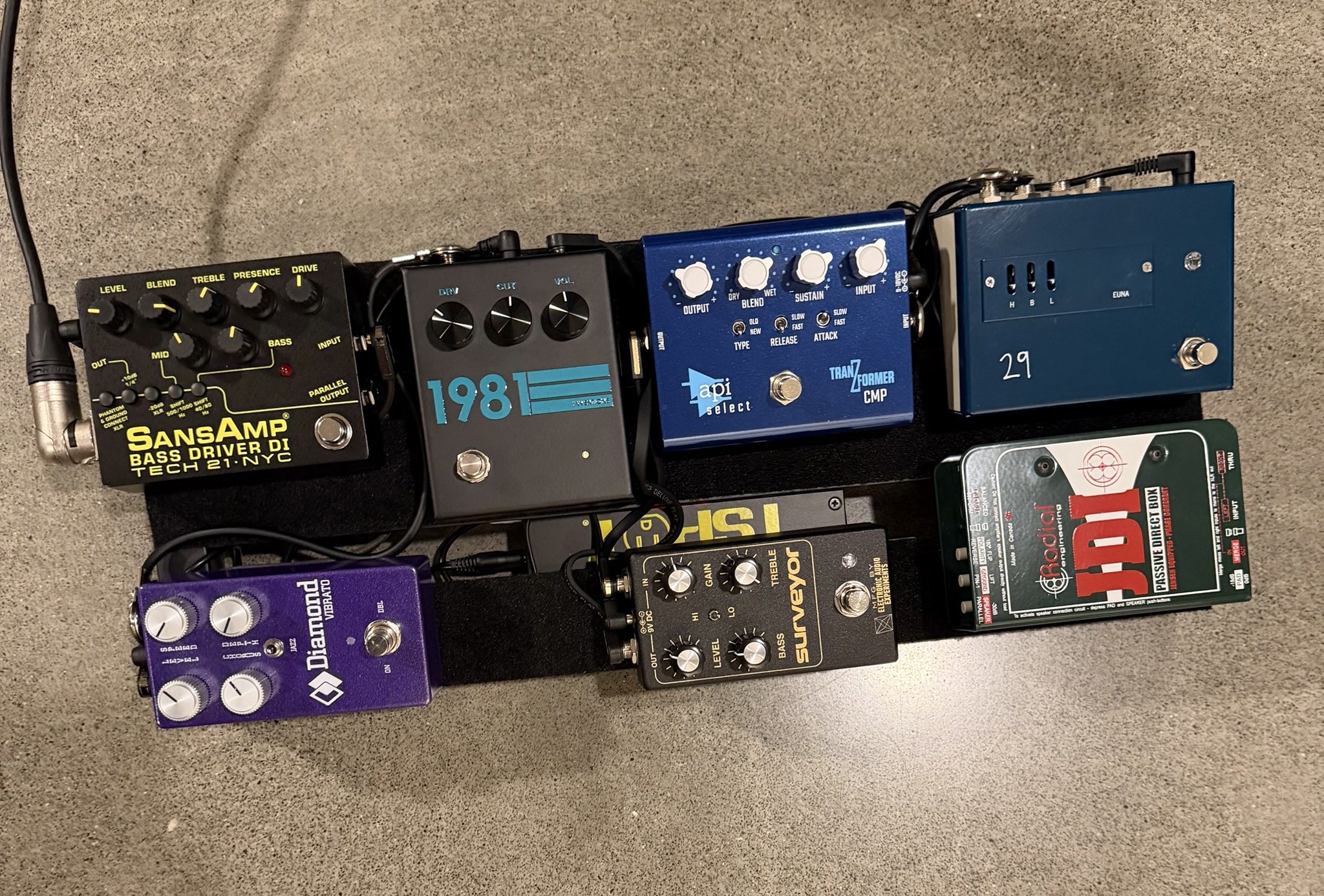
New addition pic🧙🏼‍♂️
IMG_0992.jpeg
 
I'm also keen to try out a EUNA, but I've been looking at the Skeptical Buffer pcb clone as a way to "try it out" in a little more pedal board friendly format. It also seems like a not too complex project for a first DIY pedal.
That is exactly the route I took when looking at the EUNA. I have been using the Skeptical Buffer this year on my core board with an active bass so it shouldn't be needed strictly speaking, but it does still sparkly up the place. Ryan at RCO pedals made a Skeptical Buffer and I use it quite a bit and like it quite a lot as well. It is also an easy build but Ryan had one ready when I reached out.

The Skeptical Buffer gains up the sound and has a baked in EQ in addition to the three EQ switches on top. It does not have a loop or tuner out. It also also does not have the fancy power section of the real EUNA and runs on 9V center neg only.
le Skeptical Buffer from RCO Pedals
Sometimes I like using the Low switch on the bass guitar. I almost never have liked the Bright switch on bass but that's just my problem not yours. I also put it first on a dirt board once and I could hear that all of the distortions and fuzzes really appreciated the gain before I even played a note. They became more...distorted sounding and the XLF switch on my Hot Cake clone (Anomaly) suddenly became very bassy.

I only wish I could put it in a smaller enclosure. In that case I would get rid of the foot switch and leave it as always on under the board or out of the way instead of taking an entire pedal slot. It's a utility I like and appreciate.

Edit: Clarification on which device I'm using.
 
Last edited:
That's great insight - thanks for the review on the DIY.

Always on would be great, but I don't know if there's an appropriate enclosure for that PCB. I think I'll probably grab it and gather the bits for it and try it eventually.

I basically always run passive basses, and I've found some kind of good buffer up front is great, along with something to add a little air and/or harmonics for the downstream chain is great. If I can get that into one pedal than maybe I've got a winner.
 
That's great insight - thanks for the review on the DIY.

Always on would be great, but I don't know if there's an appropriate enclosure for that PCB. I think I'll probably grab it and gather the bits for it and try it eventually.

I basically always run passive basses, and I've found some kind of good buffer up front is great, along with something to add a little air and/or harmonics for the downstream chain is great. If I can get that into one pedal than maybe I've got a winner.
I think you will really dig it on your passive basses. I would stick to the 125B full build at first but you might have...ideas. All the best.
 
  • Like
Reactions: tidbits