
- Jun 30, 2010
- 49,603
- 222,065
- Disclosures
- musician/artist/owner - Gildaxe
Hot darn this is my kinda thread. I recognize a few shots from ebay, not crying foul, just saying... still cool to see all those worn out beauties!
kindling for the fire...


TalkBass has been independent since 1998. Add your voice.
Create a free account to reply to discussions, view embedded media, and browse with fewer display ads.
Join free Log in
Want zero display ads or expanded classifieds tools? Compare plans.
Hot darn this is my kinda thread. I recognize a few shots from ebay, not crying foul, just saying... still cool to see all those worn out beauties!
Not mine, it was in a practice room a while back. Absolutely ruined. The paint that is there was dinted and peeling. Looked like it had been brown originally then black. They had guitars that had vertically no paint left and the underlying wood was scared and dinted.
I wondered at the time if they were deliberately worn copies (I have a friend who "distresses" guitars) but the owner claimed he'd had them since he opened back in the late 80s / early 90s and they were used when he'd got them.

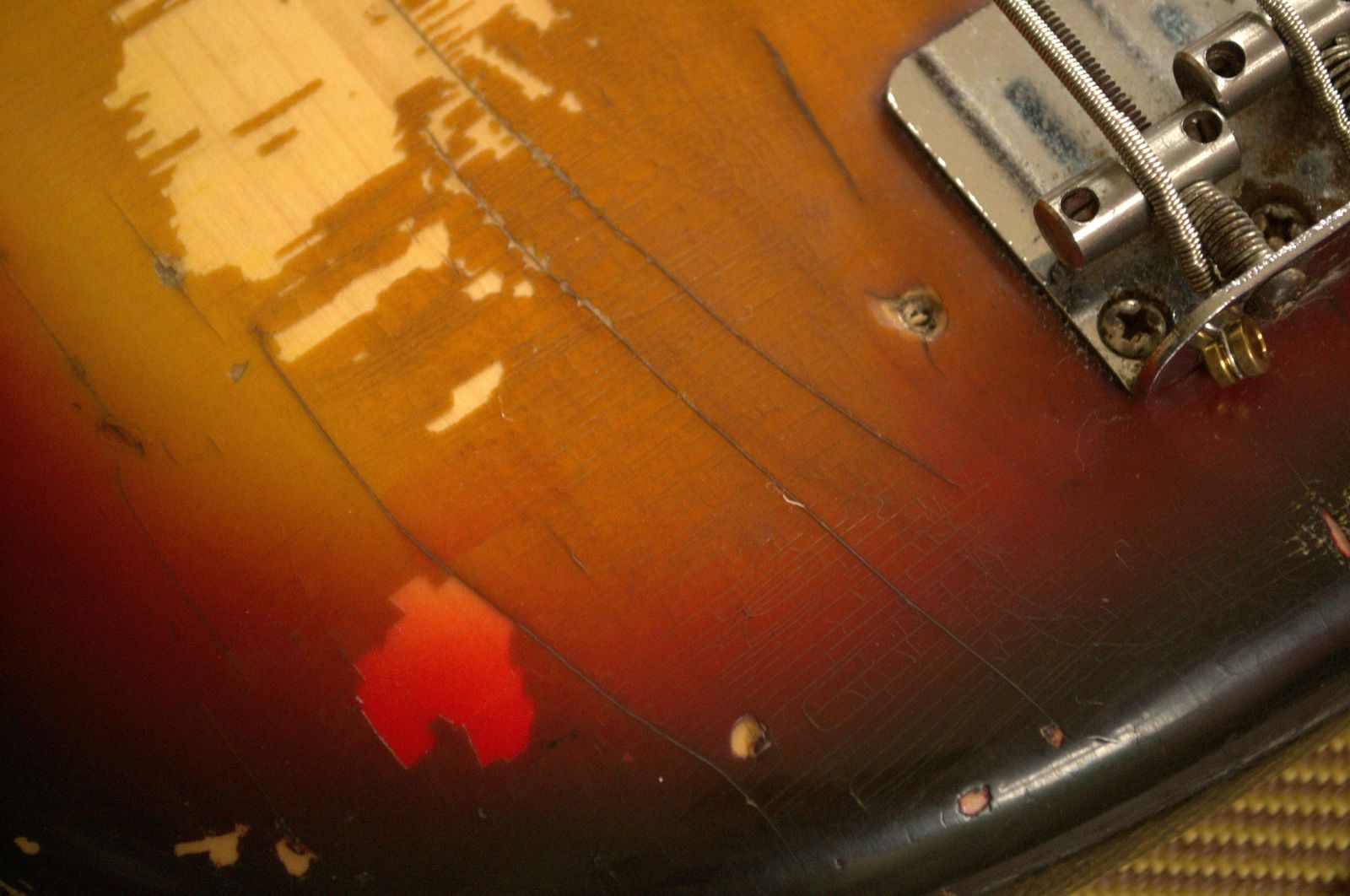
 I want to extrapolate on it's "& tell" side. I ordered ribbed saddles to replace the single slot saddles on the bent-plate (replacement) that was on it. I had been wondering about the ghosting mark of a bent-plate bridge (first pic) and figured it out once I removed the (also non-original) bridge that it came with. This is the thing about this P nearing 50, it has gone through a lot in those years. Original bridge is long-gone. Then there was some version of a replacement that had screws in each corner of the plate (and was also was a bit taller) Apparently the owner (luckily) did not add the two additional screws, but as you can see more clearly in the second pic, the ghosting tells the story. You can also see where the bridge cover lived for a while. (also long gone)
Link Removed
A sibling to mine! (what's the date?) Can you do a larger detail shot of this hs? (beautiful chequing) - and bridge also, I need a guide to sufficiently "age" mine to blend in better.
Also, I noticed yours has the Fender stamped larger paddle updated tuners - mine (made in SEPT '66) has the old-style reverse-wind tuners. Just removed one and they are original. More sleuthing!
- beauty all the way around!
Thanks. I don't have the bass with me at the moment. Mine was made Apr '66. I have seen both types of the machine heads on p basses from this year and some had lolly pop tuners as well. I got this bass used in 1968 and those tuners were on it. Threaded barrel stock bridge. Best pics I have for now.
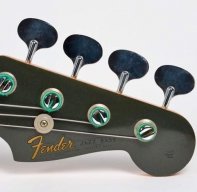
Not to be a downer, but you may want to remove one of those tuners on that '66 P to check for the pre-CBS hole pattern under them. Fender started producing the lollipops in late '65, but they didn't start making the "elephant ear" tuners like those till about '68. In '66 and '67, the pre-CBS Kluson tuners were still standard equipment for Ps. The lollipops were reserved mainly for Jazzes, but they did end up on Ps too occasionally from '66-69. So, if there is no other hole pattern under there, then that '66 P came with lollipops from the factory.


I take it you are talking about 1bassplayin's '66;
Link Removed
So are you saying that if the plate pattern/wood indent on his early '66 is original once a tuner is removed that someone (back then) took off the rarely installed (on a P) factory lollypops and replaced them (in '68 - prior to 1bassplayin buying it) w/the larger clovers non-reverse tuners, new for that year? (and then promptly sold the bass?)
Anything's possible but realistically there's no knowing what actually occurred back then.
Yes, I was talking about bassplayin's '66. What I'm saying is, those tuners aren't original to his bass because Fender hadn't started making that style yet in 1966, to the best of my knowledge. I've never come across any vintage Fender bass with those type of tuners before 1968. If anyone has evidence of otherwise, I'm all "eyes".
So chances are, like your P, it will have the Kluson hole pattern under those tuners if he was inclined to remove one and look. Otherwise, it would've had to have come with ovals if the there aren't any extra screw holes. Like I said, it was the only other choice in 1966 AFAIK.
There was another member on here just a few months ago that had the same thing - a '66 with the same tuners as bassplayin's. I told him to check for extra holes also, and sure enough, it had the Kluson pattern under there. And I helped him find some Klusons to put it back to original.
Yes, I was talking about bassplayin's '66. What I'm saying is, those tuners aren't original to his bass because Fender hadn't started making that style yet in 1966, to the best of my knowledge. I've never come across any vintage Fender bass with those type of tuners before 1968. If anyone has evidence of otherwise, I'm all "eyes".
So chances are, like your P, it will have the Kluson hole pattern under those tuners if he was inclined to remove one and look. Otherwise, it would've had to have come with ovals if the there aren't any extra screw holes. Like I said, it was the only other choice in 1966 AFAIK.
There was another member on here just a few months ago that had the same thing - a '66 with the same tuners as bassplayin's. I told him to check for extra holes also, and sure enough, it had the Kluson pattern under there. And I helped him find some Klusons to put it back to original.

That is a sublime piece of bass right there. Flippin' gorgeous.
I absolutely love this thread and all the amazing instruments that have appeared in it so far. Please keep them coming! I know there is a great difference of opinion on whether an instrument looks better if it's pristine or battered, but when it comes to bass (or guitar) I love to see them well worn in, there really is something so inherently cool about it!
very interesting... 1bassplayin will eventually have to let us all know!


