• TalkBass has been independent since 1998. Add your voice.
    Create a free account to reply to discussions, view embedded media, and browse with fewer display ads.
    Join freeLog in
    Want zero display ads or expanded classifieds tools? Compare plans.

SHOW YOUR DISTRESSED FINISHES!

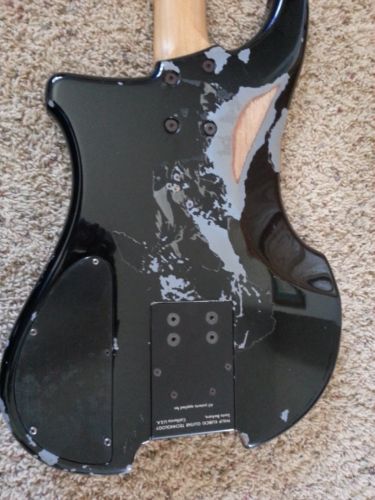
Another pic borrowed from a current ebay auction - Kubicki Factors get distressed too! The wood showing through that finish from use is actually pretty impressive. I've owned a few Factors, my first being a black '86 like this one which was played hard as well and so I stripped the finish. It was really thick with the top black layer, a grey layer (some sort of polymer/epoxy-like coating) and a rust/red bondo-like layer that was really tough to remove.

It's understanding how the early Fenders get so distressed because the finishes were so minimal/thin, and with time they get even thinner. In contrast the current poly/epoxy coatings are really tough.
_12_zpse704c5e0.jpg
 
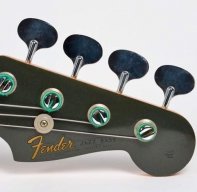
When I can, I will take one of the tuners off the bass and see whats under there and snap a picture. Like I said these were on there when I got it. From what I've read Fender used whatever they had for parts during the transition period. The stamped tuners with the Fender logo first appeared in the mid 60's and they no longer pinned the cloverleaf to the shaft. Probably replacements. And thanks for all the info.

Thanks - it's fun investigating these beautiful relics!

I thought the tuners on my '66 had the posts replaced but after studying other pics of '66's they most likely are legit/orig. It came w/mismatched non-orig screws (one was orig) and a couple didn't even have washers, but I got that sorted as well. I just ordered some relic'd Fender reverse-wind replacements and will store the originals in a box for safe keeping. As you can see, the current/new relic'd threads are tighter for more accurate/nuanced tuning - this bass is a player as well as a looker!

Speaking of which, I took it to a jam-session Friday night strung w/the cleaned rounds and a new E string (GHS Progressives) and it sounded so great in the mix! I'm rethinking putting flats on and may complete the set w/the Progressives. (treble up w/a pick - awesome tone!) Also, this P has a 1 11/16th wide nut (!) As someone who mainly plays J's, that is a w-i-d-e board! But fun to play! :bassist:

KGrHqJiQE2LHeUFSBNs2qn3Gw1_12_zps60d885ee.jpg
KGrHqEOKi0E1zwMFp7nBNs2r35fg1_12_zpsef2c5da2.jpg


IMG_6259_zps8de7562f.jpg
 
Hey JIO, that's something I've been wondering myself. I only got hold of this fair lady last month. It had been given a nice setup before I received it and had it had a new set of strings on. I have no idea what gauge the tech strung it with, but it is definitely lighter than the gauge I'd usually use (105 etc). I'm intrigued by that E string on your bass with the lead wire, might have to look into that - I have a '77 Guild B 301 that also has the nearly bottomed out E saddle and the E string is raised a fair bit higher than the others because of it pushed up at the saddle.
 
Hey JIO, that's something I've been wondering myself. I only got hold of this fair lady last month. It had been given a nice setup before I received it and had it had a new set of strings on. I have no idea what gauge the tech strung it with, but it is definitely lighter than the gauge I'd usually use (105 etc). I'm intrigued by that E string on your bass with the lead wire, might have to look into that - I have a '77 Guild B 301 that also has the nearly bottomed out E saddle and the E string is raised a fair bit higher than the others because of it pushed up at the saddle.

As I've only had this bass a week now, I'm still sorting things myself. The GHS E string w/the thin wire lead helped in the bottoming-out, I realized it created a different issue. At the body-end of the octave, the notes although in tune have a warble. Because the string was now lower, it became a pu height relation issue. So I need some pu lowering/string raising there but also need to shim the neck pocket, which I'm surprised it didn't have. (pretty common in most bolt-ons) So I'm not out of the woods yet but they are all easy fixes.
 
Got and installed the relic'd tuners. I paid a premium for them, but they are very good - very well done/convincing (no sanding or steel-wooling involved) and they work much better (than the originals).

IMG_6272_zpsad9136be.jpg


Looks legit! These tuners have slightly different hole-spacing so for now I left off one bottom screw in each one. I have to determine whether or not to fill the original hole w/a toothpick plug and re-drill, or just leave it as is. As much as it's "vintage", I may just fill & drill because my intent is to play it, not put it on a pedestal.

IMG_6277_zps3bb5c76d.jpg


Also got relic'd covers (different source) These were more reasonably priced, and also very well done. As much as the wear on this bass indicated that covers were off soon after purchase (and promptly lost) - these integrate nicely. We'll see how long they stay on. :rolleyes:

I decided to install D'Angelico "Hot Nickel Concept" med (.045"-.105") nickel plated steel roundwound strings. Never used them before, just thought I'd take a chance they are good.

IMG_6273_zpsf5a33d06.jpg
 
MJT finish. He does an awesome job. It's a 73 neck, an unknown body finished by Mark Jenney, overwound Frailins, all Fender USA RI parts ......... the neck is by far my favorite neck, and the bass plays awesome... 8.4lbs too which I won't complain about! I'll try and get a pic of the finish checking....it's well done.

I'm hearing great things about his work - yes, more pics!

and 8.4 is what I consider an ideal weight! My '66 is 8.5 and I have a few others in that 'sweet spot'