Vertigos - I have no idea what it’s like to play such a classic (elderly) Fender, and I imagine there are so many others like me who may never have a chance to play one like yours. Could you take a moment to tell us what it’s like? What’s it feel like? sound like? what’s the action and frets like??? Do you know how it compares to Fender’s recent models that are tributes to those Leo Fender originals??? Thanks!
Hi Stephen!
Every instrument is different and every bassist is different, so I can only speak to my own experience with my bass and the others that I've played over the years. Also, as a caveat, I have played plenty of incredible modern basses, and vintage is by no means the end-all. But, you asked what it feels like for me, so here goes:
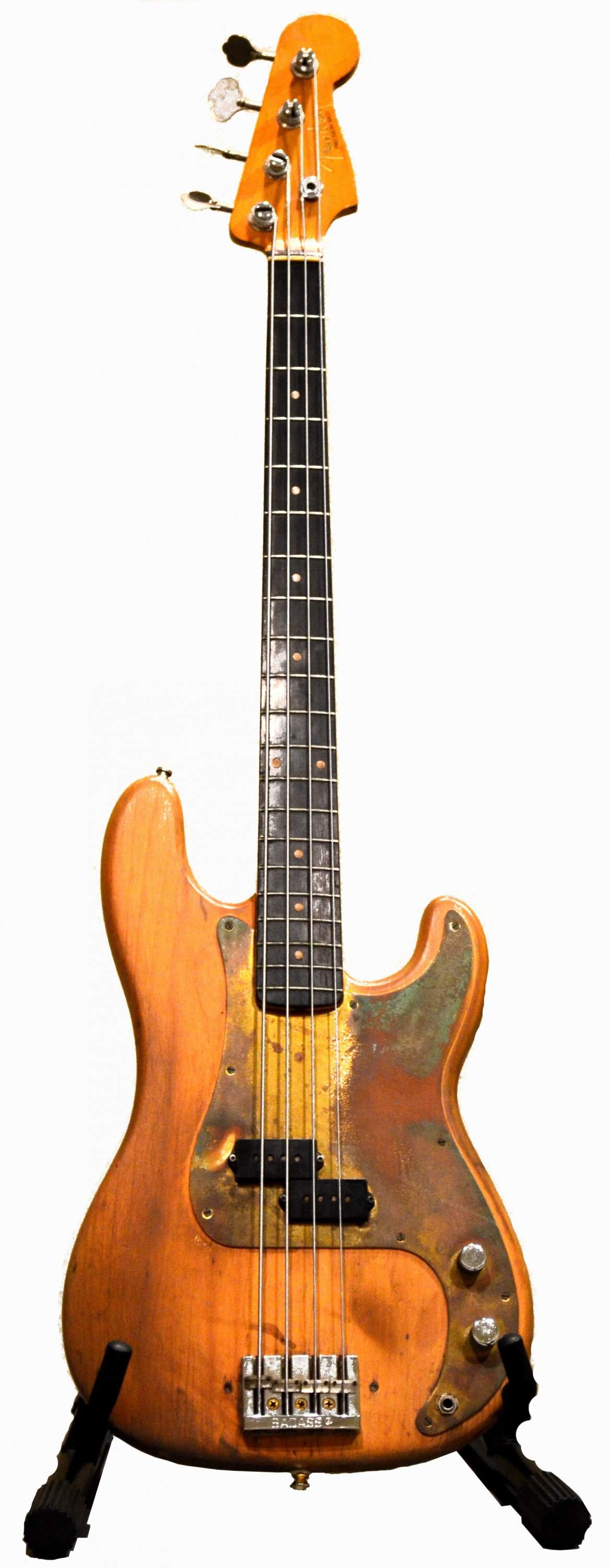
For me, the charm of vintage Fenders is all about the neck. They seem thinner than their modern counterparts, even basses that purport to be recreations of their vintage instruments. I've played "vintage reissue" or similar instruments from $300 Squiers all the way up to top-tier Custom Shops. Of course, the Custom Shops get closer to the real thing, but they still don't feel quite the same to me.
The neck on my P is lithe, strong but supple, somehow thinner than almost every other Fender-style neck I've tried. And yet I'd believe it if someone told me it didn't even have a truss rod. It feels substantial under the tension from the LaBella heavies I have on it, taking the weight with ease. The finish on the back of the neck is mostly worn off, but it still remains in some places. This almost serves as a tactile roadmap, an intuitive reminder of where I am at different places on the neck. The neck is smooth, fast, and easy. It feels good in the hands. Somehow more natural and ergonomic than modern Fenders. My hand wraps around it and my fingers push into it and it feels like an extension of myself. As I reach for it, it feels so easy that it's almost as if it's moving with me in tandem to help me play it, anticipating my moves.
The sound, I'll admit, is something I haven't agonized over as much. My P sounds phenomenal to my ears, but I haven't spent any time really A/Bing the sound of the pickup with modern basses. People talk about the fact that the pickups are handwound, that there was some degree of over- or underwind, and I'd certainly believe that this contributes both to the "vintage sound" and also the variation from pickup to pickup between various vintage instruments. People like Lindy Fralin seem to have deconstructed some of this magic and are able to recreate it.
My theory on why modern-built Fenders still don't nail the vintage neck is twofold. First, those Fullerton Fenders were made with old-growth wood. Wood that is pretty hard to come by these days. Old wood that was tight-grained and dense. Modern lumber mostly comes from tree farms where various techniques are used to accelerate the growth of the wood and make it more uniform, but this also makes it less dense. So in a literal sense, you just can't get the raw material anymore.
The second half of my theory is the fingerboard thickness. The vintage Fenders have "veneer" fingerboards - only a few mm thick. This contributes to the overall slim feel of the neck, but my intuition is that it's an overlooked aspect of it. You can only shave off so much thickness from the neck before it becomes unstable and prone to bending and bowing under the tension of the strings. When you can't spare anymore neck thickness for the sake of structural integrity, the fingerboard is the other place where you can save a few mm. I have a Squier VRI J that is supposed to ape the vintage feel of a 60s Jazz. It has a thinner fingerboard than my modern Jazz 24 V, but still not nearly as thin as the veneer board on the vintage P.
Another oft-overlooked part of the feel is the finish (or lack thereof) on the back of the neck. On older Fenders with nitro finishes, the sticky clearcoat on the back of the neck would wear off eventually and leave the bare wood, ready to absorb the oil from your fingers. Many modern builders don't bother finishing the back of the neck (or finish with a light oil, or finish it satin) because so many prefer the "quick" feel of unfinished wood. Since vintage Fenders had finish on the back of the neck, so do these Squier reissues. But the failure of the new models is that, since the neck is finished poly instead of nitro, the finish doesn't ever wear off. It just stays glossy and tacky, which I don't prefer. They've recreated the vintage aesthetics of a bass that just came off the line at Fullerton without the detail that makes it feel superior when it's worn in over time.
An ancillary factor might also be the fact that vintage necks used banjo fretwire - much smaller gauge than modern "jumbo" fretwire. I can't speak to this, because the owner of this bass before me had it refretted jumbo. I got it re-refretted by my luthier a year ago (because the previous refret was so bad and multiple frets were coming unseated) and asked if he could do the refret with the traditional banjo fretwire. He told me that since the first refret was jumbo, there would be indentations on the fingerboard where the jumbo frets used to sit. Basically, once you upsize your frets, you can't go back down. Unfortunate, but I fell in love with the bass with jumbos so it's not too big of a deal to me. Some builders (Dingwall is the first to come to mind) use banjo fretwire, and claim that it leads to more contact between the strings and the fingerboard and a more organic, natural sound. This is another point of failure for the modern recreations, at least at the cheaper pricepoints. I don't recall whether Custom Shops use period-correct fretwire.
I hope I didn't get too technical or wax poetic too much, but I've thought a lot about this stuff myself and it's nice to put it down outside of my brain. I'll leave you with something my teacher once told me about good instruments:
It's certainly true that a good player can take a mediocre instrument and still make great music with it. Getting a better (read: more expensive) instrument is not a panacea for your shortcomings as a bassist. But there is still great value in not having to fight your instrument every time you play it. Plus, having an instrument that is a joy to play will hopefully encourage you to play more, which WILL make you a better player. At the end of the day, it's still your talent above all, but having a great tool certainly helps.