• TalkBass has been independent since 1998. Add your voice.
    Create a free account to reply to discussions, view embedded media, and browse with fewer display ads.
    Join freeLog in
    Want zero display ads or expanded classifieds tools? Compare plans.

Simandl on bass guitar

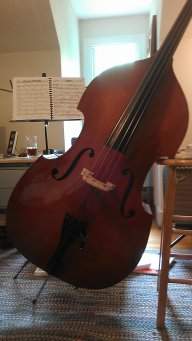
i started learning upright when I was 12, and was taught Simandl immediately (using your ring finger and pinky as one finger). When I started learning bass guitar at 13 or 14, it just kind of made sense to *not* use Simandl, and assign one finger per fret. I’ve been playing bass guitar that way for the past 35-36 years, and it just makes sense to me, especially for forms using scale position IV, where you start on your pinky, and play across the board towards the nut. I find it gives me a lot of flexibility in navigating the board, but I keep seeing things on Reddit and TB about using Simandl on bass guitar, and it never occurred to me to do that. I don’t really see any benefit, though I’m sure there must be some. Can anyone explain it to me, or explain why people seem to be disapproving of not using Simandl on bass guitar?

 
It can be helpful for folks that have trouble achieving a one finger per fret stretch in the lower positions. But also know that technically, Simandl is more than just using 3 fingers instead of 4, it is a whole fingering system that applies to different hand positions on the neck of the bass. If your hand is perfectly comfortable doing one finger per fret in the lower positions, then Simandl be damned.
 
I'm lazy. It's easier for me to span a 5th fret D to a first fret F than to change position. 34" scale. Not all of that is hand size; some of it is hand stretch, laterally.

I use Simandl on DB and EUB for the lower positions. My left hand gets pretty busy in Ab or Db. ;)
 
  • Like
Reactions: Dabndug
If you also play 1 2 4 on the upright bass it may just be easier to use the same 1 2 4 fingering on electric.

Depending on the size of your hands, you may be able to do 1 2 3 4 on fretted bass but not on a fretless. One solution is to just do 1 2 4 on both.
 
I started on electric and then made a quick transition unto being primarily an upright player, also using Simandl. The transition to 3 fingers was a short, diciplined and my teacher taped my fingers together one time.
Since transitioning back to electric some 20+ years ago I’ve lacked the “discipline” to go back to 4. I honestly think it would make me better in some situations.
A few months back I sliced the heck out of my left index finger which left me with 2 fingers to get my on. Had to play flats because the friction on my middle and pinky was intense with all the sliding around. 4 fingers definitely would have made me better in that situation. I still think it would help my chops.
 
What's the scale length of full sized upright and what's the string height? Something like 43 " for scale length and about 3 or 4 times string height off the nut vis a vis electric? For a double bass 1,2 4 probably makes perfect sense. But don't let it become dogma for what is essentially a different instrument.
 
I'm the opposite...started playing OFPF on electric about 35 years ago, then a few years ago decided to start learning how to play classical on DB. (It's, um...a work in progress! :smug: ) I was given the Simandl book when I started DB lessons, but the change hasn't been particularly easy for me--I still feel almost handicapped if I can't use four fingers, and I end up just trying to force OFPF onto the DB neck. With mixed results... :D
 
I trained on upright and played it a while before learning electric. I use it below the 5th fret and sometimes above that. I like the idea of not having to use 1234 and using 124 in lower positions. Less confusion switching between upright and electric for doublers, and like some here I think the sound,control, and muting are better with 124 below 5th fret. Although, hey - whatever works for you is what you should use.

I remember some years back George Benson came and sat in at a club I was playing. His hand positions & fingerings were seriously painful to watch up close, but he sounded AWESOME, so who am I to judge?
 
i started learning upright when I was 12, and was taught Simandl immediately (using your ring finger and pinky as one finger). When I started learning bass guitar at 13 or 14, it just kind of made sense to *not* use Simandl, and assign one finger per fret. I’ve been playing bass guitar that way for the past 35-36 years, and it just makes sense to me, especially for forms using scale position IV, where you start on your pinky, and play across the board towards the nut. I find it gives me a lot of flexibility in navigating the board, but I keep seeing things on Reddit and TB about using Simandl on bass guitar, and it never occurred to me to do that. I don’t really see any benefit, though I’m sure there must be some. Can anyone explain it to me, or explain why people seem to be disapproving of not using Simandl on bass guitar?

I was taught Simandl method on string bass. When I picked up electric bass, I continued using the Simandl fingering system for several years. When I turned pro, I eventually come to a point where there were obvious advantages to using one finger per fret (OFPF) on electric (fretted only). IMHO OFPF should be used if you hand is large enough and the music you play is technical enough to warrant a more sophisticated fingering system.

My hand is somewhat borderline with a long scale instrument. I find that some repetitive patterns in low positions are overly taxing and resort to Simandl fingering rather than damage my hand. However, with rare exception I generally play exclusively with OFPF on my #1 electric, a series I Yamaha TRB6P. If I play an extra long scale electric like my Daion PowerMark XB, I may need to use Simandl finger more frequently in low positions. I find my hand is too small to use OFPF with a fretless electric, and oddly I have never been able to get comfortable on a fretless electric bass.

Through the years, I have continued to use Simandl fingering when I play string bass or electric upright. At some point, my technique on electric bass and string bass diverged to the point where I approach them as totally different instruments with very little in common.

IMHO people should use what works best for them, and be respectful of when it comes to what works best for others.
 
I use Simandl when playing something that's not too demanding, but for the demanding stuff I always go back to 1FPF. And sometimes I do a 5 fret reach. So my thought is play whatever makes you comfortable, but know that 1FPF does have some advantages in the speed department.

Oh, and I have the smallest hands of any adult male I know of :D
 
I started on upright and was introduced to Simandl early. A few years later when I transitioned to primarily playing electric I became aware of OFPF and got familiar with that.

I never held with the notion that one technique was intrinsically “better” or “more correct” than the other. Truth is I don’t much think of it at all. I just shift to whichever technique works best for what I’m playing at the moment.

What’s the point of mastering a collection of techniques if you don’t allow yourself to make use of them? IMO technique is largely illusory after a certain point. Kinda like when you’re studying a martial art. You push yourself to learn a variety of techniques until they become second nature. And with commitment and discipline you eventually reach a level of accomplishment that earns you the designation “black belt” - or whatever its equivalent is in the style you’re studying.

But here’s the interesting thing. Once you reach that black belt level, you suddenly realize a black belt isn’t the ending. On the contrary, you now know you’ve arrived at the true beginning. You’ve gotten all the details and basics out of the way. And now that you have them down cold, you can finally start to genuinely learn what that martial art you’re studying is all about.

Instrument technique works much the same way.

Or so I think anyway. :)
 
On a 42 inch scale instrument, I find the Simandl technique indispensable. On a 35 inch (or smaller) scale instrument, I find it totally redundant. A huge difference between URB and EBG for most of us mortals is the ability to use one's ring finger independently on the EBG (note that this does not quite equate with OFPF). This allows a hack like me to play melodic runs on an EBG that would be more challenging for even a much higher level player on the URB.
 
Last edited: