FWIW, Mesa uses neodymium speakers in some of their cabs too. All the walkabout/scout cabs and the Powerhouse 212s.
Link Removed
Link Removed
Link Removed
Link Removed

TalkBass has been independent since 1998. Add your voice.
Create a free account to reply to discussions, view embedded media, and browse with fewer display ads.
Join free Log in
Want zero display ads or expanded classifieds tools? Compare plans.

I just heard that a huge neo operation competitive with the Chinese is opening in Malaysia. So we might have neo.
This whole speaker biz is a lot simpler than everyone is making it out to be. It's simple physics and the designer picks his compromises. (except for the other crazy project I'm involved in)
As a general rule I look at the vd of a speaker which in general gives an idea of how much air (volume) it will move. I have a lot of experience with the new small drivers and have even been involved in helping design some new ones. It really isn't a matter of cone size--it's the amount of air effectively moved and then the size of the motor and suspension will tell how it responds.
The Faital 8 incher has a vd of about 160 cc. The Eminence Deltalie 10 is likely better than most 10's you'll see in a bass cab and has a vd of 147cc. So the Faital in real world performance will keep up with that 10.
So the good news is that there are some great drivers out there that give us some cool new options. But there is no way that that single 8 will compete with a 15. It would take 4 of them. But you can get them to do it in a pretty small box. Say 24 x 24 x 13. Smaller than a 15 box with similar performance.
As far as a heavy box yielding a better sound than a light one---let's get back to simple physics. What we need is rigidity and the panels not resonating. A heavy box can do this. But so can a well designed lighter box with attention to bracing and breaking up panel resonances. Greenboy and Duke have paid considerable attention to this in their cabs.Composite boxes do this naturally---a properly designed composite box will perform every bit as well in terms of power and authority as the same box in heavy plywood at a fraction of the weight.. It'll just cost a lot more!
Speaker designers just pick their compromises and design goals. Roger was really smart at identifying a part of the market that really fits the sonic signature of his speaker. And he had custom drivers made to achieve that goal. Duke and Greenboy picked their sonic goals which were very different and did incredible jobs at achieving these goals.
But all of there guys had a resonable expectation of what their cabs would sound like before making them.
And I bet that their first attempts were damn close. That's what makes a good speaker designer.
The advantage (for the buyer anyway) of these small companies is that they work with lower overhead (and we make less money) than the big companies. No big company would ever be able to make a profit with composite cabs, nor could they have the materials and attention to detail of the top wood cab guys. A Fearful or a Thunderchild will sound better than a Mesa---and the Mesa is a great cab.
The big manufacturers typically can't be profitable using a lot of these top drivers that are used in the above mentioned cabs. There are other 8" cabs out there that claim high volume, bass, etc. But I'll tell you---none of them can afford to use the Faital 8" driver. It would bring the costs up too high. I've (and others I know) have researched the available 8" drivers and none of them come close to the 8PR200.And the Kappalite LF's are in a class of their own. But you won't see them in any of the top commercial manufacturers cabs.
Also, there are many different price points for neo drivers---so just saying that something is neo doesn't necessarily mean that it's high power and excursion.
And our cabs (well theirs anyway) don't look home made!

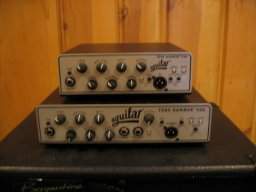
And what do you guys use to push that fearful cab, I bet its not a wallet size 6lb amp is it ?

And what do you guys use to push that fearful cab, I bet its not a wallet size 6lb amp is it ?
Not wallet size, but my Shuttlemax 9.2 weighs less than 7 lbs.
CL400Peavey said:...
Weight has no bearing on tone and volume output.

I just heard that a huge neo operation competitive with the Chinese is opening in Malaysia. So we might have neo.
This whole speaker biz is a lot simpler than everyone is making it out to be. It's simple physics and the designer picks his compromises. (except for the other crazy project I'm involved in)
As a general rule I look at the vd of a speaker which in general gives an idea of how much air (volume) it will move. I have a lot of experience with the new small drivers and have even been involved in helping design some new ones. It really isn't a matter of cone size--it's the amount of air effectively moved and then the size of the motor and suspension will tell how it responds.
The Faital 8 incher has a vd of about 160 cc. The Eminence Deltalie 10 is likely better than most 10's you'll see in a bass cab and has a vd of 147cc. So the Faital in real world performance will keep up with that 10.
So the good news is that there are some great drivers out there that give us some cool new options. But there is no way that that single 8 will compete with a 15. It would take 4 of them. But you can get them to do it in a pretty small box. Say 24 x 24 x 13. Smaller than a 15 box with similar performance.
As far as a heavy box yielding a better sound than a light one---let's get back to simple physics. What we need is rigidity and the panels not resonating. A heavy box can do this. But so can a well designed lighter box with attention to bracing and breaking up panel resonances. Greenboy and Duke have paid considerable attention to this in their cabs.Composite boxes do this naturally---a properly designed composite box will perform every bit as well in terms of power and authority as the same box in heavy plywood at a fraction of the weight.. It'll just cost a lot more!
Speaker designers just pick their compromises and design goals. Roger was really smart at identifying a part of the market that really fits the sonic signature of his speaker. And he had custom drivers made to achieve that goal. Duke and Greenboy picked their sonic goals which were very different and did incredible jobs at achieving these goals.
But all of there guys had a resonable expectation of what their cabs would sound like before making them.
And I bet that their first attempts were damn close. That's what makes a good speaker designer.
The advantage (for the buyer anyway) of these small companies is that they work with lower overhead (and we make less money) than the big companies. No big company would ever be able to make a profit with composite cabs, nor could they have the materials and attention to detail of the top wood cab guys. A Fearful or a Thunderchild will sound better than a Mesa---and the Mesa is a great cab.
The big manufacturers typically can't be profitable using a lot of these top drivers that are used in the above mentioned cabs. There are other 8" cabs out there that claim high volume, bass, etc. But I'll tell you---none of them can afford to use the Faital 8" driver. It would bring the costs up too high. I've (and others I know) have researched the available 8" drivers and none of them come close to the 8PR200.And the Kappalite LF's are in a class of their own. But you won't see them in any of the top commercial manufacturers cabs.
Also, there are many different price points for neo drivers---so just saying that something is neo doesn't necessarily mean that it's high power and excursion.
And our cabs (well theirs anyway) don't look home made!
All commercial cabs aren't junk. (well most of them, anyway). There have been a lot of advances in speaker design and the commercial market is seeing some of that. (trickle down).
It's just the limitations of the commercial companies.
They have to make a profit and they have big overhead. They have to sell for cheap enough so that the distributors and dealer make a profit. So if I can buy my parts close to the cost of the big boys I just have my profits to worry about. So---a single 15 cab that I sell for $1000 might cost me $500 in materials. That's not a lot of hourly wage left over. (especially with composite)
The big companies would have to cut that material cost in half to make a profit.
So---the big companies can't afford to use the best components or the tedious construction methods---it's just unprofitable. I do believe that they do the best they can and come up with some nice products.
It's just that they can't afford to compete with the smaller manufacturers on the same playing field. And it's a nicer playing field.
So with a large company 410 neo cab rated at 800 watts thermal and 56 pounds what do you think is the most watts the cab will actually handle before breakdown takes place, I would guess no more than 350 to 400 watts max.
Same thing with a 120 pound 410 rated at 800 watts. Those thermal ratings mean very little. What does weight or magnet structure have to do with this?
I really don't get your point. If you are talking about 'cheap' cabs poorly made versus high end stuff, of course. The Neo Mesa cabs sound quite similar to the ceramic models. And the weight of the box is a moot point, as Mike correctly points out. Some of the highest end cabs out there right now are quite lightweight, and have stunning performance.
Again, I'm trying not to OT here, but I guess the OP has his info.
So with a large company 410 neo cab rated at 800 watts thermal and 56 pounds what do you think is the most watts the cab will actually handle before breakdown takes place, I would guess no more than 350 to 400 watts max.
Same thing with a 120 pound 410 rated at 800 watts. Those thermal ratings mean very little. What does weight or magnet structure have to do with this?
I really don't get your point. If you are talking about 'cheap' cabs poorly made versus high end stuff, of course. The Neo Mesa cabs sound quite similar to the ceramic models. And the weight of the box is a moot point, as Mike correctly points out. Some of the highest end cabs out there right now are quite lightweight, and have stunning performance.
Again, I'm trying not to OT here, but I guess the OP has his info.
Well the problem is I don't live where you live and I would have to buy one without trying it out although I would love for you to recomend something that GC sells because they are the only stores around here and even then they will carry one cab from a manufacturer but not another, I would have to drive another 80 miles to try that one.
When I lived in NY used to go to the House of Guitars, now they had the stuff. Stores now only carry combos and a few other choices. Example tried out the Markbass 410 frontported cab, wanted to try out the rearported one before making a decision, salesmans answer: The rear ported cab is in our Maryland store right now, Really!
That is one thing I like about Mesa Boogie, they require stores that sell them to carry a good amount of their product, but I really don't want to carry a 69lb 210 cab so I would love to hear some choices.
Want a cab that has good lows, lots of punch but doesn't sacrifice on the high end either. My amp will put out 800 watts at 2ohms, 550 at 4ohms and 300 at 8ohms. 8
ohm cab is what I probably want so I can add another one. I can add one at 4ohms too, but don't think my amp would like 2ohms even though it says it will, its a Portabass 800 until I can afford to get another head.
So with a large company 410 neo cab rated at 800 watts thermal and 56 pounds what do you think is the most watts the cab will actually handle before breakdown takes place, I would guess no more than 350 to 400 watts max.
Well the problem is I don't live where you live and I would have to buy one without trying it out although I would love for you to recomend something that GC sells because they are the only stores around here and even then they will carry one cab from a manufacturer but not another, I would have to drive another 80 miles to try that one.
When I lived in NY used to go to the House of Guitars, now they had the stuff. Stores now only carry combos and a few other choices. Example tried out the Markbass 410 frontported cab, wanted to try out the rearported one before making a decision, salesmans answer: The rear ported cab is in our Maryland store right now, Really!
That is one thing I like about Mesa Boogie, they require stores that sell them to carry a good amount of their product, but I really don't want to carry a 69lb 210 cab so I would love to hear some choices.
Want a cab that has good lows, lots of punch but doesn't sacrifice on the high end either. My amp will put out 800 watts at 2ohms, 550 at 4ohms and 300 at 8ohms. 8
ohm cab is what I probably want so I can add another one. I can add one at 4ohms too, but don't think my amp would like 2ohms even though it says it will, its a Portabass 800 until I can afford to get another head.
Soooo... 1x10 or 2x8?
Soooo... 1x10 or 2x8?
Neither, at least a good 210.
Soooo... 1x10 or 2x8?
Don't know how into DIY you are, but check this.....
http://www.talkbass.com/forum/f15/l...ices, etc. but very good info on the subject.
Neither, at least a good 210.
My point was most of the posts have had nothing to do with my query.
Companies are making single 8 and single 10 cabs for wattages higher than the practice combos most folks are accustomed to with single speakers of that size. My curiosity was relating to how well these reproduce big-rig sounds, whatever that means to you, in lower-volume applications.
As it pertains to this thread a 210 is outside the parameters of the inquiry. If you intend to answer about a 210 then don't add to this thread.