Long post but the cases are arriving today. Joy oh joy! I really can't wait.

Also, will announce that I've done a
few mods to the original. Lot of work with this one. I'll also put up the schematic when confirmed for this one if you feel brave enough to build it. Trying to remove all the deficiencies from the original whilst having the option to revert back to it.
If you want to read about some mods that can be done or why I've gone about modding some things for the future, read on, otherwise it could all be garbage to you.
So here I go, explaining some mods to do for those at home or for those that want to wait. I'll be doing a local trial of this one so people can get a hold of it and shout at me if I've made something horrible or otherwise but either way, these are some mods you can try and a few of these will work with your Big Muff Pi or other closely modeled pedals. I won't post exact part changes just yet as it is a work in progress but you can see what can be done.
So the AC filter is actually an outcome of the error I made when tracing the pedal and
@johnk_10 earliest sound clips of the pedal had this. :lol: It increases the size of the capacitor in the treble booster stage and moves it into a more general purpose booster which pushes this pedal closer to big muff territory, just on roids :lol: . Basically, by increasing the cap size, it starts to allow more low frequencies into the pedal. In the original, it is set to hi. In the picture below, the green is hi, the blue is low. Consider it a HPF. This would probably be
the mod to do if you aren't a fan of the lack of low end
The clip filter is pretty much more of the same. However, this allows more low frequencies to go through the clipping diodes meaning the low end will start to get distorted. The picture below is a 200Hz sine wave getting passed through. The green is stock, the red is an increased cap size. The original setting will be hi. The cap I used is similar to what the Russian Big Muff has. Also at this point should note that the actual transistors (2SC2240's) in those stages aren't that high gain (HFe ~200) which makes it a lot more interesting since that would actually make the stages sound darker so a lot of that distorted treble nature is due in fact to this mod cutting away the lows. So playing around with what goes in there will change it up too.
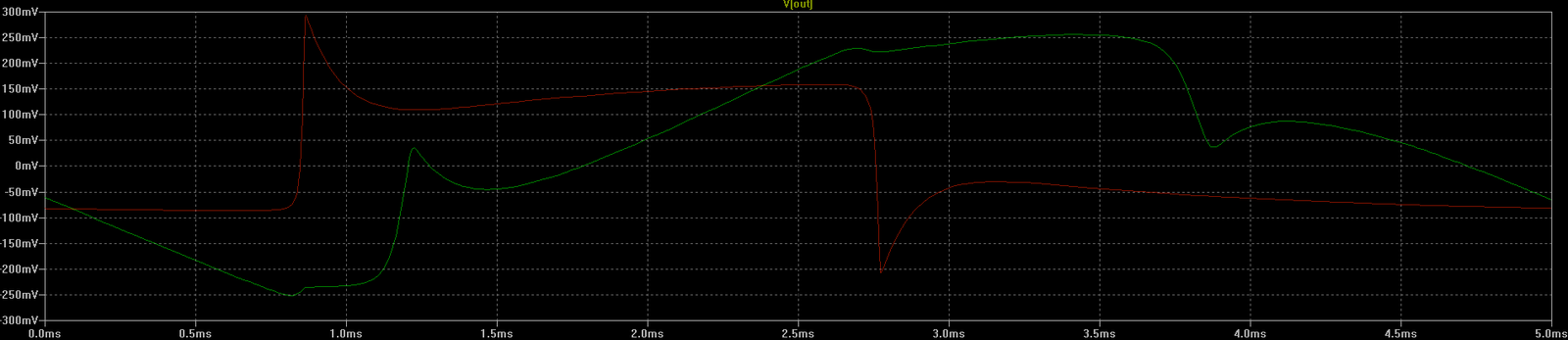
Gate is just that. A noise gate. I'm still not sold on how much gating effect I want, but this combats the issue of noise and with a subtle turn should tighten up the sound for some users. I think it's an essential mod in honesty. I can say from using the original live, it feedbacks insanely and seems to react to even the slightest breeze on the strings which could be your thing but since I like to sound rather percussive at times with my playing, it might help. That's the kind of level of gain we're playing with here. :shrug: This is just simply replacing the 100k resistor on the second gain stage with a potentiometer. Maybe put a resistor before it so you don't shunt everything to ground. This is probably the most ZVex thing you could do to any pedal but there is a fundamental reason to do it.
The blend... Well, it's just a buffered blend. Clean signal is preserved, no switch to polarity. You can find your right mix with the volume of the effect as well as the blend. I changed the blend from a non-commercial one to something a lot simpler that works nicely and keeps the integrity of the circuit. This is a prime example of what it can do on a half blend, with the volume of the pedal just below half. 200Hz wave again with the clip on low, ac on hi. Red is pedal, green is clean, blue is blend. Of course, this is just a sim but there's some idea. Reversed polarity is a no-no, you'll find it hard to get much of a nice signal out of it. For which blend to use, Google as many as you can, each will have varying results but having them with in/out buffers will help your cause more. You can go passive too but expect some volume and tone loss. Again, John was right to offer this and I would chose that mod over anything else if you are a bassist. The clean blend got recorded recently on some of our band demos and the guitarist couldn't actually believe just how full and powerful it sounded. The circuit's definition helps it along.

The tone stack has been moved to a Baxandall. I didn't need to do too much here other than drop one in. It adds a little bit more bass and a hint of scoop around 1Khz if you have the knobs dimed. A more common setting on the original will have the bass at half or lower and the treble pretty much where you'd like it to be. The original was just a straight up big muff tone stack. You can virtually drop whatever tone stack you like here. A recommendation for the bassists is set up something that opens the bass frequencies up more. The natural circuit will have a kind of band pass filter going on so you want to find ways to open that up in the low end. The best way is to go about it with the earlier mods but you can free up more through the tone stack.
This isn't the best picture to illustrate it since this is an old photo and since then I shifted the stack to be a bit more bass focused (pretend the red lines are rotated about 2-3 degrees clockwise to reduce the treble to roughly the original position) but the stack gives a little bit more width to what goes out and can bring it back to a narrow path if you desire. I'll write down my results in comparison to the original but I think it's fundamentally more
useful.
Distortion will remain the same. The rest remains the same in my case. The mods do enough to vary the tone to make it usable for bassists and even guitarists (hence the change in tone stack). I'll build one, chuck some sound clips. Modify, build any changes then send one around if people are willing to try. Might even send one of the original clones around if people want to have a dabble with it. :shrug:
Hopefully that fills you in on some things. I went through a large list of mods to knock it back to this, including a feedback loop (which sounded so awful), clipping diode removal which I wasn't a fan of, swapping diodes too but that was moved over more for changing the tone over the wave shaping since I think that's the unique point... even if it is just standard 1N4148 diodes. They're there for a reason. :yep These just give a bit of a wider use and more tweaking that can be used and I'm trying not to be gimmicky with the options because even though something like a stutter effect or self oscillation is cool, how many people
really use that for anything other than odds and ends.
Again, swapping the front transistors, making it only a single one, even going berserk by adding something ultra-high gain like a MPSA13 at the front could be another mod. There are many places to take this circuit.



 It could be that I have to do the boards by hand.