• TalkBass has been independent since 1998. Add your voice.
    Create a free account to reply to discussions, view embedded media, and browse with fewer display ads.
    Join freeLog in
    Want zero display ads or expanded classifieds tools? Compare plans.

Sorta dumb question- what woods would work for a lightweight build?

Dear Talkbass,

I got the music man to my wife's friend, incidentally on teachers appreciation day (they're both teachers).

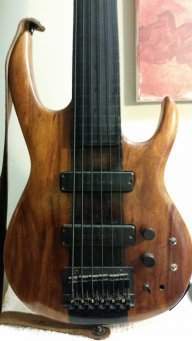
Anyways, I'm hoping to get some workshop time for Father's Day to make a bass neck/body. I'm hoping to make something like a steinbrrger, but P bass and mostly out of wood.

Any woods suitable for this? I stockpiled a huge amount of old growth quartersawn port orford cedar, and was hoping to use that, but also have some flamed soft (?, might be rock) maple.

Would both work?

I used to think I know what I'm doing, but after seeing everyone's work here....I don't know jack!
 
POC should work. If you can use it in the neck with carbon rods, to avoid neck dive. A maple neck on a cedar steinberger body might be tough otherwise.
 
I would think maple would be heavy. Dunno about cedar.

From watching the showcase bodies on Warmoth, lightest seems to be roast pine, followed by roast alder. Of course, every piece of wood is different. I’ve got a solid roast pine Jazz body in my stash that’s only 3.75 pounds.

On top of the wood, chambering and a cap/lam top can save some weight as well.

I think a cedar body with maple faces would be beautiful, dang the torpedoes, er, weight.
 
I would think maple would be heavy. Dunno about cedar.

From watching the showcase bodies on Warmoth, lightest seems to be roast pine, followed by roast alder. Of course, every piece of wood is different. I’ve got a solid roast pine Jazz body in my stash that’s only 3.75 pounds.

On top of the wood, chambering and a cap/lam top can save some weight as well.

I think a cedar body with maple faces would be beautiful, dang the torpedoes, er, weight.
port cedar is usually lighter than maple. i have it as the neck wood on a clement bass and it has a great feel and is exceptionally light.

paluwonia is a light weight body wood (not sure if this what other folx previously referred to as POC)
 
You have the wood and can measure and weigh it so you know the weight per unit volume. You know the volumes of the wood you’ll use (if you have the templates and drawings of the basses you will build). You can work out the weight from those two. In a pinch you can dunk a bass body in water and measure displacement to get a very accurate volume.
 
I've built three bodies from construction grade pine 2 x 4's. Two are my daily players. One is borderline 'neck divey' even with lightweight tuners (fender neck). The other hangs like a dream (2+2 tuners). Both weigh in just a tad over 8 lbs.
 
Catalpa is a wood that seems to be underrated for this. It has a similar grain pattern to swamp ash (in some ways), but tends to be VERY light. I found it to be resonant and easy to work with.

It is, of course, a fairly soft wood. Like Paulownia, cedar, basswood, etc, it will easily dent or scratch. Doing some kind of sealing finish that hardens the fibers is very helpful.
 
Here's an idea for you.

I've been making lightweight "pancake" bodies for 6 strings guitars out of inexpensive big box lumber yard pine. I've been painting them with General Finishes "milk paint" and I really like them. The General Finishes product is actually a very robust paint and my oldest and most used guitar still looks fine with no obvious problem from the softer wood body.

f6IyQTC.jpg


Here's a topic on another forum detailing how they are made, but the same process could be applied to bass guitars as well.

How To Make A Pancake Body

Neck dive isn't a problem with these, but might be a factor on a longer necked bass.

Gr85YOH.jpg
 
Last edited:
Now that I'm at a desktop, here's a comparison table for density, hardness and stiffness for some of the commonly used woods in solid-bodied instrument building. You can quickly see how POC stacks up against the others.

Arranged in order of 1) weight, then 2) hardness and 3) stiffness:

(Density) Weight:
1778426535772.png


Hardness:
1778426596236.png


Stiffness:
1778426692571.png
 
Not a dumb question at all.

A few “generally” lighter weight woods would be paulownia, Spanish cedar, Alaskan cedar, swamp ash, cypress. A few that can be light weight to moderate weight…. alder, cherry, swamp ash, cypress, poplar, basswood, Douglas fir.

Each piece has a lot of variability though. It’s best to ask for weights when ordering. And keep in mind that the weight given will be the whole body blank…. You’ll be removing a significant portion of wood when building the body, so a 9lb blank can wind up making a 4lb to 5lb body, generally speaking.

Again, there’s no hard rules though. Each piece has to be treated as an individual.

I hope this helps ya !
 
  • Like
Reactions: thebandcircle
I've used Spanish cedar for bodies. Very lightweight and won't dent so easily once it's sealed with water thin CA glue. Finding a suitable neck wood might be tricky, Cherry might be a good middle ground between stiffness and lightweight. Weight and stiffness can very so much in a single batch of lumber. I've been incorporating other/stiffer materials into my builds to reduce the stress and uncertainty of future neck movement. Ryan
 
Thanks everyone!

I've shifted from overconfident to super unsure about what I know. I'd gone off the wood database website, but wasn't sure if I'm overlooking something very obvious.

Meanwhile, since I'd posted, I lost a friend to a tragic accident. We're the same age. His son is my daughter's age. His wife is my wife's age.
I don't want to regret not trying some builds...even if it's impractical and silly.

Also, thanks for the pancake body tutorial, Rudy! It was one of the ones that inspired me to attempt building again, and to get a drill press off facebook marketplace last year.
 
YPOC is a wonderfully lightweight wood... But it will dent if you look at it funny! Maybe a POC core in the 1 inch range with a 1/4 to 3/8 soft maple cap fore and aft?
Yamaha used to make basses like this. They drilled holes through the body and stuck metal tubes through them to link the hardwood slabs and turn the whole thing into an integrated tonewood sandwich. Sounds gimmicky, but Ed Friedland gave them a good review in Guitar World. Maybe it works?
 
Ah. Sorry for going MIA.

I'd given up on building for a while, with all the toddler drama that was going on. Then, two friends died last month.
I figure it'd be my reminder to get off my ass and get to building.

I'm planning on making a laminated neck black with port orford cedar, and doing something like Sebastien Gavret's dragonfly bass:

It's a bit ambitious, but I figure that I'll at least have something that be like a Steinberger with wings.