
- Sep 20, 2008
- 3,369
- 38
- Disclosures
- Jim Dunlop USA, King Kong Cases, Golden Eagle Energy Drink
This is the rebop he wants to trade for a four string euro or ns2a.....without the American bridge, I think. It has the brass American bridge on it now

TalkBass has been independent since 1998. Add your voice.
Create a free account to reply to discussions, view embedded media, and browse with fewer display ads.
Join free Log in
Want zero display ads or expanded classifieds tools? Compare plans.
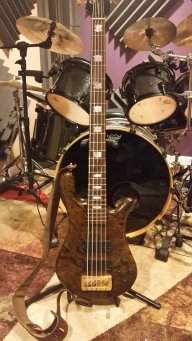
brotherbassj said:My friend with the natural 2002 rebop five with the newly installed American brass bridge wants to go back to a four string. He is looking to trade or trade plus or minus cash for a four string euro or ns2a. Upgraded are the bridge and he has a newer tone pump with trim he could include. Let me know if interested. It's the same bass John has with the bridge upgraded. I am getting pictures. Message me if interested

Listen to the first 55 seconds of this: http://soundcloud.com/trailight/a-brief-instant
That's just something I came up with and used the Harmonist for.
A much comprehensive explanation here:
This is the rebop he wants to trade for a four string euro or ns2a.....without the American bridge, I think. It has the brass American bridge on it now

Great. Now I want a Harmonist too. It was like listening to old Peter Gabriel.
 It's been a pedal GAS filled day for everyone here!
Thank you! It's very very simple:
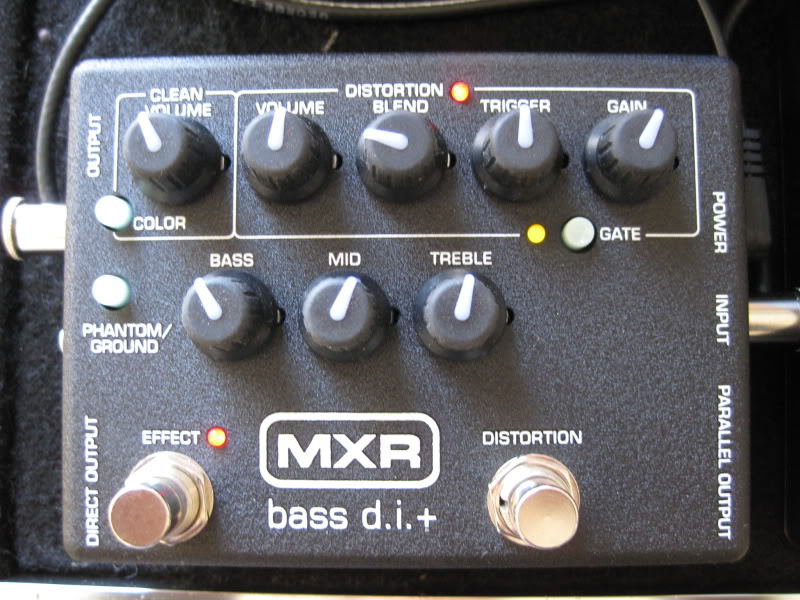
This is how I play 90% of the time when I need some grit. I turn the grit loop off (which consists only of the M-80) when I want a clean tone.
My SVT 4-Pro has the exact settings as the Bass Mid and Treb on the M-80.
And this is how I loop things:
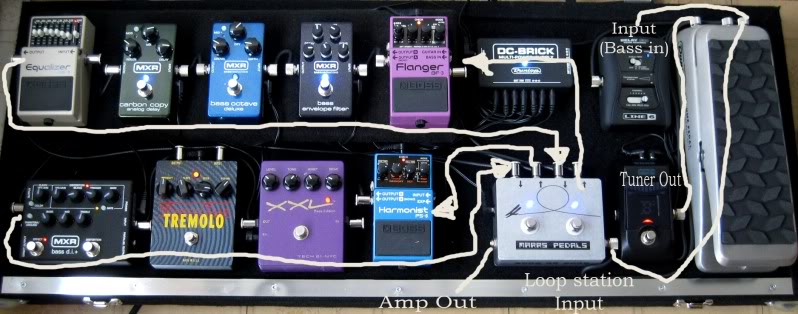
One pedal is missing, the Morpheus Divebomb
 I love you Man
Wow, he even shares his settings? this club rawks
Take Care,
Brent
HAHA! The settings is only 60% of the battle...the rest is in the fingers!
HAHA! The settings is only 60% of the battle...the rest is in the fingers!
Hey everyone! I was shocked to get the ARC6 I purchased from the Guitar Center in Seattle on Monday late yesterday afternoon. I figured at best it might be here today or tomorrow. So it was a good day yesterday. It was a new Spector day for me.
Some things to ponder... this is the first time I've ever bought an expensive guitar or bass sight unseen. And it's funny what I found.
- This guitar has obviously been in storage. It's a NAMM Show 2010 Guitar. It doesn't have a mark on it. It looks as if it was never played. No sign that the finish has been touched by human hands.
- It does show signs that at some point it was subject to excessive heat for a long period of time.
- The glue under the frets got hot enough to melt and seep out from under the frets onto the neck and fingerboard in several places. Heat will cause the nature oils of the wood to seep out as the wood looses moisture. This reacts with the glue and the glue is pushed out of the wood.
- And the finish... this is the real giveaway... these guitars are sanded smooth then gloss coated. So they should have a relatively even (smooth) gloss coat.
When you can look at the surface and there's ripples in the gloss clear coat where the wood has shrunk due to having the moisture pulled out of it (or in a lot of cases too much moisture in the air and the wood has swollen)... there's a good indication that the guitar in question has experienced excessive heat like being left in the trunk of your car for a month during the heat of the summer or being stored for two years in your garage or attic.
- Different areas of the wood top shrink at a different rates.
- More dense areas take longer to loose the moisture and because they are packed tighter with the cellular material of the tree wood, they "deflate" down less than the more porous areas which are less dense.
In short, you can look at this guitar from the front and it's amazing. Look at the top from an angle in the right light to catch the reflection and the clear coat is rippled (in a way that's consistent with the wavy pattern of the quilt). This type of rippling is usually consistent with the guitar being exposed to too much moisture or not enough.
- Because this guitar came from Seattle, a notoriously damp area... I would have first bet this guitar was stored somewhere really humid.
- But in it's case were several of the silica moisture traps. So... when I noticed the fret glue I knew immediately that heat was the culprit.
- There's no visible shrinkage of the neck or fingerboard because being solid Rosewood (which is packed with natural oils and really hard to dehydrate which is why it's a great material for necks) it seemed to escape the effects that ravaged the more delicate Maple top.
The issues from the mistreatment of this guitar in it's past are nothing more than cosmetic at this point. The neck and body are slowly adjusting to the climate-controlled environment in my office. So pretty soon the moisture will be normalized and the wood will be healthy again. The ripples in the finish will never go away. But this doesn't really affect the tone or playability.
The neck was set with a very minimal amount of relief. The strings were a little high for my taste. And with the Pigtail bridge that's an easy adjustment. Just unscrew or screw in the side of the bridge that needs adjustment with the strings under tension using a large flat-head screw driver.
I noticed last fall that I had a dryness issue with The Black Pearl's neck started shrinking some and I could feel fret edges. A nice room humidifier later the neck was fine and all is well.
In all, I got an amazing deal on a beautiful, beautiful transition ARC6 (from the original ARC6 body/control configuration of Pigtail bridge and 4 control knobs to the current 2-piece bridge and 2 control knobs). This guitar is one of two or three made with three knobs and the pigtail bridge.
It was worth every penny. But I thought I'd share this little insight into buying an expensive guitar from someone you don't know sight unseen. Little things that most people probably wouldn't see. But I'm an UBER Spector Geek (USG) so what did you expect.
I took this baby completely apart last night, cleaning, conditioned and polished it. I strung it with Spector regular (10s) guitar strings.
The guitar sounds amazing. I'm going to yank the Seymour Duncans out of it at some point and put in Harmonic Design stacked single-coil pups for a different sound.
It's a wicked sounding guitar. Here are some pics of it with my basses.
Link Removed
Link Removed
Link Removed
Link Removed
Link Removed
Link Removed
Link Removed
Link Removed
Link Removed
Link Removed
Link Removed

So true!
True. You have a pretty aggressive attack on the strings and that helps your tone for sure.
Here's another track for you guys using a bassline I think we all know. One of these basses is my NS 2 (with ProSteels) and the other is the Forte (Cobalts). Which is which and which tone do you like better. I'll post the answer later tonight.
http://soundcloud.com/husky123/forte-ns-2-dry
smadder said:Yeah, that's definitely the Euro Aluminum bridge on it in the pic. Would be interested to see it with the American.

Listen to the first 55 seconds of this: http://soundcloud.com/trailight/a-brief-instant
That's just something I came up with and used the Harmonist for.
A much comprehensive explanation here:
Hey everyone! I was shocked to get the ARC6 I purchased from the Guitar Center in Seattle on Monday late yesterday afternoon.
That's pretty cool, I generally find that Boss pedals are pretty digital/boring sounding, but that pedal seems pretty sweet....might have to get one

Here's another track for you guys using a bassline I think we all know. One of these basses is my NS 2 (with ProSteels) and the other is the Forte (Cobalts). Which is which and which tone do you like better. I'll post the answer later tonight.
http://soundcloud.com/husky123/forte-ns-2-dry