• TalkBass has been independent since 1998. Add your voice.
    Create a free account to reply to discussions, view embedded media, and browse with fewer display ads.
    Join freeLog in
    Want zero display ads or expanded classifieds tools? Compare plans.

SPECTOR® Club - Part 64

Status
Not open for further replies.
I only have experience with the Pau and Ebony (at least till tomorrow) The Ebony board has a little more zing to it and the grain is tighter. Out of the two I prefer the Pau due to the midrange of that wood suits my style better. I also like the lighter wood, but I really don't consider that in my decision. The Pau seemed like the half way point between the older Rosewood fretboards and the Ebony.

Interesting, I understand what your talking about with the Pau Ferro it has a wonderful tone and the touch is smooth yet you can get a good grip (I would still like to play a Ebony and feel/listen to it). The BEM is hard, plays fast, sounds bright and loud to me....I just practiced the songs for the show this Saturday using the BEM and love the tone it produces.
 
Interesting, I understand what your talking about with the Pau Ferro it has a wonderful tone and the touch is smooth yet you can get a good grip (I would still like to play a Ebony and feel/listen to it). The BEM is hard, plays fast, sounds bright and loud to me....I just practiced the songs for the show this Saturday using the BEM and love the tone it produces.

If you like the BEM you would like the Ebony. Playing the Ultra Amber today (not plugged in) I could really tell a difference in how much harder the maple fretborad was. It didn't seem overly obnoxious considering that I play hard and over the P position. We'll see tomorrow how that translates through the electronics. I'm sure that if it was a bolt on, different pre, etc you would get different results. We'll have to get Bunk to give us the low down on the Coda neck vs. his other setups.
 
If you like the BEM you would like the Ebony. Playing the Ultra Amber today (not plugged in) I could really tell a difference in how much harder the maple fretborad was. It didn't seem overly obnoxious considering that I play hard and over the P position. We'll see tomorrow how that translates through the electronics. I'm sure that if it was a bolt on, different pre, etc you would get different results. We'll have to get Bunk to give us the low down on the Coda neck vs. his other setups.

A lot of people focus on the look of the BEM bass, gets a lot of attention. I would like to hear what you think after you run it into your system...and...good idea about Bunk comparing his BEM boards to the others he has!
 
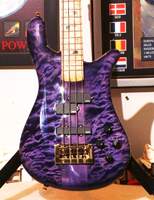
Here's a bass owned by PJ. And as you may know both my builds in progress are getting ebony boards.

desktop_12_zps6ffebb3e.jpg


'Nuff said. :D

It's awesome that you posted this as that is basically the kind of wood top that I am looking for as well...

Thanks to all who contributed their opinions/experiences...keep'em coming!

I am leaning towards the Ebony for 3 reasons...a) I have heard it has a tight response to slap/funk b) I've always thought ebony boards just looked sexy and c) I plan on adding a Coda 5 with Bahama Blue/BEM at some point as well. ...in fact, Todd is quoting both a BO 5 MM and a Coda 5LX just to see which one is more in line with my current finances! :D

I have a few more weeks before anything is set in stone so any ideas suggestions are appreciated!

I have also been talking a bit with PJ about what is available and get his thoughts/ideas on this build. This and my fretless will have to be my only basses for the foreseeable future, as I sense a cross country move in my near future, so I want to make the best decision possible!

...this is the fun part before the inevitable and torturous wait! :hiding:
 
New Rex-Pro, along with my almost new euro. I really need to spend some time learning to take real pics, but this gives the gist... Had to move the strap button... Not trying to cause strife, but I figured the USA strap button position is "good enough" for me.

image.jpg
 
It's awesome that you posted this as that is basically the kind of wood top that I am looking for as well...

OK. I need to make an admission here. This photo was created, in Photoshop, by yours truly.

This is actually PJ's NS-230. And the fingerboard and neck in this image is not real. And the inlays, if you look closely, are NOT the right size.

The wings of this bass and everything else you see is real. But to be able to use PJ's NS-230 on the front cover of the 2011 Spector Print Catalog (the last year Spector did a print catalog), I had to "cheat" the image to make it look like a standard NS-2. And NOT the NS-230, which was no longer available.

Link Removed

I am leaning towards the Ebony for 3 reasons...a) I have heard it has a tight response to slap/funk b) I've always thought ebony boards just looked sexy and c) I plan on adding a Coda 5 with Bahama Blue/BEM at some point as well. ...in fact, Todd is quoting both a BO 5 MM and a Coda 5LX just to see which one is more in line with my current finances! :D

Ebony and Pau Ferro are roughly the same density. And very comparable in tone. Pau Ferro is more like Brazilian Rosewood (which is the ultimate wood for fingerboards but is also protected and it's illegal to use) in that it does have a warmer tone than Ebony.

The problem with Ebony, and anyone considering an Ebony fingerboard needs to pay CLOSE attention to what I'm about to say, is that it is a very brittle wood. And you have to keep it hydrated. If it dries, it cracks. And you can't recondition it and bring it back. It'll never be the same.

It's a high-maintenance wood. Unless you live in a humid area where the average humidity is greater than 50% all year... it's going to take work to keep your fingerboard from cracking.

Where I live in Southern California, I have to deep condition an Ebony board every other month.

So think about it carefully. Pau Ferro is more durable, sounds a little warmer (which I prefer) and has roughly the same density, so lows/mids/highs are expressed in a very similar fashion.

I have a few more weeks before anything is set in stone so any ideas suggestions are appreciated!

OK. If you really like the darker look... ask for a darker Pau Ferro stain, or treat your fingerboard with a product like Behlen's fingerboard oil, which will darken your board up with each new application.

Look at the photo below of my NS-4 and The Blue Dream side by side... Look at how much darker The Blue Dream is... that's because of the Behlen fingerboard oil applications I do to it that I DO not do to the NS-4. I use the Dunlop 65 products on it. Ignore the cat in front of the curtain... LOL...

Link Removed

So if you want Ebony for the look... you can make Pau Ferro look much darker.

If you want it specifically for its tone... then you need to be prepared to make a commitment to pay close attention to your fingerboard's condition and be prepared to oil it regularly (depending on your location).

And for the record. PJ's Brooklyn Era NS-2 #603 has an Ebony board. And living the Washington DC area... PJ rarely has to do anything to maintain that board. That bass is 31 years old and the board is in really good shape. But he still has to be careful with it. Travel to a really dry location with it and it would deteriorate quickly if not conditioned.

I have also been talking a bit with PJ about what is available and get his thoughts/ideas on this build. This and my fretless will have to be my only basses for the foreseeable future, as I sense a cross country move in my near future, so I want to make the best decision possible!

Honestly, trust PJ. He'll never steer you wrong.

...this is the fun part before the inevitable and torturous wait! :hiding:

Yep. I'm almost in the mid-point for that wait myself. My newest will be another BEM neck-thru... this one having a SINGLE MM pup and an Aguilar OBP-3 circuit at 18v. Basically an NS-4MM. I can't wait!!!
 
The problem with Ebony, and anyone considering an Ebony fingerboard needs to pay CLOSE attention to what I'm about to say, is that it is a very brittle wood. And you have to keep it hydrated. If it dries, it cracks. And you can't recondition it and bring it back. It'll never be the same.

It's a high-maintenance wood. Unless you live in a humid area where the average humidity is greater than 50% all year... it's going to take work to keep your fingerboard from cracking.

I must have gotten lucky with my 20 year old Carvins, both of which have ebony boards. I never really did anything with them, and they've go not cracks. It's pretty humid here in the warmer months but it can get dry in the winter.

The Webster does have a very slight crack in the fretboard but it has not gotten worse the whole time I have had it.

How often would you do the Behlen application to a pau ferro to darken it up? Thinking about doing it with the 6XL.
 
I must have gotten lucky with my 20 year old Carvins, both of which have ebony boards. I never really did anything with them, and they've go not cracks. It's pretty humid here in the warmer months but it can get dry in the winter.

The Webster does have a very slight crack in the fretboard but it has not gotten worse the whole time I have had it.

How often would you do the Behlen application to a pau ferro to darken it up? Thinking about doing it with the 6XL.

Virginia is pretty forgiving with its humid ass weather. lol My acoustic has a ebony fretboard and I only use Dunlop conditioner on it every so often.
 
The problem with Ebony, and anyone considering an Ebony fingerboard needs to pay CLOSE attention to what I'm about to say, is that it is a very brittle wood. And you have to keep it hydrated. If it dries, it cracks. And you can't recondition it and bring it back. It'll never be the same.

After reading this I went back into my bedroom and broke out my Modulus Quantum 5 which I bought back in 1994 and played a lot for the next 11 years. It has an ebony fingerboard. I hate to admit but I've conditioned it only once or twice and I've lived in Albuquerque the whole time. I've also subjected it to a lot of "Kean & Shine" to clean the strings and neck.

I just broke out my SureFire LED flashlight and inspected the fingerboard "up close and personal" and other than the expected wear it's flawless. Not a single crack. Is what you are referring to a Spector ebony thing?
 
After reading this I went back into my bedroom and broke out my Modulus Quantum 5 which I bought back in 1994 and played a lot for the next 11 years. It has an ebony fingerboard. I hate to admit but I've conditioned it only once or twice and I've lived in Albuquerque the whole time. I've also subjected it to a lot of "Kean & Shine" to clean the strings and neck.

I just broke out my SureFire LED flashlight and inspected the fingerboard "up close and personal" and other than the expected wear it's flawless. Not a single crack. Is what you are referring to a Spector ebony thing?

I own several Spector basses with ebony fingerboards and have never once had an issue.
 
OK. I need to make an admission here. This photo was created, in Photoshop, by yours truly.

This is actually PJ's NS-230. And the fingerboard and neck in this image is not real. And the inlays, if you look closely, are NOT the right size.

The wings of this bass and everything else you see is real. But to be able to use PJ's NS-230 on the front cover of the 2011 Spector Print Catalog (the last year Spector did a print catalog), I had to "cheat" the image to make it look like a standard NS-2. And NOT the NS-230, which was no longer available.

Link Removed


Ebony and Pau Ferro are roughly the same density. And very comparable in tone. Pau Ferro is more like Brazilian Rosewood (which is the ultimate wood for fingerboards but is also protected and it's illegal to use) in that it does have a warmer tone than Ebony.

The problem with Ebony, and anyone considering an Ebony fingerboard needs to pay CLOSE attention to what I'm about to say, is that it is a very brittle wood. And you have to keep it hydrated. If it dries, it cracks. And you can't recondition it and bring it back. It'll never be the same.

It's a high-maintenance wood. Unless you live in a humid area where the average humidity is greater than 50% all year... it's going to take work to keep your fingerboard from cracking.

Where I live in Southern California, I have to deep condition an Ebony board every other month.

So think about it carefully. Pau Ferro is more durable, sounds a little warmer (which I prefer) and has roughly the same density, so lows/mids/highs are expressed in a very similar fashion.


OK. If you really like the darker look... ask for a darker Pau Ferro stain, or treat your fingerboard with a product like Behlen's fingerboard oil, which will darken your board up with each new application.

Look at the photo below of my NS-4 and The Blue Dream side by side... Look at how much darker The Blue Dream is... that's because of the Behlen fingerboard oil applications I do to it that I DO not do to the NS-4. I use the Dunlop 65 products on it. Ignore the cat in front of the curtain... LOL...

Link Removed

So if you want Ebony for the look... you can make Pau Ferro look much darker.

If you want it specifically for its tone... then you need to be prepared to make a commitment to pay close attention to your fingerboard's condition and be prepared to oil it regularly (depending on your location).

And for the record. PJ's Brooklyn Era NS-2 #603 has an Ebony board. And living the Washington DC area... PJ rarely has to do anything to maintain that board. That bass is 31 years old and the board is in really good shape. But he still has to be careful with it. Travel to a really dry location with it and it would deteriorate quickly if not conditioned.


Honestly, trust PJ. He'll never steer you wrong.


Yep. I'm almost in the mid-point for that wait myself. My newest will be another BEM neck-thru... this one having a SINGLE MM pup and an Aguilar OBP-3 circuit at 18v. Basically an NS-4MM. I can't wait!!!

I wanted to co-sign this. I was having a conversation with my friend and luthier. I'm condensing and simplifying, but essentially his take is; ebony might be the perfect surface for fretless. Fretted, not so much. Though, of course, even a fretless ebony board should be properly maintained.
 
Status
Not open for further replies.