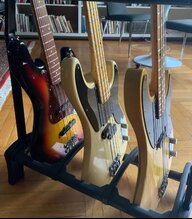
Fixed.
PS. If you ever want to sell it.........dibs.
My bad... typing without my glasses on again.


TalkBass has been independent since 1998. Add your voice.
Create a free account to reply to discussions, view embedded media, and browse with fewer display ads.
Join free Log in
Want zero display ads or expanded classifieds tools? Compare plans.
Fixed.
PS. If you ever want to sell it.........dibs.


Good question. I don't know.
To me, the Terminator was perfect for "Death Metal" because it's a metal death machine.
I actually designed it for my friend Chris from Kill the Masses. I figured he'd get a kick out of it.
I guess I could do a series of this sort of thing. MMmmm... it's a thought.
 In fact, there are a lot of death metal players that use Spector from what I can recall. And everyone loves the Terminator... Universal just might want a word or two about copyright and all that if Spector were (and should) use something as awesome as that.

Universal just might want a word or two about copyright and all that if Spector were (and should) use something as awesome as that.

Not really. It depends on what you are doing. As a session-oriented bassist and not a performance/gig bassist, I need to know scales, read music (not just tabs) and be able to speak the language of the guy who wrote the music and has hired me to come in and lay the tracks down.
So theory, scales, modes and being able to improvise in a particular key, knowing the notes of each string on each position of the fingerboard, all of it becomes really important.
But if you are gigging, doing covers, even writing your own stuff, you don't have to know any of this. I know many very talented bassists who don't know how to read music and can't tell you the notes they are playing. It doesn't stop them from sounding awesome and performing like rock-stars.
Where'd you learn all those things at? Books, lessons,.....self taught?

So in the next few months I plan to get a 4-string Spector. It will be a regular player and I want it to roughly match the quality of my 5-string Warwick Corvette Standard, so my plan was to look for a Euro of some sort.
Now, I've read through this thread and a few other Spector threads and have found a wealth of info, but I still have a few unanswered questions.
1. What are the main differences between a "regular" Euro and the Rebop? Spector's website is less than forthcoming. I really like the curved NS body shape, so if the Rebops don't have them they're out. But what are the other differences?
2. I'm looking for a P-J pickup specifically. Does that limit me into certain models? If so, what do I gain or lose by limiting myself like that (in other words, what features might I lose by ignoring other pickup designs)?
3. Is the quality/tone/total package difference between the Legend and Euro series enough to justify the price difference? Like I said, I'm looking for this bass to be a regular player for me not a backup, so I'd like to get the best possible quality I can afford. I've played a few Euros and was in love from the beginning, but I've had a hard time finding Legends to compare.
Thanks in advance!

Thanks for the quick replies!
This actually won't become my "main" single player, I just want it to have alongside the Warwick for a 4-5 thing. The band I'm in that plays out the most does about half our set in drop-D so I'd like a quality 4-stringer for that.
That's definitely a possibility! I love the half-a-bat neck though. It took me a little while to feel comfortable with it but I absolutely love it now. I have other basses with thinner necks and those are fine, but every time I pick up the Warwick again I feel at home.
1. What are the main differences between a "regular" Euro and the Rebop? Spector's website is less than forthcoming. I really like the curved NS body shape, so if the Rebops don't have them they're out. But what are the other differences?
2. I'm looking for a P-J pickup specifically. Does that limit me into certain models?
3. Is the quality/tone/total package difference between the Legend and Euro series enough to justify the price difference?
Thanks in advance!