
Enjoy the benefits of a premium membership!
Upgrade Account
-
TalkBass has been independent since 1998. Add your voice.
Create a free account to reply to discussions, view embedded media, and browse with fewer display ads.
Join free Log in
Want zero display ads or expanded classifieds tools? Compare plans.
You are using an out of date browser. It may not display this or other websites correctly.
You should upgrade or use an alternative browser.
You should upgrade or use an alternative browser.
Squier Owners Club
- Thread starter Bassplayer_479
- Start date
-
- Tags
- club
More options
Who Replied?

Should be: it is, according to what I found on various (guitar) forums, with most Chinese Squiers, and the CV is Chinese.Any of you Squier guys able to tell me how exactly one goes about identifying the year on a CV series?
Is it the first two digits of the serial# ?
The Chinese and Taiwanese Squier
YN: Y stands for Yako Taiwan and the N means that the Squier was built in the 90s 1990s. The first number was always the year.
From stratomaniac.com, and probably autamatically translated from another language: "bedeteutet" is very similar to the German word "bedeutet", which means ... "means" (verb, 3rd person singular).For example:
YN5: bedeteutet that the Squier was built by Yako in 1995.
CY: C stands for China.
Y: stands for Yako Taiwan, followed by the first two characters meaning prefix serial number in the serial number the year.
For example:
CY97: means that the Squier was built by Yako in 1997.
CY series are usually crafted built China Squiers. Some Chinese Gretsch guitars have a CY serial number.
There are various Chinese series: CD, CT, CJ, NC: C = China, the first number following the serial number prefix is the year.
Some Squiers that are sold only in the Chinese and Asian markets, starting with usually the serial number
CXS: the "X" stands for "Axl"
Lambic said:Should be: it is, according to what I found on various (guitar) forums, with most Chinese Squiers, and the CV is Chinese.
The Chinese and Taiwanese Squier
YN: Y stands for Yako Taiwan and the N means that the Squier was built in the 90s 1990s. The first number was always the year.
From stratomaniac.com, and probably autamatically translated from another language: "bedeteutet" is very similar to the German word "bedeutet", which means ... "means" (verb, 3rd person singular).
Damn, thank you, much appreciated that was way more than expected.

do the CV's have an S or a C, etc... in front of the first 2 #'s for Samick or Cort, etc... manufacture?
From our dear Wikipedia:do the CV's have an S or a C, etc... in front of the first 2 #'s for Samick or Cort, etc... manufacture?
Squier Classic Vibe series guitars/basses serial numbers start with CG. e.g. CGSxxxxxxx
Well, probably 2010 for the first and 2008 for the second. But as to find the factories hidden behind "R" and "RL"...Ok so I've got one (CGR108 ) CV Sonic Blue P Bass and then a (CGRL08 ) CVJ Bass
Are they 2008? 2010? I'm lost here.
Lambic said:Well, probably 2010 for the first and 2008 for the second. But as to find the factories hidden behind "R" and "RL"...
Sorry, forgive my rookie-ies questions here, but I'm not following, are you saying the R & RL stand for where they were made?
And also did they have the CV series around in 08?
I'm kinda taken back by that because I just bought this J Bass and it's immaculate and I mean literally not so much as a slight scuff on it anywhere. That's pretty impressive that a bass with no case at all has made it 4 almost 5 years completely unscathed.
Sorry, forgive my rookie-ies questions here, but I'm not following, are you saying the R & RL stand for where they were made?
And also did they have the CV series around in 08?
I'm kinda taken back by that because I just bought this J Bass and it's immaculate and I mean literally not so much as a slight scuff on it anywhere. That's pretty impressive that a bass with no case at all has made it 4 almost 5 years completely unscathed.
Welcome in guitardating hell

Sometimes I wonder if even at Fender's (or Gretsch's or Gibson's or whatever) there's anyone keeping track of who is making what when where (and how much) at all: in Fender's case the numbering is a strange story in itself, so if they change overseas factories when they find that quality and/or price aren't right, or when a factory ceases production for whatever reason...
We'll have to wait until Squiers become collectables, I guess. Then we'll see expert sites popping up!
Lambic said:Welcome in guitardating hell
Sometimes I wonder if even at Fender's (or Gretsch's or Gibson's or whatever) there's anyone keeping track of who is making what when where (and how much) at all: in Fender's case the numbering is a strange story in itself, so if they change overseas factories when they find that quality and/or price aren't right, or when a factory ceases production for whatever reason...
We'll have to wait until Squiers become collectables, I guess. Then we'll see expert sites popping up!
Yeah I've notched, dating any of them is anything but an exact science.
But at the same time that's kinda what makes dating an old Fender and it's parts so interesting.
In that since there really does seem to be a method to the madness. At least amongst the Fender experts anyway, it definitely wasn't for any type of good order Fender ever followed that is for sure.

As of today, I have two  I already had a CV 50's Butterscotch Precision, but today, I got a Squier Telecaster from '89, the Samick era, with a Seymour Duncan Hotrail in the neck position. Very nice guitar
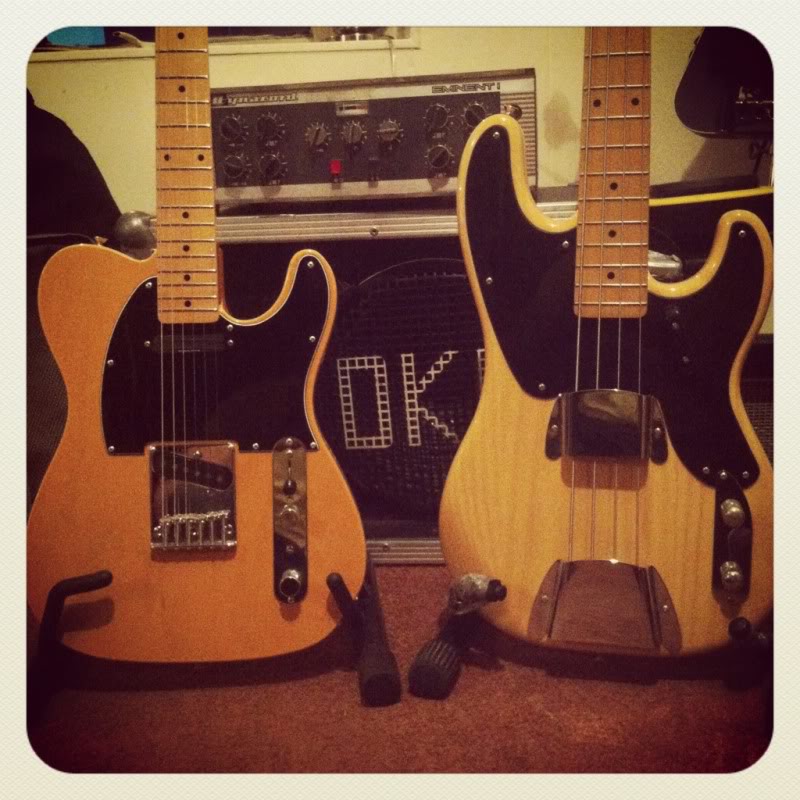
I already had a CV 50's Butterscotch Precision, but today, I got a Squier Telecaster from '89, the Samick era, with a Seymour Duncan Hotrail in the neck position. Very nice guitar 
I'm about to buy my first Squier - a local shop (Fretworks!) has a Squier Vintage Modified Jazz in natural that I'm picking up. I've owned 26 basses, everything from 'Wicks, Rics, Carvins, Deans, Corts, a MIM P and a MIM active J, and I've ~built~ eleven Warmoths. I tried out that Squier J yesterday and didn't put it down for three hours.
So I'll be laying out the $300 bones and picking it up. It's a natural finish model, I am to understand that those have "soft maple" bodies, is this correct?
I didn't have my glasses on (I'm farsighted) so I couldn't tell - are those block inlays real? And the neck binding? My fingers were too numb to tell by feel.
Anyhow, taking the chance on this one. It just felt like ~home~. I haven't even heard it through an amp yet! So I would imagine once I tweak the setup to suit me better and run it through my personal EQ pile of shat that I'll find what I need in it.
Anything I should know about this model?
Thanks.
So I'll be laying out the $300 bones and picking it up. It's a natural finish model, I am to understand that those have "soft maple" bodies, is this correct?
I didn't have my glasses on (I'm farsighted) so I couldn't tell - are those block inlays real? And the neck binding? My fingers were too numb to tell by feel.
Anyhow, taking the chance on this one. It just felt like ~home~. I haven't even heard it through an amp yet! So I would imagine once I tweak the setup to suit me better and run it through my personal EQ pile of shat that I'll find what I need in it.
Anything I should know about this model?
Thanks.

YES THE INLAYS ARE REAL! (plastic). The binding is real too. The reason I yelled is that there was a debate back last year if they were. I inspected the inlays with a high powered magnifying glass and could clearly see the tiny lines of wood filler on the edges; some still didn't believe me. It's tricky because tiny ridges from final sanding and shaping are on the plastic and it almost looks like wood grain; but it's not.
Body is soft maple. I'm sure you'll love it. Just remember to put some jazz knobs on it!
Body is soft maple. I'm sure you'll love it. Just remember to put some jazz knobs on it!
Thanks, like I said I couldn't quite tell.
As for Jazz knobs .. heheh ... it's getting a lot changed, and very little of it will probably end up traditionally "Jazz Bass".
** The tone control will be removed and replaced with another output jack (total of two).
** The pickups will each have their own outputs.
** Volume pots may get changed - depends.
** E-string tuner will be replaced with a Hipshot detuner with Double Stop Lever option (natural "Y key").
** Pickguard is getting replaced with a Warmoth black laminant pickguard with red in the middle (if it fits - they have a full sized PDF you can print out to check fitment prior to buying a pickguard from them - cool right?)
** Adding a brass thumbrest between the pickups above the strings.
** Depending on how they sound the supplied pickups may be goners and replaced with (perhaps) 1/4 pounders or one of the EMG types. I'll have to see what's up in that department.
** The remaining 3 tuners may get replaced with Hipshot "Y key" lightweights (natural).
** Bridge getting changed to a brass black Hipshot - haven't decided which one yet (A, B, or vintage replacement) with a .659 spacing and brass saddles.
** And I'll try my oddball string setup. On my rock basses, I use the thinnest four strings from the Ernie Ball slinky 6 string set (80-66-45-32). If that is a suck with this one, then I'll use Elixir mediums (105-45 tuned to either DGCA or DGBD).
** Straplocks (black).
This will happen over the course of about a month or two. I'll want to record and document how each change worked with (or against) my goals.
As for Jazz knobs .. heheh ... it's getting a lot changed, and very little of it will probably end up traditionally "Jazz Bass".
** The tone control will be removed and replaced with another output jack (total of two).
** The pickups will each have their own outputs.
** Volume pots may get changed - depends.
** E-string tuner will be replaced with a Hipshot detuner with Double Stop Lever option (natural "Y key").
** Pickguard is getting replaced with a Warmoth black laminant pickguard with red in the middle (if it fits - they have a full sized PDF you can print out to check fitment prior to buying a pickguard from them - cool right?)
** Adding a brass thumbrest between the pickups above the strings.
** Depending on how they sound the supplied pickups may be goners and replaced with (perhaps) 1/4 pounders or one of the EMG types. I'll have to see what's up in that department.
** The remaining 3 tuners may get replaced with Hipshot "Y key" lightweights (natural).
** Bridge getting changed to a brass black Hipshot - haven't decided which one yet (A, B, or vintage replacement) with a .659 spacing and brass saddles.
** And I'll try my oddball string setup. On my rock basses, I use the thinnest four strings from the Ernie Ball slinky 6 string set (80-66-45-32). If that is a suck with this one, then I'll use Elixir mediums (105-45 tuned to either DGCA or DGBD).
** Straplocks (black).
This will happen over the course of about a month or two. I'll want to record and document how each change worked with (or against) my goals.
YES THE INLAYS ARE REAL! (plastic). The binding is real too. The reason I yelled is that there was a debate back last year if they were. I inspected the inlays with a high powered magnifying glass and could clearly see the tiny lines of wood filler on the edges; some still didn't believe me. It's tricky because tiny ridges from final sanding and shaping are on the plastic and it almost looks like wood grain; but it's not.
Body is soft maple. I'm sure you'll love it. Just remember to put some jazz knobs on it!
Exactlly the same thing here T. Under magnification I could even see where the routing for a couple of blocks had been a little sloppily overdone by at least a millimeter and had been filled. Also, last year, I was scraping a bit of schmutz off the fretboard, and I noticed I could actually feel my fingernail catch on the edge of one of the blocks, tried it on other blocks and could feel it catch there, too.
Add to that offiical confirmation from Fender's Customer Relations department that the inlays and binding are real. Case closed.
I'd really like to know how this BS got started, and why it still persists.
Oh, and I did put the proper black jazz knobs (and other 70's style bling) on mine, too!
(here's this pic again!)
The final piece would be if I could get a chrome bullet truss rod nut to fit. I'm not sure the ones I've found (official Fender and a generic aftermarket part) would fit.
Any ideas on that?

C.Linton, where did you get that sweet bridge cover? What was that originally off of? I've never seen one that long with the "F" on it. Really cool.
Pretty sure the threads on the rod will be metric. Have you seen any metric bullets? Dunno, I like the black "hole protector". It's like the black cherry on a black and tan sundae, but I have black Hipshots and tree on mine so it all fits.


