• TalkBass has been independent since 1998. Add your voice.
    Create a free account to reply to discussions, view embedded media, and browse with fewer display ads.
    Join freeLog in
    Want zero display ads or expanded classifieds tools? Compare plans.

Steinberger Club

Anyone know what pick-up heights should be? And the adjusting screw on the drop-tuner is loose!

No specifications for the pickup height I'd know of. These are passive pickups, so they shouldn't be too close to the string (in contrast to EMGs which have less magnetic force).

For setting up the DB bridge correctly, Invalid Link Removed.
 
  • Like
Reactions: maggsybass
Yes but it refers to another bass, i refer my experience to Spirit, last release, it is setted from house directli with the P.U. very close (especialli the bridge) to the strings and it sound well, not too loud not sustain loosing, the P.U. passive are not very strong magnetic field.
 
  • Like
Reactions: maggsybass
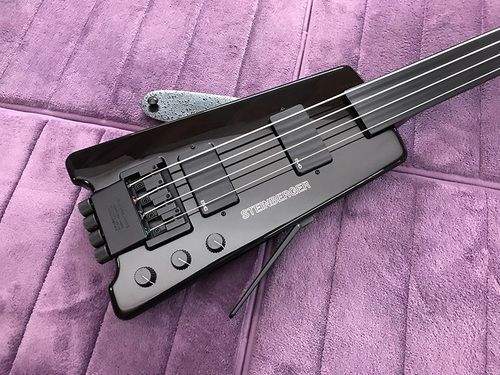
Last Friday, after coveting one for nearly 30 years, I finally bought an unlined fretless 4-string Steinberger XL2 from HeadlessUSA.

First, the obligatory photos:


It's been many years since I've handled an XL bass, and upon lifting it out of the case I was instantly struck by its density and heft. To anyone not familiar with the materials used in the construction of the Steinberger L/XL series, they might assume such a compact instrument would be featherweight, and dismiss it as an insubstantial novelty. Upon picking one up, however, I think that the weight, stiffness, and immediately apparent build quality are the first clues that this is no mere toy, and they hint to the XL's legendary status as a triumph of engineering and as a serious musical instrument.

Playing my first notes on the bass brought a huge smile to my face. It was instantly apparent that I've purchased a true, enduring classic. I've been playing the same bass since 1991, my Kubicki Factor fretless. During the past 28 years, I've tried other fretless basses, and I can count on one hand the number of instruments that I would actually have considered adopting. The two that come to mind are a fretless F Bass and a fretless Sukop bass. Both of them were wood construction, with traditional headstocks. I've tried out a few fretted Steinberger XLs over the years, but unfortunately I never had the opportunity to try a fretless. I did once see a narrow 5-string fretless XL in person, but it had already been sold and was not available to demo. My experiences with trying the fretted XLs made me appreciate their sonic clarity and sustain, and I always wondered how those qualities would translate to a fretless version. Alas, I shall wonder no more.

Unsurprisingly, the same qualities that make the fretted version of the XL bass so formidable are equally beneficial to a fretless. The stability and consistency of the composite unibody construction endows the XL bass with an incredible sustain and clarity that must be experienced to appreciate. The bass I purchased has a passive tone control. As I understand it, passive tone controls are cut-only; that is, the fully open position provides no boost of any frequency, and rolling back the knob gradually cuts higher frequencies. If that is the case, then what I'm hearing from the bass with no tone control cut is incredible. The combination of the XL's construction and its high-fidelity, full-range active EMG pickups results in a clear, brilliant tone that is rich in harmonics on top of the strong fundamental of each note. Any audio engineer will agree that subtractive EQ is always preferable to additive EQ. It's better to cut/filter frequencies than to artificially add them, because boosting frequencies also boosts the noise floor. In short - it's better to subtract what's there than to add what's not. In the case of the XL bass, it's there.

Moving on to playability: After having played the same bass for 28 years, an adjustment period to a new instrument is to be expected. Fortunately, the XL2UF is well within the range of my adaptability, and with some further tweaks, I expect to acclimate to it in short order. The bass's action, as received, was too a bit too high for my taste. It arrived well set up and balanced, but I did ultimately need to lower the action, and subsequently tweak intonation. Fortunately, the combination of double ball strings and quick, convenient Allen key and slotted driver bridge adjustment makes this process relatively painless. I'm still dialing in the fine tuning, but I'm 90% there.

There are some design differences between my Factor bass and the XL that will require some recalibration on my part. The XL's fingerboard, while not completely flat, has a flatter radius than my Factor neck, which has a more pronounced arch. The plastic covers of the EMG pickups are also flat across the top, unlike the Kubicki pickups, whose plastic covers replicate the same radius arch as the neck. This feels a bit different under my fingers, but it's not an insurmountable obstacle. The XL's EMG pickups also don’t extend as far out from either side of the strings as the Kubicki, so the place where I’m used to resting my right thumb is a bit closer to the string, as well as being less elevated from the body. Until I fully adapt to the XL's layout, it will feel a bit like I'm playing someone else's bass. Interestingly, I've used the same analogy when driving a new car. There is an initial break-in period in which one's muscle memory adapts to a new set of parameters.

For reasons I don't quite understand, the middle strings (A and D) register a few dB louder than the edge strings (E and G) with the same plucking force. There is not an appreciably large difference between the action height of each string, and the outer strings are actually closer to the pickups than the inner strings, so I'm a little perplexed. I've raised the the action slightly on the A and D strings in an attempt to counteract the discrepancy in level, but there's still a slight difference. I'm curious to know if there's something specific to the EMG pickups' design that might favor the inner strings in this regard...

The "boomerang" is yet another impressive feat of engineering. I was quite surprised to find that once strapped on, the bass easily rotates around its pivot point, allowing changes in orientation without any strap adjustment being necessary.

I do have a couple of minor niggles. First, gloss black finishes are a fingerprint magnet! It's easy enough to keep a soft cloth in the case with the bass for post-session wipe-downs, but keeping the bass free of prints and smudges will require due diligence on my part. Second, glossy finish necks have a bit more thumb drag than satin finish necks. Rather than changing the finish of the bass neck itself, I think I might apply a satin vinyl appliqué strip to the back of the neck, which is an easily reversible, non-destructive modification. In any case, I'd prefer not to undertake any modifications that might diminish the bass's value as a collectible classic.

These are just my first impressions after having the bass for a few days. I'll be sure to add more observations once I've had time to play the XL for a while.
 
Last Friday, after coveting one for nearly 30 years, I finally bought an unlined fretless 4-string Steinberger XL2 from HeadlessUSA.

First, the obligatory photos:


It's been many years since I've handled an XL bass, and upon lifting it out of the case I was instantly struck by its density and heft. To anyone not familiar with the materials used in the construction of the Steinberger L/XL series, they might assume such a compact instrument would be featherweight, and dismiss it as an insubstantial novelty. Upon picking one up, however, I think that the weight, stiffness, and immediately apparent build quality are the first clues that this is no mere toy, and they hint to the XL's legendary status as a triumph of engineering and as a serious musical instrument.

Playing my first notes on the bass brought a huge smile to my face. It was instantly apparent that I've purchased a true, enduring classic. I've been playing the same bass since 1991, my Kubicki Factor fretless. During the past 28 years, I've tried other fretless basses, and I can count on one hand the number of instruments that I would actually have considered adopting. The two that come to mind are a fretless F Bass and a fretless Sukop bass. Both of them were wood construction, with traditional headstocks. I've tried out a few fretted Steinberger XLs over the years, but unfortunately I never had the opportunity to try a fretless. I did once see a narrow 5-string fretless XL in person, but it had already been sold and was not available to demo. My experiences with trying the fretted XLs made me appreciate their sonic clarity and sustain, and I always wondered how those qualities would translate to a fretless version. Alas, I shall wonder no more.

Unsurprisingly, the same qualities that make the fretted version of the XL bass so formidable are equally beneficial to a fretless. The stability and consistency of the composite unibody construction endows the XL bass with an incredible sustain and clarity that must be experienced to appreciate. The bass I purchased has a passive tone control. As I understand it, passive tone controls are cut-only; that is, the fully open position provides no boost of any frequency, and rolling back the knob gradually cuts higher frequencies. If that is the case, then what I'm hearing from the bass with no tone control cut is incredible. The combination of the XL's construction and its high-fidelity, full-range active EMG pickups results in a clear, brilliant tone that is rich in harmonics on top of the strong fundamental of each note. Any audio engineer will agree that subtractive EQ is always preferable to additive EQ. It's better to cut/filter frequencies than to artificially add them, because boosting frequencies also boosts the noise floor. In short - it's better to subtract what's there than to add what's not. In the case of the XL bass, it's there.

Moving on to playability: After having played the same bass for 28 years, an adjustment period to a new instrument is to be expected. Fortunately, the XL2UF is well within the range of my adaptability, and with some further tweaks, I expect to acclimate to it in short order. The bass's action, as received, was too a bit too high for my taste. It arrived well set up and balanced, but I did ultimately need to lower the action, and subsequently tweak intonation. Fortunately, the combination of double ball strings and quick, convenient Allen key and slotted driver bridge adjustment makes this process relatively painless. I'm still dialing in the fine tuning, but I'm 90% there.

There are some design differences between my Factor bass and the XL that will require some recalibration on my part. The XL's fingerboard, while not completely flat, has a flatter radius than my Factor neck, which has a more pronounced arch. The plastic covers of the EMG pickups are also flat across the top, unlike the Kubicki pickups, whose plastic covers replicate the same radius arch as the neck. This feels a bit different under my fingers, but it's not an insurmountable obstacle. The XL's EMG pickups also don’t extend as far out from either side of the strings as the Kubicki, so the place where I’m used to resting my right thumb is a bit closer to the string, as well as being less elevated from the body. Until I fully adapt to the XL's layout, it will feel a bit like I'm playing someone else's bass. Interestingly, I've used the same analogy when driving a new car. There is an initial break-in period in which one's muscle memory adapts to a new set of parameters.

For reasons I don't quite understand, the middle strings (A and D) register a few dB louder than the edge strings (E and G) with the same plucking force. There is not an appreciably large difference between the action height of each string, and the outer strings are actually closer to the pickups than the inner strings, so I'm a little perplexed. I've raised the the action slightly on the A and D strings in an attempt to counteract the discrepancy in level, but there's still a slight difference. I'm curious to know if there's something specific to the EMG pickups' design that might favor the inner strings in this regard...

The "boomerang" is yet another impressive feat of engineering. I was quite surprised to find that once strapped on, the bass easily rotates around its pivot point, allowing changes in orientation without any strap adjustment being necessary.

I do have a couple of minor niggles. First, gloss black finishes are a fingerprint magnet! It's easy enough to keep a soft cloth in the case with the bass for post-session wipe-downs, but keeping the bass free of prints and smudges will require due diligence on my part. Second, glossy finish necks have a bit more thumb drag than satin finish necks. Rather than changing the finish of the bass neck itself, I think I might apply a satin vinyl appliqué strip to the back of the neck, which is an easily reversible, non-destructive modification. In any case, I'd prefer not to undertake any modifications that might diminish the bass's value as a collectible classic.

These are just my first impressions after having the bass for a few days. I'll be sure to add more observations once I've had time to play the XL for a while.

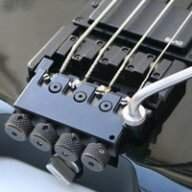
Huge score! A Kubicki and a XL2 in the same house? It's like you are John Ritter ( RIP ) on 3's Company! Beautiful bass. Enjoy.
 
Last Friday, after coveting one for nearly 30 years, I finally bought an unlined fretless 4-string Steinberger XL2 from HeadlessUSA.

First, the obligatory photos:


It's been many years since I've handled an XL bass, and upon lifting it out of the case I was instantly struck by its density and heft. To anyone not familiar with the materials used in the construction of the Steinberger L/XL series, they might assume such a compact instrument would be featherweight, and dismiss it as an insubstantial novelty. Upon picking one up, however, I think that the weight, stiffness, and immediately apparent build quality are the first clues that this is no mere toy, and they hint to the XL's legendary status as a triumph of engineering and as a serious musical instrument.

Playing my first notes on the bass brought a huge smile to my face. It was instantly apparent that I've purchased a true, enduring classic. I've been playing the same bass since 1991, my Kubicki Factor fretless. During the past 28 years, I've tried other fretless basses, and I can count on one hand the number of instruments that I would actually have considered adopting. The two that come to mind are a fretless F Bass and a fretless Sukop bass. Both of them were wood construction, with traditional headstocks. I've tried out a few fretted Steinberger XLs over the years, but unfortunately I never had the opportunity to try a fretless. I did once see a narrow 5-string fretless XL in person, but it had already been sold and was not available to demo. My experiences with trying the fretted XLs made me appreciate their sonic clarity and sustain, and I always wondered how those qualities would translate to a fretless version. Alas, I shall wonder no more.

Unsurprisingly, the same qualities that make the fretted version of the XL bass so formidable are equally beneficial to a fretless. The stability and consistency of the composite unibody construction endows the XL bass with an incredible sustain and clarity that must be experienced to appreciate. The bass I purchased has a passive tone control. As I understand it, passive tone controls are cut-only; that is, the fully open position provides no boost of any frequency, and rolling back the knob gradually cuts higher frequencies. If that is the case, then what I'm hearing from the bass with no tone control cut is incredible. The combination of the XL's construction and its high-fidelity, full-range active EMG pickups results in a clear, brilliant tone that is rich in harmonics on top of the strong fundamental of each note. Any audio engineer will agree that subtractive EQ is always preferable to additive EQ. It's better to cut/filter frequencies than to artificially add them, because boosting frequencies also boosts the noise floor. In short - it's better to subtract what's there than to add what's not. In the case of the XL bass, it's there.

Moving on to playability: After having played the same bass for 28 years, an adjustment period to a new instrument is to be expected. Fortunately, the XL2UF is well within the range of my adaptability, and with some further tweaks, I expect to acclimate to it in short order. The bass's action, as received, was too a bit too high for my taste. It arrived well set up and balanced, but I did ultimately need to lower the action, and subsequently tweak intonation. Fortunately, the combination of double ball strings and quick, convenient Allen key and slotted driver bridge adjustment makes this process relatively painless. I'm still dialing in the fine tuning, but I'm 90% there.

There are some design differences between my Factor bass and the XL that will require some recalibration on my part. The XL's fingerboard, while not completely flat, has a flatter radius than my Factor neck, which has a more pronounced arch. The plastic covers of the EMG pickups are also flat across the top, unlike the Kubicki pickups, whose plastic covers replicate the same radius arch as the neck. This feels a bit different under my fingers, but it's not an insurmountable obstacle. The XL's EMG pickups also don’t extend as far out from either side of the strings as the Kubicki, so the place where I’m used to resting my right thumb is a bit closer to the string, as well as being less elevated from the body. Until I fully adapt to the XL's layout, it will feel a bit like I'm playing someone else's bass. Interestingly, I've used the same analogy when driving a new car. There is an initial break-in period in which one's muscle memory adapts to a new set of parameters.

For reasons I don't quite understand, the middle strings (A and D) register a few dB louder than the edge strings (E and G) with the same plucking force. There is not an appreciably large difference between the action height of each string, and the outer strings are actually closer to the pickups than the inner strings, so I'm a little perplexed. I've raised the the action slightly on the A and D strings in an attempt to counteract the discrepancy in level, but there's still a slight difference. I'm curious to know if there's something specific to the EMG pickups' design that might favor the inner strings in this regard...

The "boomerang" is yet another impressive feat of engineering. I was quite surprised to find that once strapped on, the bass easily rotates around its pivot point, allowing changes in orientation without any strap adjustment being necessary.

I do have a couple of minor niggles. First, gloss black finishes are a fingerprint magnet! It's easy enough to keep a soft cloth in the case with the bass for post-session wipe-downs, but keeping the bass free of prints and smudges will require due diligence on my part. Second, glossy finish necks have a bit more thumb drag than satin finish necks. Rather than changing the finish of the bass neck itself, I think I might apply a satin vinyl appliqué strip to the back of the neck, which is an easily reversible, non-destructive modification. In any case, I'd prefer not to undertake any modifications that might diminish the bass's value as a collectible classic.

These are just my first impressions after having the bass for a few days. I'll be sure to add more observations once I've had time to play the XL for a while.

I personally feel like any modification done by Headless USA is already diminishing the bass’s value but I understand they’re a business and the amount of great lengths they go through to refurbish old relics to life is already a treasure in itself. Congrats on the new purchase! XL’s are definitely the best engineered basses around.

I’m not shocked about your A & D strings being a bit shy on the DB level compared to the other strings. In fact, I think that’s common in an XL. An easy pickup adjustment should work out that kink.
 
  • Like
Reactions: Fretlessaurus
I personally feel like any modification done by Headless USA is already diminishing the bass’s value but I understand they’re a business and the amount of great lengths they go through to refurbish old relics to life is already a treasure in itself. Congrats on the new purchase! XL’s are definitely the best engineered basses around.

I’m not shocked about your A & D strings being a bit shy on the DB level compared to the other strings. In fact, I think that’s common in an XL. An easy pickup adjustment should work out that kink.

The A and D strings are actually a bit louder than the E and G, and the pickups are already adjusted to an ideal height, so I'll just have to compensate with my playing.

As for Headless USA, their work is purely repair, refurbishment and adjustment unless the customer demands specific modifications. Don actually discouraged me from doing any mods before I'd first had a chance to play the bass in its stock configuration. I had been considering installing a DB bridge, and possibly even buffing the rear of the neck to a satin finish as opposed to the stock glossy, but I'm glad I took Don's advice and left it alone.
 
  • Like
Reactions: sonojono
The A and D strings are actually a bit louder than the E and G, and the pickups are already adjusted to an ideal height, so I'll just have to compensate with my playing.
What strings are mounted when delivered by HeadlessUSA, you talk an issue i've never heard about?
And yes, Don & Jeff are getting quite a grip into an instrument's history; my L is pretty worn but i guess i wouldn't like it appearing as new. A true L/XL afficionado would pardon this for she plays and sounds still as the day she left the factory.
Btw, mucho congratz to this beauty, a friends owns the same, maybe one day ... :smug:
 
What's going on with the 'zero' fret? Was this a standard on XL fretlesses? My L2LF Transitional doesn't have one so wide and so white.

Good catch. It’s actually a bare metal fret (silver), but it appears white in the photo. The serial of my bass indicates it’s a Newburgh model, but I noticed that the zero fret isn’t visible on the XL2UF in the catalog that I have (Newburgh era). I’ll check with Don and Jeff at Headless USA for clarification.
 
  • Like
Reactions: Gunga Din
Here's the 'zero' on my L2LF Transitional....
Screenshot_20191001-151117_Gallery.jpg
 
By comparing several stages on production lineups, i've got the impression that in details the gear were in constant evolving modes. Looks like Ned (perhaps not only) intervened ceaseless with new ideas and modifications, from the early L to the late XL must be around a 100 types with plenty a this'n'that in proceeding: sticker vs. print labeling, the two leg rests, first style up to late Zen tuners, different neck-claw types a.s.o. And this is not talking yet the '83 L2-5 up to the late XL5W.
Over the years i collected a 1000 pics on ... here Ned's kinda real freak out engineering, the fret/fretless lever:
xm2fl1.jpg
xm2fl1.jpg
xm2fl2.jpg
xm2fl2.jpg
xm2fl4.jpg
 

Attachments

  • xm2fl3.jpg
    xm2fl3.jpg
    9.7 KB · Views: 47
Last edited: