• TalkBass has been independent since 1998. Add your voice.
    Create a free account to reply to discussions, view embedded media, and browse with fewer display ads.
    Join freeLog in
    Want zero display ads or expanded classifieds tools? Compare plans.

Stingray 4 vs G&L L-2000

The L-2000, on the other hand, never quite took off the way it should have, IMO. Maybe poor marketing, maybe a lack of original appearance- I don't know. My guitarist actually loves my stingray more than the L-2000, and keeps pushing me to play it more, which is sometimes tough not to given the fact that, from a shear, shallow appearance perspective, nothing looks as cool as a Stingray, IMO. :)

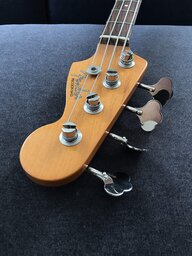
Its that point on the headstock that's been a deal-breaker for me. Being the creator of the most inspired, recognized, and copied headstock designs in guitar/bass history with the J, P, and MM, its hard to believe that Leo approved of the G&L's headstock. That point on it just ruins the bass's otherwise clean lines.
 
Tough call, man. Both are excellent basses. I own an L-2000, so I'm probably more partial to G&L. The versatility of that bass is undeniable. I play it in a metal setting, but it could easily adapt to any style-same with the 'Ray.

Rays are great basses, I just find that for my tastes, I lean more towards the G&L. I think regardless of your choice between the two, you'll be pleased. ;)
 
I like the Stingray better. I find the active electronics to be way too noisy on the G&L. I also feel like it is a jack-of-all-trades and master of none. I like the 3-band eq, and find very little difference if you just leave the mid control alone.
 
Its that point on the headstock that's been a deal-breaker for me. Being the creator of the most inspired, recognized, and copied headstock designs in guitar/bass history with the J, P, and MM, its hard to believe that Leo approved of the G&L's headstock. That point on it just ruins the bass's otherwise clean lines.

Well, in Leo's defense, what options did he have? He had to get far enough away from the Fender headstock design to be proprietary, and he had already used the 3+1 design on the MusicMan. The 2+2 thing was Gibson's domain so he certainly wasn't going to go there. I've always thought the G&L "point" was a little wonky too, but under the circumstances I don't know that I could have done much better.
 
i'm interested as well. also, tell me more about this pseudo humbucking circuit.

http://www.talkbass.com/forum/showthread.php?t=243994

You may like the way your G & L sounds. To me the stock preamp sounds like there is a lump in your throat waiting to be coughed out.

The design allows you to have "bass" & "treble" tone controls in passive mode by sharing part of the circuitry with the active portion of the circuit.
 
http://www.talkbass.com/forum/showthread.php?t=243994

You may like the way your G & L sounds. To me the stock preamp sounds like there is a lump in your throat waiting to be coughed out.

The design allows you to have "bass" & "treble" tone controls in passive mode by sharing part of the circuitry with the active portion of the circuit.

The bass and treble controls come prior to the opamp and are actually routed around it in passive mode. As I said before, the preamp in the G&L is really used more as a standard line amp to solve line impedance issues, etc, rather than tone shaping. The "sound" of the G&L comes from it's pups.
 
http://www.talkbass.com/forum/showthread.php?t=243994

You may like the way your G & L sounds. To me the stock preamp sounds like there is a lump in your throat waiting to be coughed out.

The design allows you to have "bass" & "treble" tone controls in passive mode by sharing part of the circuitry with the active portion of the circuit.

i don't know if that's true. the bass and treble controls are passive and are cut only. this allows them to function even with the battery removed.

i still don't understand the pseudo hum cancelling circuit you talked about. i read the thread you linked and daveplaysbass mentioned that some G&Ls have the single coil with bass boost setting when in series mode. but he makes no mention of the parallel setting which i guarantee is hum cancelling. and still, he was only talking about "some" G&Ls. neither my L-2000 or my L-1505 have single coil with bass boost when in series mode.

when i flip on the active circuit, my G&Ls sound anything but muffled. in fact, even with both pickups on, in series setting, set passive and the treble rolled all the way down, every G&L i've ever played still speaks with a certain amount of clarity. i think if you want to describe the G&L sound, one word you could use is "detailed".
 
Try it sometime if you get the chance, the stock preamp is very compromised as a design.It will be like lifting a blanket from your bass....I did it on my L2500 with a Bart preamp.

Gotta agree with the other posters here - the one thing my L2000 does NOT sound like is that a blanket is over the sound. The L2K simply knifes through any mix out there - with clarity and authority. The MFDs are, in a word, HUGE. Not in size, but in sound. In many ways, the real challenge with a G&L with MFDs is to tame the pickup output to match the tone you're going for.

I am a real fan, obviously, but even though I've tried and owned numerous instruments (still own 10), I have yet to try a Ray.

One point on the US vs. Tribute. If you can, swing the US made instrument - do a search in the G&L forum as the differences have been discussed several times at length. Nothing wrong with the Tribby's - please don't misunderstand me, but there are numerous small attention to detail issues as well as equipment/material/option upgrades that make the US models stand out.

Jay
 
i don't know if that's true. the bass and treble controls are passive and are cut only. this allows them to function even with the battery removed.

i still don't understand the pseudo hum cancelling circuit you talked about. i read the thread you linked and daveplaysbass mentioned that some G&Ls have the single coil with bass boost setting when in series mode. but he makes no mention of the parallel setting which i guarantee is hum cancelling. and still, he was only talking about "some" G&Ls. neither my L-2000 or my L-1505 have single coil with bass boost when in series mode.

when i flip on the active circuit, my G&Ls sound anything but muffled. in fact, even with both pickups on, in series setting, set passive and the treble rolled all the way down, every G&L i've ever played still speaks with a certain amount of clarity. i think if you want to describe the G&L sound, one word you could use is "detailed".

Good for you then, but try it sometime. You don't have to feel if I have stepped on your toes or insulted your G & L selection.

Try another preamp, or run the pickups direct to the output bypassing the passive G&L circuit you might be able to tell how much the stock preamp attenuates the pickup's full range. If the G& L works for you all power to you. But try it sometime and if you do post back your results here.
 
Good for you then, but try it sometime. You don't have to feel if I have stepped on your toes or insulted your G & L selection.

Try another preamp, or run the pickups direct to the output bypassing the passive G&L circuit you might be able to tell how much the stock preamp attenuates the pickup's full range. If the G& L works for you all power to you. But try it sometime and if you do post back your results here.

The G&L already has a passive switch that totally bypasses the preamp.
 
My 2 cents:

re. G&L vs. EB: EB will have better resale, but the GL is a more versatile bass. I've had both (in fact, a few of each) and I miss my G&L 2000 fretless quite a bit... But I also miss my Sterling...

re. G&L vs. Tribby: I've had both, and while the tribby was a lot of bass for the money, it is not the same quality as the US made G&L. Mine had a few undressed frets and the nut was poorly set. It looked great and sounded very good, but it was *just a bit* crude. I don't think you'll find those issues with a US G&L. And G&Ls sell CHEAP used.

To sum up: If you have ~$300, I'd look for a used Tribby; ~$500, I'd get a used G&L... If you had ~$1000 I'd look for a used Sterling...
 
Good for you then, but try it sometime. You don't have to feel if I have stepped on your toes or insulted your G & L selection.

Try another preamp, or run the pickups direct to the output bypassing the passive G&L circuit you might be able to tell how much the stock preamp attenuates the pickup's full range. If the G& L works for you all power to you. But try it sometime and if you do post back your results here.

no no no ... this is a discussion, not a fist fight. no feelings hurt here. ken baker put up a post either here or on another forum about switching out the preamp on his L-2xxx for an aguilar (i think) and he said there was a huge change. but i thought the point was he had more flexibility and tone shaping capability but the inherent tone was still the same....

i for one would be interested in wiring the MFDs straight to the jack or maybe with a volume control only.

my main thing was i didn't understand what you meant by pseudo humbucking...

it's all clear now.

by the way, you mentioned several preamps. which ones in conjunction with the G&L do you have direct experience with?
 
I'm going to give another vote for the Stingray. Best musical tool I've ever bought. The preamp is so good that I just set my amp flat and use the onboard preamp for tone shaping. The preamp is very versatile, you can make it sound so dramatically different just by turning any knob. The build quality is top notch, not a single flaw. Aesthetically it is one of the most identifiable designs. As a designer, I can appreciate the effort put into this.

The G string issue is a little annoying, I will definitely agree with that. I raised the pickup on the side of the G string and it helps. It's definitely a bass that is intentionally geared towards funk. That's what I use it for.

Not that you could break anything on either bass, but I would think replacement parts are easier to find for the Stingray.

Which Mediterranean island are you from? Good luck with your choice. As someone said earlier, you can't go wrong with either bass.
 
Good for you then, but try it sometime. You don't have to feel if I have stepped on your toes or insulted your G & L selection.

Try another preamp, or run the pickups direct to the output bypassing the passive G&L circuit you might be able to tell how much the stock preamp attenuates the pickup's full range. If the G& L works for you all power to you. But try it sometime and if you do post back your results here.


There's a thread on this in the G&L forum...some folks notice a difference in passive when the battery is removed, possible because the capacitors on the front of the preamp are still "seeing" the signal. The signal without the battery is generally described as "lower output" and "fenderish" (as opposed to higher output & scooped). However, not everyone notices this. Several (including myself) have played around with it alot, and notice no difference at all. it may depend on what year the bass was made, as wiring may have changed a bit.