

Enjoy the benefits of a premium membership!
Upgrade Account
-
TalkBass has been independent since 1998. Add your voice.
Create a free account to reply to discussions, view embedded media, and browse with fewer display ads.
Join free Log in
Want zero display ads or expanded classifieds tools? Compare plans.
You are using an out of date browser. It may not display this or other websites correctly.
You should upgrade or use an alternative browser.
You should upgrade or use an alternative browser.
Stingray-the most divisive bass sound?
- Thread starter Vanheusen77
- Start date
More options
Who Replied?

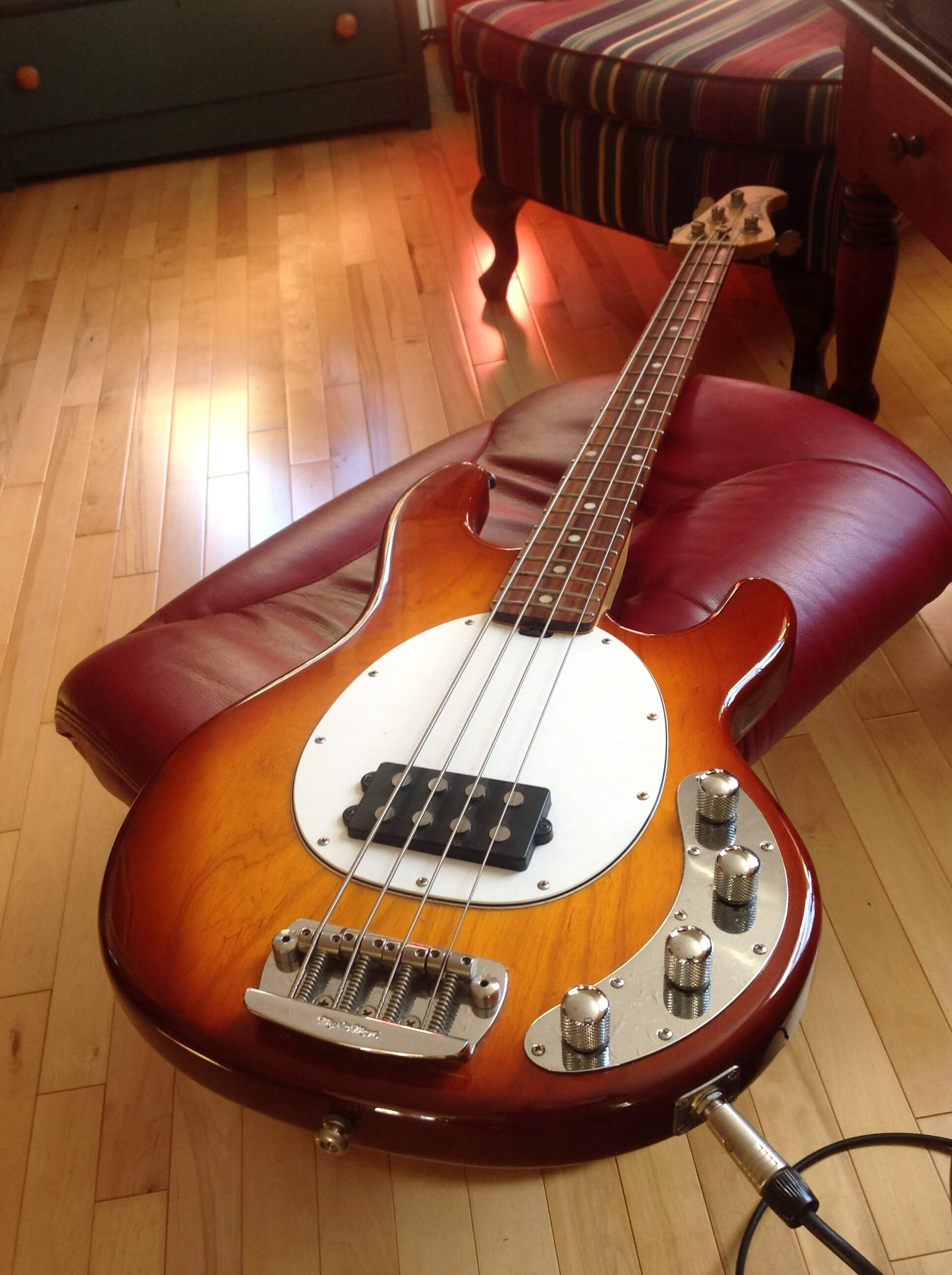
I've had this for over fifteen years now . I rarely take it out to gigs , but it has a special spot beside the couch . I put a lot of time on it .
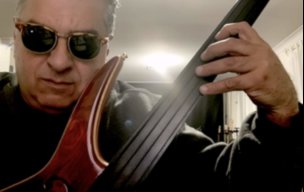
I have two SR's with the 3 band pre and I always roll off some treble and boost bass and mids. That produces a nice punchy, warm sound that works well with what I do (think Paul Denman with Sade). I think that they have become so 'famous' for their grind and treble that people don't look beyond that to the other tones they can produce.It is obviously not a bass that everyone seems to be able to turn the knobs in the correct direction with, but the bass is not the issue.

I've definitely had an on and off again relationship with my Stingray, I bought it new way back in 1995/96, black/maple 3-band. I played it almost exclusively for the first 10 years, than it spent almost as long in its case in the closet. I favor P's or J's for most gigs in recent years. At times I found the tone to be a bit harsh, twangy and it really did have the missing G string issue. Early on I replaced the pickup and preamp with the SD basslines alnico when they came out, and that really did even out the tone, and added more mid punch and tighter lows. Its out of the closet now and I use it semi-regularly on a few projects. With broken in DR Sunbeams, the bass really sounds great. The SD electronics cleared up the missing G years ago, so that's no longer an issue.


No, I have not observed this. Most people can't even hear the bass in most recordings, much less identify the kind of bass it is, even if it's playing a strong counter-melody. Live, people have all sorts of opinions and expectations, but it's important to place the views of half-drunk bedroom players listening with their eyes into the proper context.I find this interesting. Both in real life and from a couple of YouTube comparisons I've made it seems that the Stingray is the bass sound that people either love or hate. One of the few instances where someone has asked me to record with a certain sound it was a Ray. On the other hand many people find it annoying and artificial sounding. P or Jazz type basses by comparison most people (especially non bassists) do not really have strong opinions on IMO. Has anyone else noticed this?
Last edited:
Love them, most of the time. I have two, but not all Stingrays sound the same. Sold one that had way too much baked in mids at the 350 to 500Hz range. Have noticed to be a common attribute of the 3 band eq models on several of the ones I owned (rosewood fingerboards), so it did not sound good to me no matter how much eq work was done. I really like the 2 band stingrays, despite some people feeling the 3 band gives more flexibility (round/punchy and less baked in mids, but not scooped). Anyway, I also have had numerous jazz & p basses. For rock, funk, pop, blues etc... I would take the ray over any of the other 50 basses I have owned. 2 centsI find this interesting. Both in real life and from a couple of YouTube comparisons I've made it seems that the Stingray is the bass sound that people either love or hate. One of the few instances where someone has asked me to record with a certain sound it was a Ray. On the other hand many people find it annoying and artificial sounding. P or Jazz type basses by comparison most people (especially non bassists) do not really have strong opinions on IMO. Has anyone else noticed this?
Last edited:

I hear you. Stingray/Sterling's are one of those that you either hate/love.
They are kind of finicky and rollercoaster in terms of what you like of them.
To my taste. The sound kind of "artificially" and the clanky/freety sound bothers me a lot. Reason I sold my 2 EBMM Rays.
I the other hand, the best sound I have Had was my stingray coming from a P.A for a 3000 people. There was no Map support. Just P.A. It sounded beautiful.
But I can't have a 3K people P.A support to sound at home LOL.
Speaking of artificial sound it's very ironically that my Fender passive always screams to me to be always plugged to my Sadowsky active preamp.
So again, there's no general rules. Just personal tastes
They are kind of finicky and rollercoaster in terms of what you like of them.
To my taste. The sound kind of "artificially" and the clanky/freety sound bothers me a lot. Reason I sold my 2 EBMM Rays.
I the other hand, the best sound I have Had was my stingray coming from a P.A for a 3000 people. There was no Map support. Just P.A. It sounded beautiful.
But I can't have a 3K people P.A support to sound at home LOL.
Speaking of artificial sound it's very ironically that my Fender passive always screams to me to be always plugged to my Sadowsky active preamp.
So again, there's no general rules. Just personal tastes

Of course! No Copyright on that one!So good! Can I sig this?


I've owned 4 and they all went away. I love the bass but in my hands it just doesn't jive.
IMO the Stingray tone definitely works better in a mix and blended among the other instruments, than alone or in a smaller group like a trio. What can harsh or twangy by itself, can sit well in a mix.I hear you. Stingray/Sterling's are one of those that you either hate/love.
They are kind of finicky and rollercoaster in terms of what you like of them.
To my taste. The sound kind of "artificially" and the clanky/freety sound bothers me a lot. Reason I sold my 2 EBMM Rays.
I the other hand, the best sound I have Had was my stingray coming from a P.A for a 3000 people. There was no Map support. Just P.A. It sounded beautiful.
But I can't have a 3K people P.A support to sound at home LOL.
Speaking of artificial sound it's very ironically that my Fender passive always screams to me to be always plugged to my Sadowsky active preamp.
So again, there's no general rules. Just personal tastes
In the early 2000s I moved from the Stingray to the dual pickup Lakland 44-02 thinking the addition of the J neck pickup would mix in well with the MM although most of the time I favor the J pup which is a dual coil "P" in "J" shell. Go figure.

No, I have not observed this. Most people can't even hear the bass in most recordings, much less identify the kind of bass it is, even if it's playing a strong counter-melody. Live, people have all sorts of opinions and expectations, but it's important to place the views of half-drunk bedroom players listening with their eyes into the proper context.
100% this. The StingRay really is my thing. After years of Wal, PJ and Jazz I really wish I had taken the plunge 30 years ago instead of leaving it until 2015.
Just for a laugh, see how many of you can identify the basses in the attached *.mp3. In here is a PJ, a Corvette J/J and a StingRay, all with flats. Nothing flashy, just a couple of C Major scales and a C Major arpeggio over 1 octave. All of the active EQ are centred and the passive PJ tone was wide open. Each bass appears more than once and in no particular order. The 2-pickup basses have separate bridge, neck and 100/100 blend examples, again in no particular order. All recorded just a moment ago through Zoom B3n with Avalon DI-5 and mild Corona Chorus. I imagine the StingRay will be identifiable - the point of different instruments is not to sound like all the others - but is it really so radically different as to be that divisive?
Time Bass Pickup
00:00 ? ?
00:15 ? ?
00:30 ? ?
00:45 ? ?
01:00 ? ?
01:16 ? ?
01:33 ? ?
01:45 ? ?
02:00 ? ?
02:16 ? ?
02:36 ? ?
02:51 ? ?
Attachments
It is said that one knows when a Ray is correctly dialed in is when it sounds "pi$$ed off".
Since I'm the type of person who is usually "pi$$ed off" about one thing or another, my Ray perfectly fits my personality!
Haha!!!
Since I'm the type of person who is usually "pi$$ed off" about one thing or another, my Ray perfectly fits my personality!
Haha!!!
Totally. Hence my conclusion. The EBMM Rays sounds are more usable in band/mix/concert rather than alone.IMO the Stingray tone definitely works better in a mix and blended among the other instruments, than alone or in a smaller group like a trio. What can harsh or twangy by itself, can sit well in a mix.
One that I haven't tried and would love will be a fretless sterling. I can live with the "artificial" active sound. But a must no with the clanky/fretty sound
I can hear minor timbral differences in the low-mids, but absolutely no idea which is which. The first one is probably my favourite though. Also: on my browser, I can't see the time marker, so it's pretty easy to get lost.100% this. The StingRay really is my thing. After years of Wal, PJ and Jazz I really wish I had taken the plunge 30 years ago instead of leaving it until 2015.
Just for a laugh, see how many of you can identify the basses in the attached *.mp3. In here is a PJ, a Corvette J/J and a StingRay, all with flats. Nothing flashy, just a couple of C Major scales and a C Major arpeggio over 1 octave. All of the active EQ are centred and the passive PJ tone was wide open. Each bass appears more than once and in no particular order. The 2-pickup basses have separate bridge, neck and 100/100 blend examples, again in no particular order. All recorded just a moment ago through Zoom B3n with Avalon DI-5 and mild Corona Chorus. I imagine the StingRay will be identifiable - the point of different instruments is not to sound like all the others - but is it really so radically different as to be that divisive?
Time Bass Pickup
00:00 ? ?
00:15 ? ?
00:30 ? ?
00:45 ? ?
01:00 ? ?
01:16 ? ?
01:33 ? ?
01:45 ? ?
02:00 ? ?
02:16 ? ?
02:36 ? ?
02:51 ? ?
Here's one from me.
Instead of determining which bass/basses are used to make the recording, the conclusion I hope you'd reach is that Toto writes killer music.
Attachments
Last edited:
I love'em. The tone, the feel, the neck and the build quality are superb.
I've owned three—when I decided that was a little excessive, I sold the two 3eq basses and kept the Classic 2eq.
My first EBMM was an American Sterling 4H, and I found the tone to be incredible. Sadly, the thin Jazz profile neck just didn't agree with my hand, so that's when I moved over to the Stingray. I think if the neck pockets we're compatible I'd put a Stingray neck onto a Stirling body and I'd be in heaven.
I've owned three—when I decided that was a little excessive, I sold the two 3eq basses and kept the Classic 2eq.
My first EBMM was an American Sterling 4H, and I found the tone to be incredible. Sadly, the thin Jazz profile neck just didn't agree with my hand, so that's when I moved over to the Stingray. I think if the neck pockets we're compatible I'd put a Stingray neck onto a Stirling body and I'd be in heaven.
It is said that one knows when a Ray is correctly dialed in is when it sounds "pi$$ed off".
...


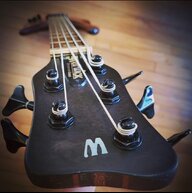

I have an SR5 and a Sabre Classic. Love, love, love them both. I used the SR5 in the praise band for years. EQ'd to "sound like" an active Pbass. Music director gave me stink eye if I brought any other bass.
The Sabre has many voices. I love it for 80's rock, and can get a convincing Pbass tone when needed.
I play Jazz basses mostly, so I really appreciate the difference the EB basses bring. That said, if I had to show up for a gig with no idea what the music style was, I'd bring a Jazz, or my Pbass.
EBMM quality is AAA+ good.
The Sabre has many voices. I love it for 80's rock, and can get a convincing Pbass tone when needed.
I play Jazz basses mostly, so I really appreciate the difference the EB basses bring. That said, if I had to show up for a gig with no idea what the music style was, I'd bring a Jazz, or my Pbass.
EBMM quality is AAA+ good.


